

Summary
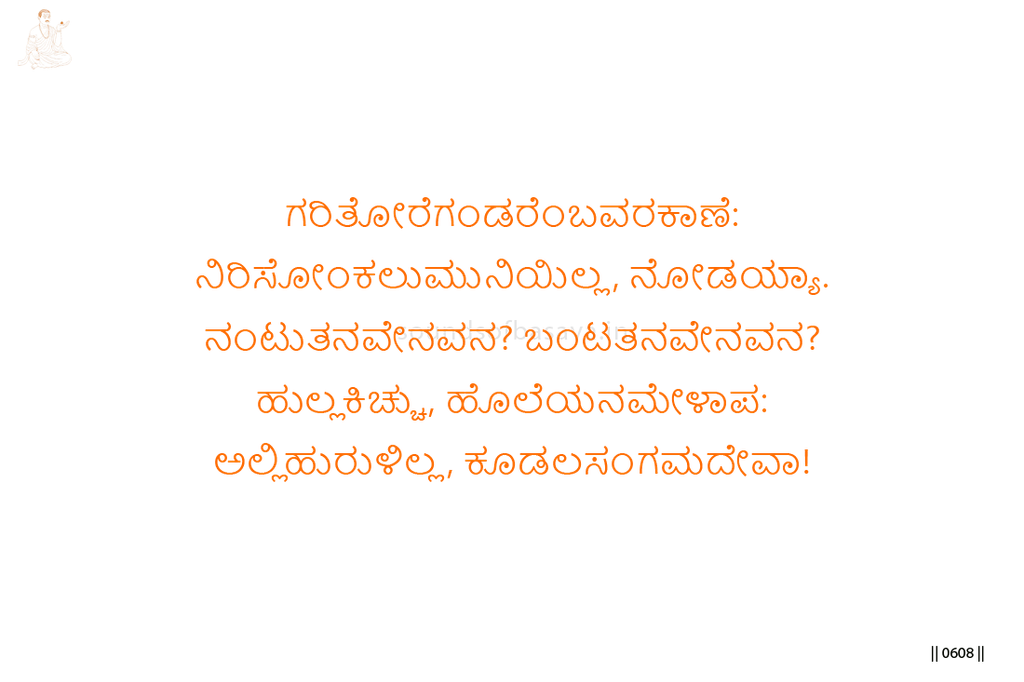
Basavanna questions the strength that fails before even a slight sign of threat. If one trembles at the feather of an arrow, how can such a one be called a warrior?
He then questions what kind of strength and what kind of bond this is. The final image gives the answer: it is like dry grass set on fire. It flares, but there is no lasting substance in it. Before Kudalasangama Deva, such strength is shown to be hollow.
Imagery & Symbolic Relevance
The feather of the arrow is the first image. It is not the full arrow, nor the wound of battle, but only a slight sign connected with danger. If even this causes trembling, the claim of being a warrior becomes doubtful.
The shadow upon water is the next image. It appears, but it has no firm substance. Basavanna uses this to show a presence that cannot stand as real strength.
The questions “What strength is this?” and “What bond is this?” are the center of the vachana. Basavanna is not impressed by name, display, or claim. He tests whether there is substance.
The dry grass fire completes the teaching. Dry grass burns quickly, but it does not endure. Its blaze may appear strong for a moment, but there is no lasting core in it.
The final statement, “there is no essence there,” gives the judgment. The vachana is therefore a warning against strength, bond, or identity that appears forceful but has no substance before Kudalasangama Deva.
Lingayoga
In Lingayoga, the relevance of this vachana lies in the movement given by the source: outer claim is tested by steadiness, and what cannot endure even a slight test is shown to lack essence.
The practice-point is direct: the seeker should not mistake sudden heat, display, or claimed strength for true steadiness. What cannot stand when tested is only dry grass fire.
Editorial Commentary
This vachana should be read as a test of substance. Basavanna does not define strength by appearance or title. The warrior is tested by steadiness; the bond is tested by endurance; the fire is tested by what remains after it burns. The source image is severe: where there is only a quick flare and no essence, there is no true strength before Kudalasangama Deva.
Related Vachana
Supporting Vachana
Maheshwara Sthala Vachana 669 — The Water Snake and the Withdrawn Warrior
Maheshwara Vachana 669 supports this vachana by showing the difference between outward readiness and actual steadiness. There, one may tie the warrior’s cloth, fasten the sword, and appear ready, yet withdraw when the moment comes. The fear is compared to trembling before a water-snake. Sharana Vachana 112 carries the same test into a sharper image: one who trembles at the feather of an arrow cannot truly be called a warrior. Both vachanas reject appearance without inner substance.
Advancing Vachana
Aikya Sthala Vachana 976 — The Natural Abidance of Mahadevi Akka
Aikya Vachana 976 advances this teaching by carrying the test of substance into true dissolution. In Sharana Vachana 112, the dry grass fire flares but has no essence. In Aikya Vachana 976, ignorance dissolves, pride withdraws, the inner enemies are burnt, the coverings fall, the senses loosen, and the mind becomes silent. Thus the Sharana-stage warning against hollow fire advances into Aikya as the state where what must burn is truly consumed, and natural abidance remains before Kudalasangama Deva.
