
Summary
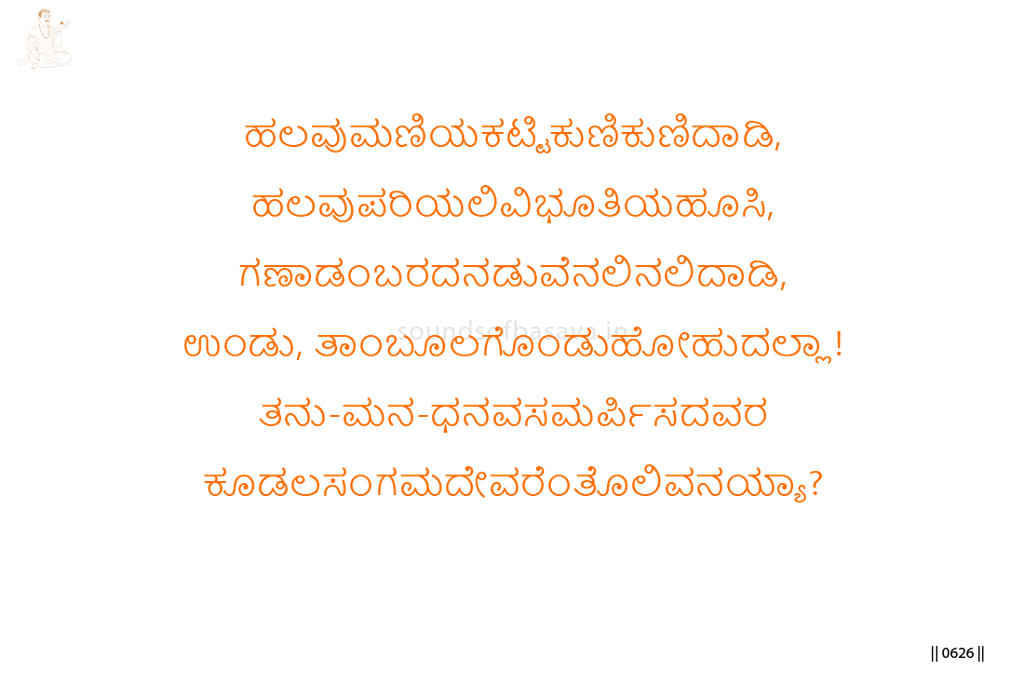
In this vachana, Basavanna questions devotion that remains outward. A person may wear many rosaries, apply Vibhuti in many ways, move among the religious gathering, eat, take betel, and depart. These acts may appear devotional, but they do not complete the path by themselves.
The decisive question comes at the end. If body, mind, and wealth are not offered, how can Kudalasangama Deva be reached? Basavanna does not reject rosaries, Vibhuti, gathering, or participation. He rejects the assumption that these are enough when the inner offering has not taken place.
The teaching is clear: devotion must not remain in display, movement, or communal presence alone. Body, mind, and wealth must be surrendered. Without that offering, outward religious appearance remains incomplete before Kudalasangama Deva.
Imagery & Symbolic Relevance
The many rosaries form the first image. Rosaries indicate visible devotion and repeated practice. Basavanna’s concern is not the rosary itself, but the danger of wearing and displaying it while the deeper surrender remains absent.
Vibhuti is the second image. It is a sacred mark, but here Basavanna speaks of applying it in many forms. The many forms show religious visibility. Yet sacred ash on the body does not complete the inward offering by itself.
The gathering is the third image. The person moves among the religious crowd and participates in its atmosphere. Basavanna shows that participation in a devotional assembly is not the same as transformation.
Eating and taking betel complete the outward scene. One joins, partakes, and leaves. The movement begins and ends externally. Nothing in the line proves that body, mind, and wealth have been surrendered.
The final triad gives the true measure: body, mind, and wealth. Body is the field of action, mind is the field of intention, and wealth is the field of capacity and possession. If these are not offered, the previous acts remain partial.
The question to Kudalasangama Deva is therefore a test. What reaches the Divine if the whole person has not been offered? Basavanna’s answer is implied: outward show cannot substitute for inward surrender.
Lingayoga
In Lingayoga, this vachana distinguishes sacred marks from actual offering. Marks, gatherings, and acts of participation have value only when they are joined to inward surrender.
The practice-point is direct: do not measure devotion by what is worn, shown, or publicly performed. Let body, mind, and wealth be offered.
For Sharana Sthala, the teaching concerns integrity of offering. A Sharana does not remain satisfied with devotional appearance. The life itself must be placed before Kudalasangama Deva.
Editorial Commentary
This vachana should not be read as a rejection of rosaries, Vibhuti, or religious gathering. Basavanna’s correction is more precise. Sacred signs become incomplete when they are not joined to the surrender of body, mind, and wealth. The final question governs the whole vachana: without inward offering, outward participation does not reach completion.
Related Vachana
Supporting Vachana
Pranalingi Sthala Vachana 798 — The Touchstone of Truth
Pranalingi Vachana 798 supports this teaching by showing that sacred actions, songs, meanings, vows, and declarations remain incomplete if the mind has not touched the Linga. Vachana 205 gives the same correction through visible devotional acts: rosaries, Vibhuti, gathering, eating, and departing do not fulfill devotion unless body, mind, and wealth are offered. The support is direct: outer sacred activity must become inward contact and real offering before Kudalasangama Deva.
Advancing Vachana
Aikya Sthala Vachana 216 — The Rightful Harmony of Body, Mind, and Wealth
Aikya Vachana 216 advances this teaching by showing body, mind, and wealth brought into rightful harmony. In Vachana 205, these three remain unoffered, so outward display is exposed as incomplete. In Aikya Vachana 216, body, mind, and wealth are no longer scattered or claimed separately; they become ordered instruments of realized life. Thus the Sharana-stage warning against outward show advances into Aikya as inward offering made whole before Kudalasangama Deva.
