

Summary
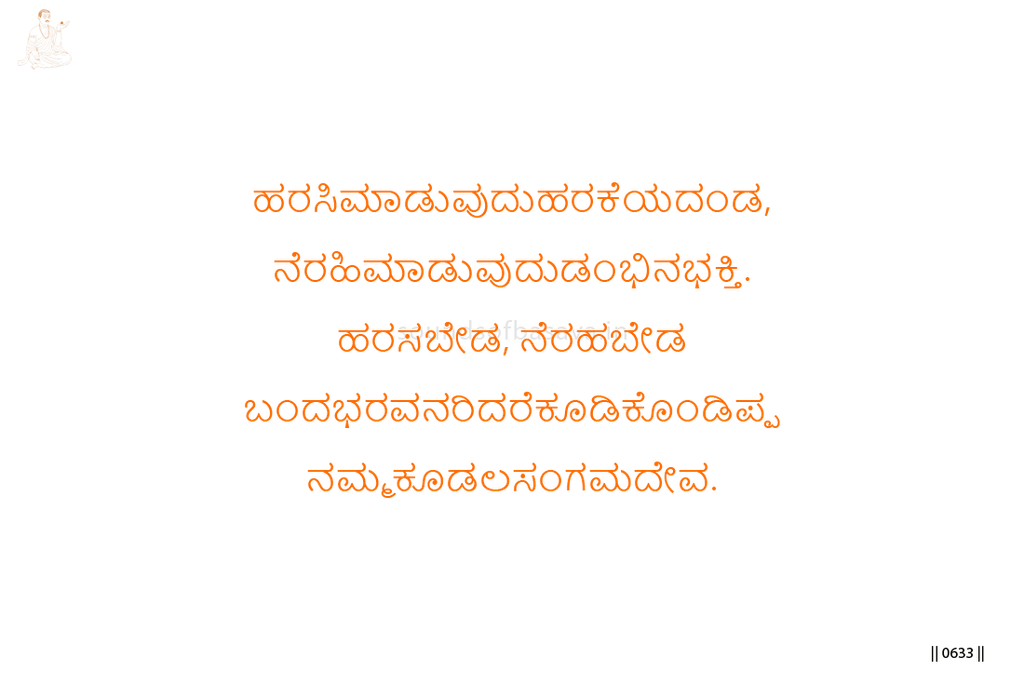
In this vachana, Basavanna corrects devotion that becomes noise, vow-seeking, or public display. Calling “Hara” for the sake of a vow or desired result becomes the ruin of the vow itself. Gathering people and making devotion into spectacle becomes ostentatious bhakti.
The instruction is direct: do not call “Hara” in that way; do not gather in that way. Basavanna is not rejecting the Divine Name, nor is he rejecting true Sharana-sanga. He is rejecting the use of sacred utterance and religious gathering for self-purpose, display, or gain.
The final line gives the deeper teaching. One must understand the movement of coming and going and act from that understanding. Then the movement turns inward: Kudikondippa indicates turning within, being gathered inward, and becoming joined. Kudala is the moment of meeting, Sangama is merger, and Deva is the divine Self, the at-one state. Kudalasangama Deva is therefore realized not by shouting or display, but in the inward confluence where right understanding becomes merger.
Imagery & Symbolic Relevance
The cry of “Hara” is the first image. The Divine Name is sacred, but Basavanna tests the intention behind its use. When the name is used for gain, vow-fulfilment, public force, or devotional impression, the sacred utterance is weakened by self-purpose.
The vow is the second image. A vow should bind the seeker to truth. It should not become a way of binding the Divine to the seeker’s desire. When the vow is used as bargaining, its sacred direction is spoiled.
The gathering is the third image. A gathering can be a true field of Sharana-sanga. But when people are gathered so that devotion may be seen, praised, or made impressive, bhakti becomes display.
The phrase “ostentatious bhakti” is therefore central. It shows devotion turned toward appearance. The problem is not shared worship itself, but bhakti that seeks visibility.
The instruction “do not call, do not gather” should be read with this precision. Basavanna is not making silence or solitude into a rule. He is removing dependence on noise and public religious display.
The coming and going form the next field of meaning. They point to the movement of life: arrival and departure, birth and death, gain and loss, appearance and disappearance, action and consequence. One who does not understand this movement remains caught in outward effort.
Kudikondippa gives the turning point. The seeker turns within and becomes gathered into union. This is not outward pursuit, but inward joining.
The closing name, Kudalasangama Deva, becomes the resolution. Kudala is not only a name; it is the moment of meeting. Sangama is not merely confluence as place; it is merger. Deva is the divine Self, the at-one condition. When the seeker understands coming and going and turns inward without display, that very moment becomes Kudala-Sangama-Deva.
Together, the images teach that devotion is not completed through volume, crowd, vow, or display. It is completed when action arises from clear understanding and turns inward into the confluence where the self is made divine.
Lingayoga
In Lingayoga, this vachana distinguishes invocation from realization. Sacred sound has value only when it arises from inner alignment.
The practice-point is direct: do not use the Divine Name as a transaction. Do not use gathering as spiritual display. Understand the coming and going, then turn within.
For Sharana Sthala, the teaching concerns inward maturity. A Sharana does not depend on loud calling or public demonstration to prove bhakti. The Sharana understands the movement of life, turns inward, and enters the moment of merger before Kudalasangama Deva.
Editorial Commentary
The word “Hara” should not be treated as rejected in itself. Basavanna is correcting its misuse when sacred invocation becomes tied to vow-seeking, gain, or display. Likewise, gathering is not condemned when it is true Sharana-sanga; it is condemned when it becomes ostentatious bhakti.
The closing phrase requires careful handling. Kudikondippa should include the sense of turning within, inward gathering, and becoming joined. Kudalasangama Deva should not be reduced here to a distant divine name alone. In the force of this vachana, it also reveals the spiritual event itself: Kudala as the very moment of meeting, Sangama as merger, and Deva as the divine Self or at-one-ment. This makes the final line the climax of the vachana: when coming and going are understood, outward display drops, and the seeker turns within, the Divine is realized as the confluence itself.
Related Vachana
Supporting Vachana
Pranalingi Sthala Vachana 798 — The Touchstone of Truth
Pranalingi Vachana 798 supports this teaching by saying that songs, meanings, vows, disciplines, and declarations remain incomplete if the mind has not touched the Linga. Vachana 228 gives the same correction through the cry of “Hara,” vow-seeking, and gathered display. In both, sacred expression is tested by inward contact. Without that contact, sound, vow, and public devotion remain hollow before Kudalasangama Deva.
Advancing Vachana
Aikya Sthala Vachana 391 — Holding Fast to Both
Aikya Vachana 391 advances this teaching by questioning the illusion that the Divine comes and goes. In Vachana 228, Basavanna says one must know coming and going, act from that understanding, and turn within into the joined state of Kudalasangama Deva. In Aikya Vachana 391, this matures further: coming and going are seen as movements of limited perception, while the seeker holds fast to Linga and Jangama. Thus the Sharana-stage correction of noisy and display-based devotion advances into Aikya as undivided abidance in the confluence where separation no longer stands.
