

Summary
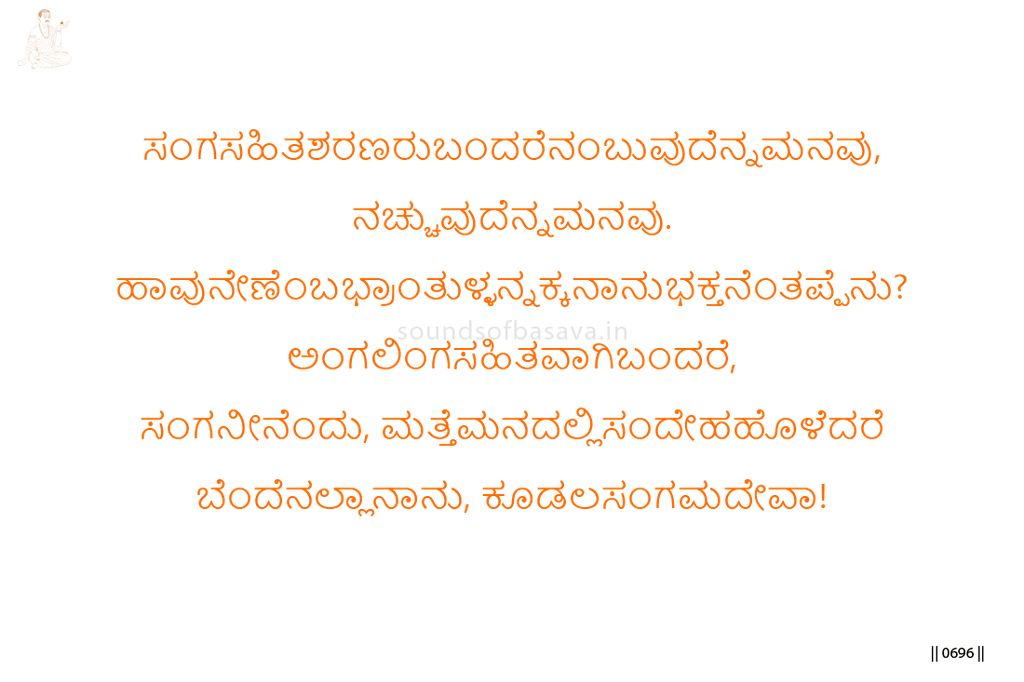
In this vachana, Basavanna says that when the Sharanas who have come with Sangha arrive, his mind trusts and rejoices.
He then turns to the danger of delusion. If the mind mistakes a rope for a snake, how can he call himself a bhakta? The problem is not absence of sacred presence, but misperception after contact with it.
When Anga and Linga come into nearness, Basavanna recognizes this as Sangha. Yet if doubt rises again in the mind, he says he is broken before Kudalasangama Deva.
The teaching is direct: Sharana-presence awakens trust and joy, Anga-Linga nearness reveals true Sangha, but renewed doubt fractures the clarity that has been received.
Imagery & Symbolic Relevance
The arrival of the Sharanas is the first image. Their coming brings trust and joy to the mind. Basavanna shows the effect of realized presence upon the seeker’s inner state.
The trusting mind is not presented as blind belief. It is the mind responding to the presence of Sharanas.
The rope mistaken for a snake is the central image of delusion. What is present is not seen rightly. The error arises in perception, and that error makes the seeker question whether he can truly call himself a bhakta.
Anga and Linga coming into nearness gives the next movement. The embodied seeker and the Linga are not treated as distant at this moment. Their nearness is recognized as Sangha.
Doubt returning in the mind is the final danger. The mind that has trusted and rejoiced can still fracture. When doubt returns after recognition, Basavanna says he is broken.
The imagery therefore moves from Sharana-presence, to trust, to delusion, to Anga-Linga nearness, to renewed doubt. The vachana teaches that clarity must be guarded after it arises.
Lingayoga
In Lingayoga, this vachana teaches vigilance after recognition.
The practice-point is direct: receive the presence of the Sharanas with trust, recognize Anga-Linga nearness as Sangha, and do not allow renewed doubt to fracture the clarity that has been given.
For Sharana Sthala, the concern is stability. A moment of recognition is not enough if the mind falls back into delusion and doubt. The Sharana must move from received clarity into steadiness before Kudalasangama Deva.
Editorial Commentary
The rope-snake image should remain central. Basavanna is not saying that truth disappears; he is showing that the mind can misperceive what is present. The strongest line is the final confession: even after Anga and Linga come near, if doubt rises again, the seeker is undone.
Related Vachana
Supporting Vachana
Pranalingi Sthala Vachana 371 — Better Death Than Separation
Pranalingi Vachana 371 supports this teaching by showing the anguish that arises when the Sharanas are not seen. There, separation from Kudalasangama’s Sharanas overturns the seeker’s inward order. Vachana 404 carries this into Sharana Sthala: when the Sharanas come, the mind trusts and rejoices, but the seeker must guard against delusion and renewed doubt after contact with realized presence.
Advancing Vachana
Aikya Sthala Vachana 941 — See the Sahaja Sharana
Aikya Vachana 941 advances this teaching by showing the mature Sharana as one not bound by doubt and as one established in uninterrupted Sahaja. Vachana 404 shows the fragility of clarity when doubt returns; Aikya Vachana 941 carries this into Aikya, where the Sharana stands in doubtless vastness before Kudalasangama.
