

Summary
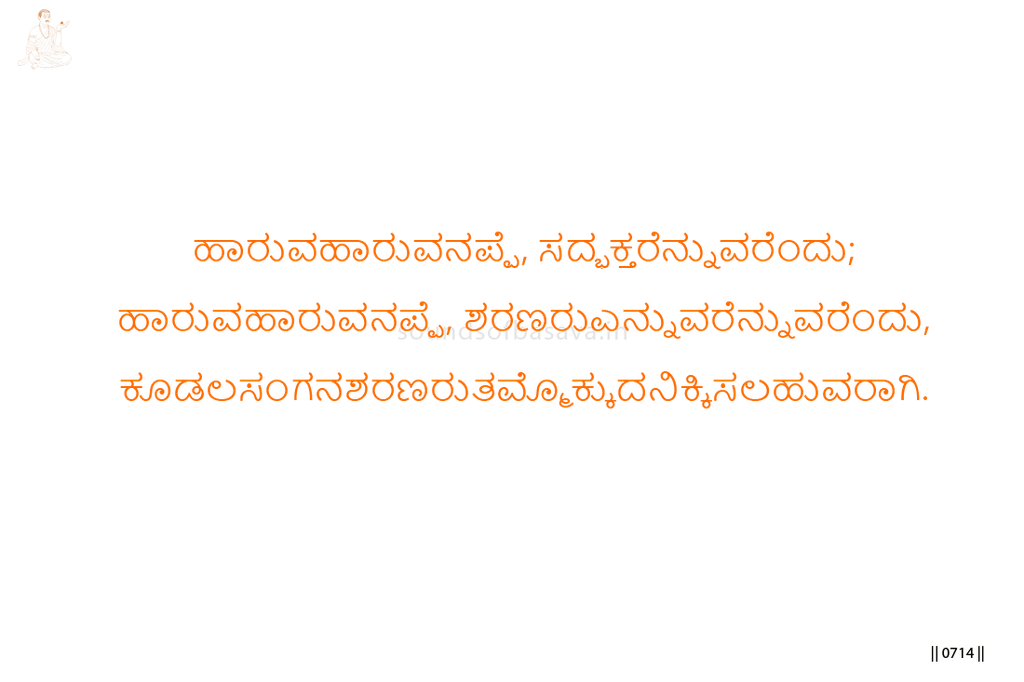
In this vachana, Basavanna calls again and again to the true Bhaktas, saying, “I am yours.” He then calls again and again to the Sharanas, saying, “I belong to you.”
For the reader, this is not a claim of achievement. Basavanna is not saying, “I have become great.” He is speaking from longing and surrender. The repeated calling shows need, humility, and the desire to be held in true company.
The final line explains why he longs for the Sharanas of Kudalasangama Deva. They gather, receive, and sustain. Their company is not ordinary social belonging; it is the living field where the seeker is steadied, corrected, and protected on the path.
The teaching is direct: the Sharana does not walk alone. He calls out to belong to those who live in truth.
Imagery & Symbolic Relevance
The repeated calling is the first image. Repetition matters here. Basavanna calls again and again because longing is not casual. It rises from the whole being.
“I am yours” is the second image. This is the language of surrender. The seeker gives up self-standing and asks to belong to the true devotees.
The shift from Bhaktas to Sharanas is important. Bhakta means one established in devotion. Sharana means one who has taken refuge so completely that surrender has become the basis of life. Basavanna moves from longing for devotees to deeper belonging among the Sharanas.
The gathering of Kudalasangama’s Sharanas gives the final image. This gathering is not merely a crowd. It is Sharana-sanga, the fellowship of those whose lives are shaped by the Divine.
For the reader, Sharana-sanga means sacred company that forms and protects the seeker. In such company, pride is corrected, weakness is held, and longing is given direction.
The imagery therefore moves from calling, to surrender, to belonging, to the gathered Sharanas who sustain the path.
Lingayoga
In Lingayoga, this vachana teaches that longing must become right belonging.
The practice-point is direct: do not turn spiritual life into private self-claim. Call out for the company of those who live the path. Let longing draw the seeker into Sharana-sanga.
For Sharana Sthala, this is belonging as surrender. The Sharana’s identity is not built by personal achievement, but by refuge in Kudalasangama Deva’s Sharanas.
Editorial Commentary
The key clarification is that “I am yours” should not be read as emotional dependence or social flattery. It is the language of refuge. Basavanna is not seeking status among the Sharanas; he is asking to be held by them. The repeated cry gives the vachana its force: longing for true company is itself a sign that the seeker no longer trusts isolated selfhood.
Related Vachana
Supporting Vachana
Pranalingi Sthala Vachana 994 — The Incomprehensible State of the Sharana
Pranalingi Vachana 994 supports this teaching by showing the immeasurable state of Kudalasangama Deva’s Sharanas. Their standing cannot be measured by the three worlds, and Basavanna asks what he can truly know if he does not know the state of the Lord’s Sharanas.
Vachana 460 gives the Sharana form of that recognition. Because the state of the Sharanas is so great, Basavanna does not stand apart and analyze them. He calls out to belong to them. The supporting movement is clear: knowing the greatness of the Sharanas leads to longing for their company.
Advancing Vachana
Aikya Sthala Vachana 1135 — Established in the Great House of Grace
Aikya Vachana 1135 advances this teaching by showing the completed state of shared abiding. There, Kudalasangama Deva removes the imagined, reveals the Unimagined, stills the mind, fills the inner being with great knowledge, establishes outer conduct, and brings the devotee into the Great House where Basavanna and Madivala abide together in joy.
Vachana 460 says, “I belong to the Sharanas,” as a cry of longing. Aikya Vachana 1135 carries this into fulfillment: the longing for Sharana-sanga becomes actual shared abiding in the Great House of Kudalasangama Deva.
