

Summary
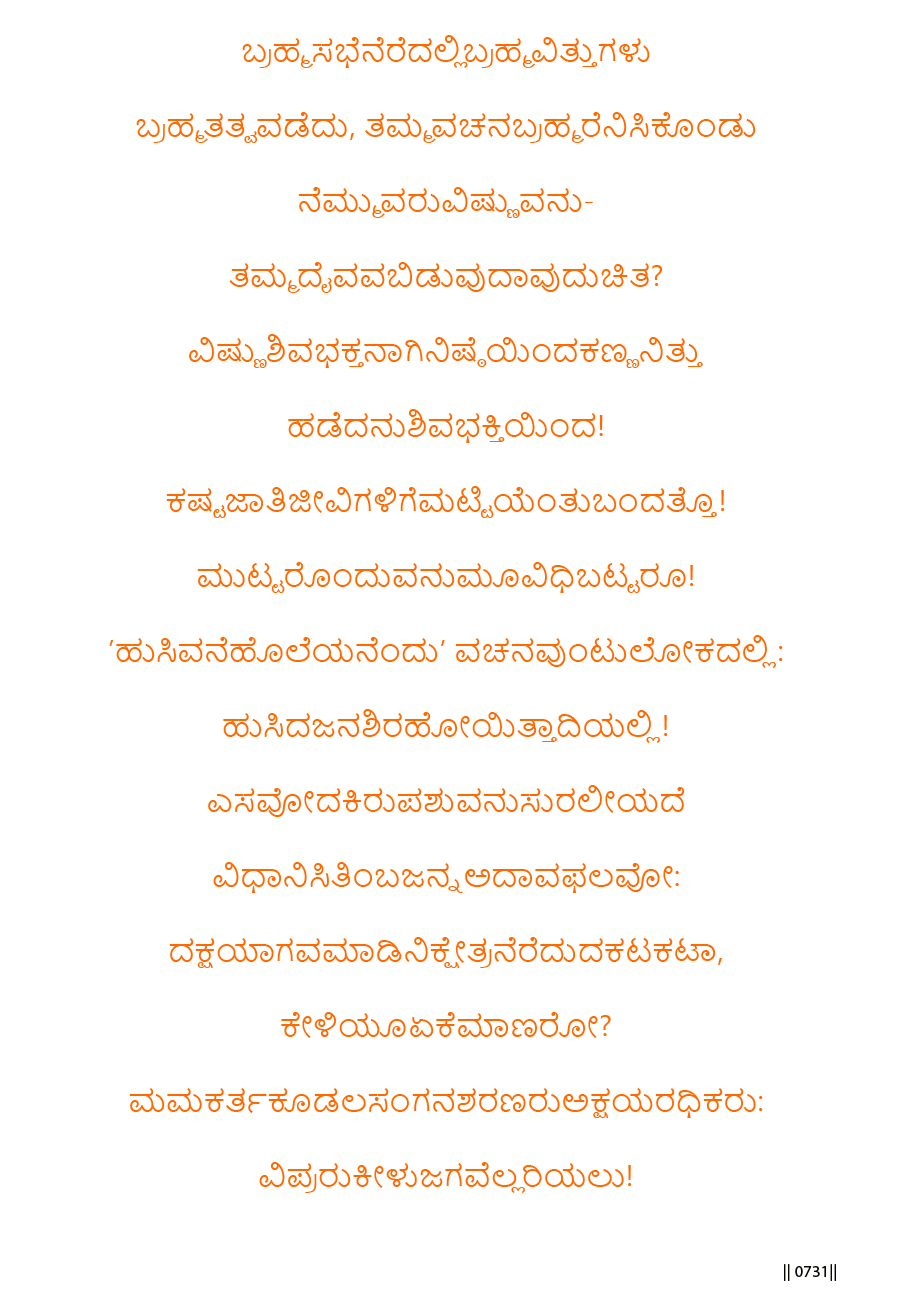
In this vachana, Basavanna questions the authority of religious claims, divine status, caste superiority, and external signs when they are not joined to truth.
He begins with the image of Brahma’s assembly, where those who claim Brahma-knowledge speak with authority. He then recalls Vishnu himself as a Shiva-bhakta, one who gained through Shiva-bhakti. The point is clear: if even exalted divine figures stand in devotion, how can human beings claim superiority through status, caste, or sacred speech?
Basavanna then turns sharply toward social and ethical contradiction. The world may call some people low by birth or occupation, but those who harm the weak, kill in the name of sacred practice, or stand in pride after hearing truth are not made pure by their claims.
He ends by declaring the Sharanas of Kudalasangama Deva as the true and imperishable holders of authority. The teaching is direct: no assembly, title, caste, mark, scripture, or claim can replace lived truth. The true measure is the Sharana established in Kudalasangama Deva.
Imagery & Symbolic Relevance
Brahma’s assembly is the first image. It represents religious authority, learned speech, and public recognition. Basavanna does not accept such assembly as final proof of truth.
The Brahma-knowers are the next image. They may speak as if they possess the highest knowledge. Basavanna questions whether such speech has become lived realization.
Vishnu as Shiva-bhakta gives the correcting image. Even one honored as divine is shown through devotion, not through independent pride. This weakens all claims of superiority based on name or status.
High and low form the social image. Basavanna asks how superiority and inferiority can be fixed among embodied beings. Caste-pride becomes unstable before devotion and truth.
The one called low by the world is another important image. Basavanna exposes how language itself can create false social judgment. A person may be condemned by social speech, while those who condemn may themselves live in deeper contradiction.
The harming of the weak and the reference to sacrificial violence form the ethical test. Sacred claim is not enough. If conduct harms life or hides behind ritual authority, it cannot be called true Dharma.
Daksha’s sacrifice recalls the failure of ritual pride. It reminds the reader that sacrifice, status, and religious arrangement cannot stand when they are severed from true recognition.
The Sharanas of Kudalasangama Deva are the final image. They are the ones whose authority does not perish, because their standing is not built on caste, mark, claim, or ritual display, but on refuge and lived truth.
Lingayoga
In Lingayoga, this vachana teaches discernment beyond external authority.
The practice-point is direct: do not measure spiritual worth by assembly, title, caste, external sign, scriptural speech, or inherited privilege. Look for lived devotion, truthful conduct, and refuge in Kudalasangama Deva.
For Sharana Sthala, this is surrender of identity-pride. The Sharana does not stand on claims of high birth, learning, religious speech, or social mark. The Sharana stands in the Lord’s truth, where all false measures fall away.
Editorial Commentary
This vachana should be kept grounded in its sequence of corrections: religious assembly is not enough, divine name is not enough, caste superiority is not enough, and ritual action is not enough. Basavanna’s final contrast is decisive: the Sharanas of Kudalasangama Deva are the true authority because their life is rooted in refuge and realization, not in claim.
Related Vachana
Supporting Vachana
Pranalingi Sthala Vachana 548 — The Uncaused Beyond All Names
Pranalingi Vachana 548 supports this teaching by warning against selective sacred memory. There, Basavanna questions the claim that there is no higher deity than Keshava, recalls Vishnu’s own statement that Maheshwara is his doer, and invokes the destruction of Daksha’s sacrifice by Kudalasangama Deva.
This supports Vachana 582 directly. Vachana 582 uses Brahma’s assembly, Vishnu’s devotion, caste-pride, and Daksha’s sacrifice to break false authority. Vachana 548 prepares the same discernment: sacred names, scriptural claims, and ritual pride must not be remembered selectively. They must lead to fuller recognition of Kudalasangama Deva.
Advancing Vachana
Aikya Sthala Vachana 876 — The Feet as the Supreme Beyond Word, Vision, and Reach
Aikya Vachana 876 advances this teaching by showing that even Brahma, Vishnu, and Rudra are bound by word, vision, and action, while for the Sharana of Kudalasangama Deva, the Feet alone are supreme.
Vachana 582 rejects superiority based on assembly, claim, caste, mark, and ritual authority. Aikya Vachana 876 carries this into Aikya: the seeker no longer rests in word, sight, action, divine hierarchy, or external distinction. All such measures end at the Feet, where the Sharana stands in surrender before Kudalasangama Deva.
