

Summary
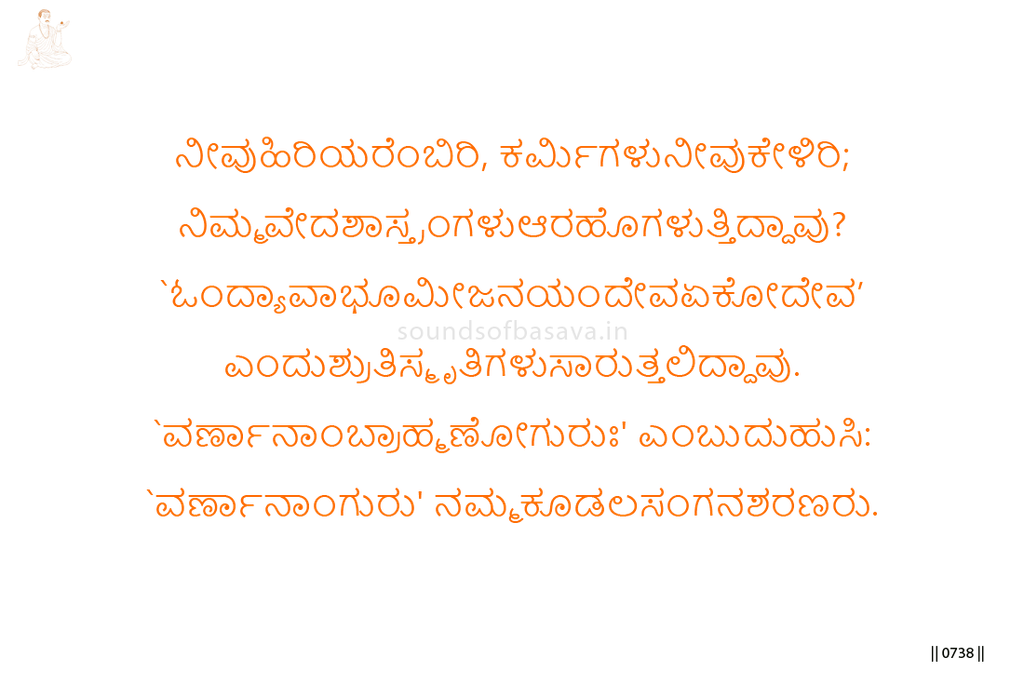
In this vachana, Basavanna addresses those who call themselves learned and ritual-performers. He asks them to listen carefully to what their own Vedas and Shastras truly praise.
For the reader, Veda and Shastra refer to scriptural and traditional sources of religious authority. Śruti means revealed scripture; Smriti means remembered tradition. Basavanna does not reject these sources here. He uses them to expose a contradiction.
The first important claim is this: scripture declares that He alone is the source of heaven and earth. This means that the whole field of existence has one Divine source. If the source of all is one, then spiritual authority cannot belong exclusively to one caste or birth-group.
The second important claim is the one Basavanna rejects: “Among the varnas, the Brahmin is the Guru.” Varna means social classification, and Brahmin here refers to inherited ritual status. Basavanna calls this false when it is used to make Guruhood a birth-right.
His correction is clear: the Guru among all is the Sharana of Kudalasangama Deva. A true Guru is not made by birth, caste, ritual status, or scriptural possession. A true Guru is the one who lives in realized relation to Kudalasangama Deva.
Imagery & Symbolic Relevance
The learned and the ritual-performers form the first image. Basavanna speaks directly to those who claim religious authority through learning and ritual action. His question is simple: have they truly understood what they recite?
The Vedas and Shastras form the next image. Basavanna treats them as witnesses. He asks what they actually praise, not what social pride has made them say.
The declaration that one Divine source brings forth heaven and earth is the central scriptural image. Heaven and earth stand for the whole field of existence. If both arise from one source, then no birth-group can claim exclusive ownership of spiritual access.
The claim “the Brahmin is the Guru among the varnas” is the false social image. It places Guruhood in caste-status instead of realization. Basavanna rejects this because it contradicts the deeper teaching of one source.
The Sharana of Kudalasangama Deva gives the correcting image. A Sharana is one who has taken refuge in the Lord and whose life is shaped by surrender, realization, and lived truth. Such a one becomes Guru because truth is embodied there.
The movement of the vachana is precise: claimed authority is questioned, scripture is asked to speak truthfully, the one-source teaching is affirmed, caste-based guruship is rejected, and the realized Sharana becomes the true Guru of all.
Lingayoga
In Lingayoga, this vachana teaches discernment of spiritual authority.
The practice-point is direct: do not accept someone as Guru merely because of birth, caste, ritual role, learning, or scriptural possession. Ask whether the person lives in realized relation to Kudalasangama Deva.
For Sharana Sthala, this is the replacement of inherited authority with realized authority. The Sharana becomes Guru because the path is lived there, not merely spoken.
Editorial Commentary
This vachana should not be written as a rejection of scripture. Basavanna uses scripture to correct those who misuse scripture.
The contradiction he exposes is simple. One cannot affirm that the whole universe arises from one Divine source and then claim that spiritual authority belongs by birth to one caste. If the source is one, the true Guru is the one who knows and lives that source. For Basavanna, that one is the Sharana of Kudalasangama Deva.
Related Vachana
Supporting Vachana
Pranalingi Sthala Vachana 820 — Time Arises in the Linga
Pranalingi Vachana 820 supports this teaching by defining sacred authority through lived conduct and experience. There, Guru is linked with Sadachara, or right conduct. Jangama is linked with Anubhava and Samayachara, meaning lived realization and disciplined conduct. Both become clear in Linga.
This supports Vachana 600 because Basavanna’s true Guru is not a person elevated by birth alone. The true Guru is recognized through conduct, Anubhava, and living relation to Linga and Jangama. What Vachana 600 rejects as birth-based authority, Vachana 820 grounds in realized practice.
Advancing Vachana
Aikya Sthala Vachana 1380 — One Vessel, One Offering
Aikya Vachana 1380 advances this teaching by dissolving separation between Bhakta, Linga, Jangama, and Guru. It teaches that there is no true difference between the devotee and Linga, no true difference between the devotee and Jangama, and no final separation between Guru and Bhakta when realization is complete.
Vachana 600 declares that the Sharana of Kudalasangama Deva is the true Guru of all, not the Brahmin by birth. Aikya Vachana 1380 carries this into fulfillment: where Guru, Linga, Jangama, and the true devotee are no longer divided, caste-based spiritual hierarchy has no ground left. The Guru is not inherited status; the Guru is realized unity lived before Kudalasangama Deva.
