

Summary
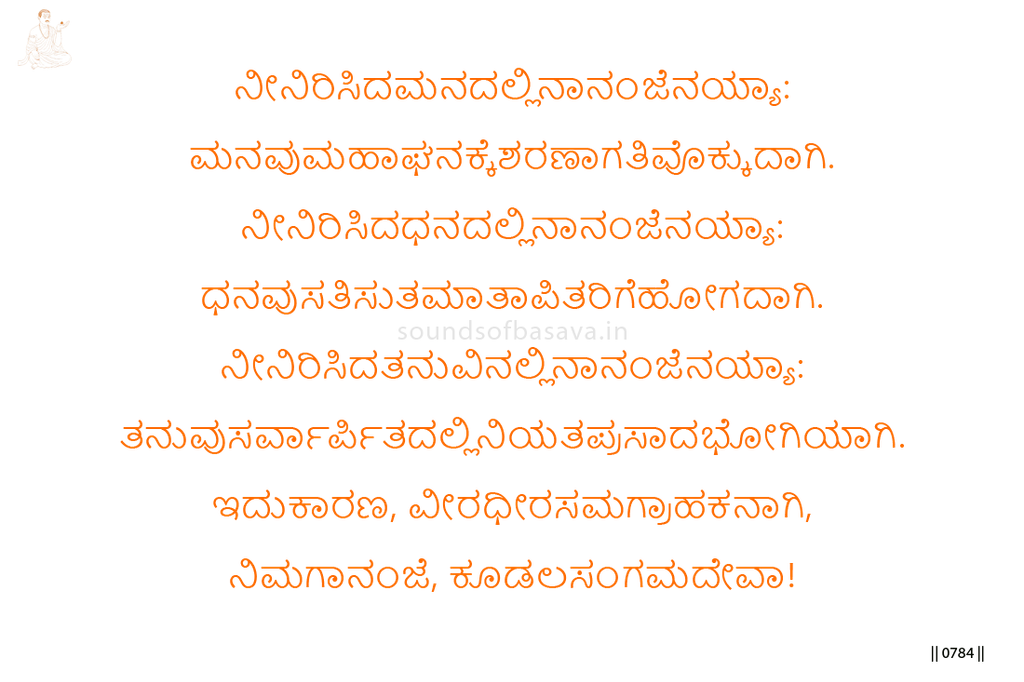
In this vachana, Basavanna shows fearlessness arising from right placement of mind, wealth, and body.
He first says that in the mind given by Kudalasangama Deva, he does not fear. The reason is that the mind has entered refuge in Mahāghana, the great dense fullness of the Lord. Mind is no longer left as a restless private possession.
He then says that in the wealth given by the Lord, he does not fear. Wealth is not held merely for self-protection or accumulation. It becomes rightly used in relation to wife, children, mother, and father. Wealth becomes ordered service, not a ground of fear.
He then says that in the body given by the Lord, he does not fear. The body becomes part of sarvārpita, total offering, and lives as one who regularly receives Prasada. The body is not clung to as private identity; it is brought into consecrated receiving.
For this reason, Basavanna stands complete as vīra-dhīra — brave and steady. His fearlessness does not arise from denial of mind, wealth, or body, but from their right relation to Kudalasangama Deva.
The teaching is direct: the Sharana becomes fearless when mind, wealth, and body are no longer privately held, but placed in refuge, service, offering, and Prasada before Kudalasangama Deva.
Imagery & Symbolic Relevance
The mind is the first image. Basavanna does not reject the mind. He says that in the mind given by the Lord, he does not fear. The mind becomes fearless because it has entered refuge in Mahāghana.
Mahāghana gives the mind its proper destination. It suggests the great compact fullness of the Divine, not a scattered or divided field. When the mind enters that refuge, fear loses its inner ground.
Wealth is the second image. Wealth usually creates fear because it is tied to possession, loss, family duty, and continuity. Basavanna does not condemn wealth itself. He shows that wealth must become rightly placed.
The reference to wife, children, mother, and father keeps the teaching within lived responsibility. Wealth becomes meaningful when it serves rightful relations rather than private accumulation. It is not hoarded as self-security.
The body is the third image. Basavanna again does not reject it. He says that in the body given by the Lord, he does not fear. The body becomes part of total offering.
Sarvārpita, total offering, gives the body its right condition. The body is not merely preserved or displayed; it is offered.
Niyata-Prasada-bhogi completes the body-image. The body receives Prasada in a disciplined and regular way. It becomes a field of consecrated receiving, not a field of uncontrolled desire.
Vīra-dhīra is the final human image. Vīra is courage; dhīra is steadiness. Basavanna’s fearlessness is therefore not excitement or defiance, but complete steadiness born from right ordering.
The movement of the vachana is therefore from mind to refuge, wealth to service, body to offering and Prasada, and finally to fearless steadiness before Kudalasangama Deva.
Lingayoga
In Lingayoga, this vachana teaches that fear is removed by consecrating the actual fields of life.
The seeker should ask: where is the mind placed? Is wealth held as private security, or does it serve rightful responsibility? Is the body treated as possession, or has it entered offering and Prasada?
For Sharana Sthala, the practice-point is clear: do not create fear by holding mind, wealth, and body as separate possessions. Let the mind enter refuge, let wealth serve rightly, and let the body live through offering and Prasada before Kudalasangama Deva.
Editorial Commentary
The threefold order should remain central. The vachana does not teach fearlessness by rejecting mind, wealth, and body. It teaches fearlessness by placing each correctly. The mind enters Mahāghana, wealth serves rightful relations, and the body becomes sarvārpita and niyata-Prasada-bhogi. Only then does Basavanna call himself vīra-dhīra-samagra, complete in brave steadiness.
Related Vachana
Supporting Vachana
Pranalingi Sthala Vachana 963 — Body, Mind, and Being as the Vessels of Linga
Pranalingi Vachana 963 supports this teaching by giving the sacred ordering of life: the mind belongs to Linga, wealth belongs to Jangama, the body belongs to Prasada, and speech belongs to Linga-Jangama-Prasada. This supports Vachana 730 directly. Vachana 730 shows mind, wealth, and body becoming fearless when each is rightly placed: mind in refuge, wealth in ordered service, and body in total offering and Prasada. Vachana 963 gives the supporting structure: each part of life must find its proper sacred vessel before Kudalasangama Deva.
Advancing Vachana
Aikya Sthala Vachana 1183 — Behold the One Ripened in the Dense Reality
Aikya Vachana 1183 advances this teaching by showing the ripened one who has known the Dense Reality, installed the Great Guru within, offered body, mind, and wealth into Guru, Linga, and Jangama, and become established in Kaya-Prasada. This is the natural advancement from Vachana 730. Vachana 730 orders mind, wealth, and body into refuge, service, offering, and Prasada; Aikya Vachana 1183 carries that ordering into fulfilled ripeness, where body, mind, and wealth are wholly offered and the realized one stands established in Kudalasangama Deva.
