

Summary
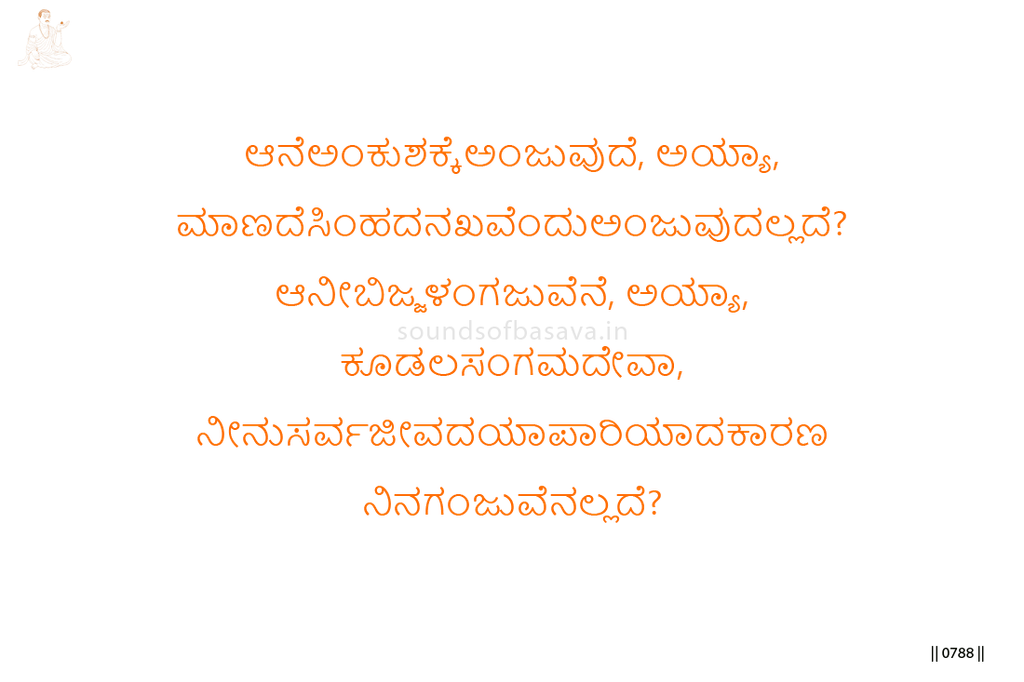
In this vachana, Basavanna distinguishes between outer control and true fear.
He asks whether the elephant fears the goad. The goad may direct the elephant, but it does not become the elephant’s deepest fear. The greater fear is the lion’s claw. Basavanna uses this contrast to separate ordinary pressure from real spiritual awe.
He then turns the image toward Bijjala. Basavanna asks whether he should fear Bijjala. The implied answer is no. Worldly power may command, threaten, or press upon life, but it is not the final authority before the Sharana.
The final line gives the true ground of reverence. Kudalasangama Deva is compassionate toward all living beings. Therefore Basavanna fears Him alone. This fear is not terror of cruelty; it is reverent fear before the One whose compassion embraces all life.
The teaching is direct: the Sharana does not tremble before worldly authority as final. His true reverence is toward Kudalasangama Deva, the compassionate Lord of all living beings.
Imagery & Symbolic Relevance
The elephant is the first image. It is large, powerful, and not easily overcome. Basavanna uses it to show that strength does not need to tremble before every instrument of control.
The goad is the second image. It is small compared with the elephant, yet it can direct the elephant’s movement. The goad represents external pressure, correction, or command. It can guide, but it is not the deepest source of fear.
The lion’s claw is the third image. Unlike the goad, it represents a force before which even the elephant’s strength is tested. Basavanna uses it to mark the difference between ordinary control and true danger.
Bijjala is the worldly image. As king, he represents political authority, public power, and social pressure. Basavanna places him within the field of the goad, not the lion’s claw. He does not grant worldly power the final place of fear.
Kudalasangama Deva is the final measure. The Lord is not described here as a ruler who frightens by violence, but as sarva-jīva-dayāpari — compassionate toward all living beings. This is the reason Basavanna fears Him alone.
The fear of Kudalasangama Deva is therefore reverent accountability before compassion itself. To fear such a Lord is to refuse hardness, cruelty, and false reliance on worldly power.
The movement of the vachana is therefore from elephant and goad, to elephant and lion, to Bijjala and worldly authority, and finally to Kudalasangama Deva as the only true ground of reverent fear.
Lingayoga
In Lingayoga, this vachana teaches the right ordering of fear.
The seeker should ask: do I fear worldly power more than Kudalasangama Deva? Do I allow authority, punishment, reputation, or public pressure to become greater than the Lord’s claim upon me? Do I remember that the true measure is the compassionate Lord of all living beings?
For Sharana Sthala, the practice-point is clear: do not give final fear to Bijjala-like power. Stand in reverence before Kudalasangama Deva alone, and let that reverence protect compassion toward all life.
Editorial Commentary
The elephant-goad-lion sequence should remain central. The vachana does not say that worldly power has no force; it says that such force is not the final object of fear. The last phrase should also remain precise. Kudalasangama Deva is feared because He is compassionate toward all living beings. The Sharana’s fear is therefore reverent accountability before universal compassion, not fear of arbitrary punishment.
Related Vachana
Supporting Vachana
Pranalingi Sthala Vachana 552 — That Which Cannot Be Forgotten
Pranalingi Vachana 552 supports this teaching by testing exalted divine names such as Hari, Brahma, and the thirty-three crore gods before Kudalasangama Deva, who alone is placed as the one who cannot be forgotten. This supports Vachana 737 directly. Vachana 737 refuses to make Bijjala the final object of fear and reserves true reverence for Kudalasangama Deva alone. Vachana 552 gives the supporting ground: all other names and powers are measured before the one Lord who cannot be lost.
Advancing Vachana
Aikya Sthala Vachana 390 — You Alone Know
Aikya Vachana 390 advances this teaching by showing Kudalasangama Deva as the one presence in distress and joy, and as mother and father. It removes the division that treats some conditions as separate from the Lord and some as belonging to Him. This is the natural advancement from Vachana 737. Vachana 737 teaches that the Sharana fears Kudalasangama Deva alone, the compassionate Lord of all living beings; Aikya Vachana 390 carries that reverence into fulfilled recognition, where in every condition and relation, there is no other ground than Kudalasangama Deva.
