

Summary
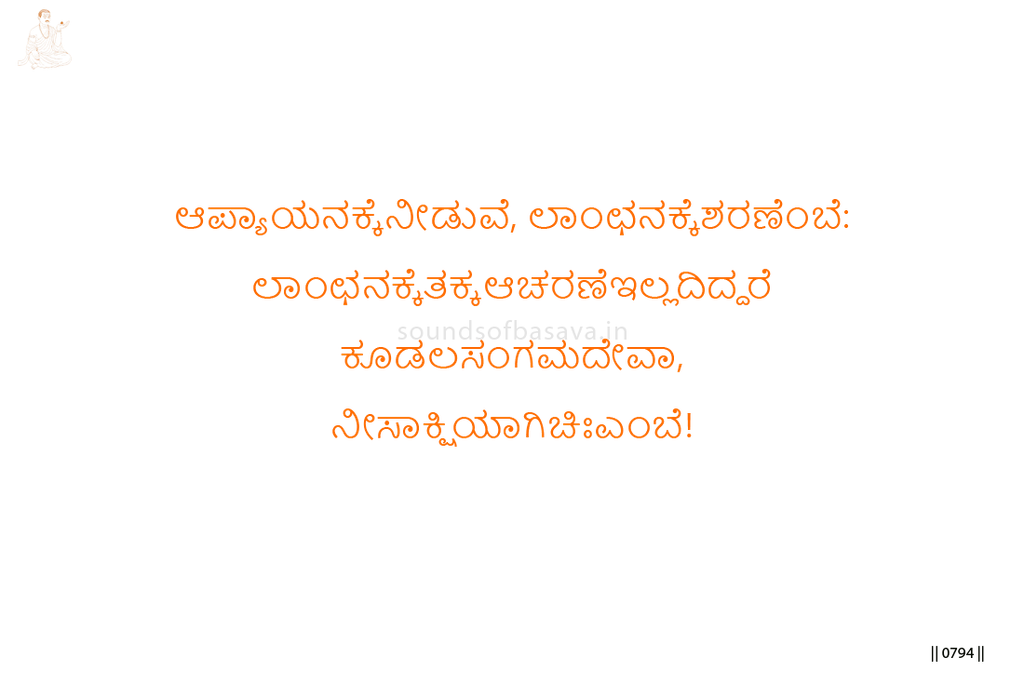
In this vachana, Basavanna tests the relation between spiritual mark and conduct.
He says that he gives for nourishment or satisfaction. He also says that because of the mark, he calls one “Sharana.” The mark is not dismissed; it is recognized as a sign that carries spiritual meaning.
But Basavanna immediately adds the condition. If there is no conduct fitting that mark, the claim cannot stand. The mark by itself is not enough.
The final line places Kudalasangama Deva as witness. With the Lord as witness, Basavanna says he will reject such contradiction plainly. The issue is not personal dislike, but accountability before the Lord.
The teaching is direct: a sacred mark must be matched by conduct worthy of it. To bear the mark and lack the corresponding conduct is to make the name “Sharana” hollow before Kudalasangama Deva.
Imagery & Symbolic Relevance
Giving is the first action. Basavanna begins with the act of giving for satisfaction, nourishment, or appeasement. The act shows relation, response, and participation.
The mark is the central image. A mark identifies, declares, or signifies belonging. In this vachana, it becomes the reason one is called Sharana.
The name “Sharana” is therefore not casual. It is not merely social address. It is spoken because the mark claims a sacred relation.
Conduct is the decisive test. Basavanna says that if conduct fitting the mark is absent, the mark loses its force. The visible sign must be supported by lived behavior.
The phrase “fitting conduct” is important. Basavanna does not oppose the mark itself. He opposes the contradiction between mark and conduct.
Kudalasangama Deva as witness gives severity to the statement. Basavanna is not making a private accusation. He speaks under divine witness.
The rejection expressed in the final line should be preserved. Basavanna does not soften the matter. Where the mark is not matched by conduct, he refuses to accept the claim as true.
The movement of the vachana is therefore from giving, to the mark, to the naming of Sharana, to the demand for conduct fitting the mark, and finally to truthful rejection under Kudalasangama Deva’s witness.
Lingayoga
In Lingayoga, this vachana teaches that outer sign and lived conduct must not separate.
The seeker should ask: do I carry a mark without conduct worthy of it? Do I accept the name Sharana while failing to live what the name requires? Do I let the visible sign become a substitute for inward and outward truth?
For Sharana Sthala, the practice-point is clear: do not rely on the mark alone. Let conduct become worthy of the mark. Let Kudalasangama Deva be the witness before whom sign, name, and life are brought into one truth.
Editorial Commentary
The word “mark” should remain central. The vachana is not a general teaching about all symbols, nor a rejection of the sacred mark. It is a test of correspondence: if one bears the mark and is called Sharana, conduct must be fitting to that mark. Without such conduct, Basavanna says he will reject the claim with Kudalasangama Deva as witness.
Related Vachana
Supporting Vachana
Pranalingi Sthala Vachana 820 — Time Arises in the Linga
Pranalingi Vachana 820 supports this teaching by joining Guru with Sadachara, Jangama with Anubhava and Samayachara, and their fulfilment in Linga. It teaches that conduct, experience, and Linga-relation cannot be divided. This supports Vachana 758 directly. Vachana 758 says that the mark of Sharana must be matched by conduct fitting that mark; Vachana 820 gives the supporting structure, where right conduct and lived experience must be integrated in the Linga before Kudalasangama Deva.
Advancing Vachana
Aikya Sthala Vachana 685 — The Divine Instrument
Aikya Vachana 685 advances this teaching by showing the mature state in which the steps that arise are from Linga and the words that arise are from Linga. The Lingavanta therefore need not fear, because movement and speech no longer stand apart from Linga. This is the natural advancement from Vachana 758. Vachana 758 demands conduct fitting the sacred mark; Aikya Vachana 685 shows the fulfilled state where conduct and speech themselves arise from Linga, so the outer sign is no longer contradicted by the life that bears it before Kudalasangama Deva.
