

Summary
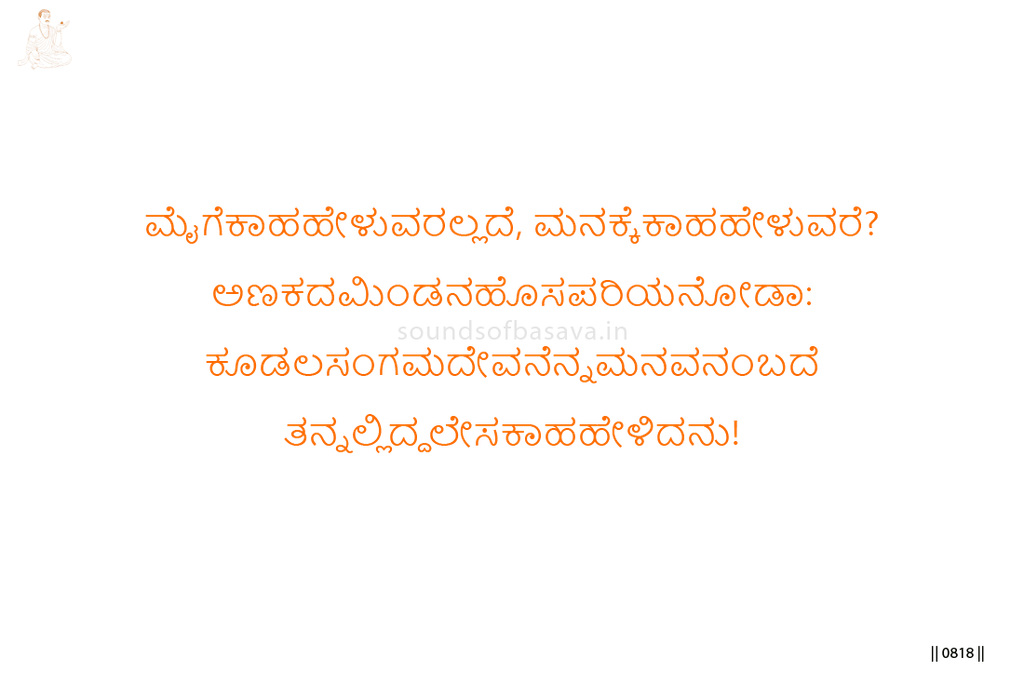
Basavanna contrasts guarding the body with guarding the mind. The body may be watched, restrained, or protected from outside, but the mind cannot be guarded in the same way. The question exposes the insufficiency of outer discipline when inward movement remains unsteady.
He then points to the strange conduct of the mind. The mind appears as a difficult inner force, one whose movement cannot be trusted merely because the body is guarded. Its instability requires a deeper reliance.
The final movement turns to Kudalasangama Deva. Basavanna says that without trusting his mind, Kudalasangama Deva showed the good protection that rested in Himself. The Sharana-stage teaching is clear: the mind is not its own safeguard. True protection is found by relying on Kudalasangama Deva rather than on the mind’s unstable movement.
Imagery & Symbolic Relevance
The body is the first image. It can be guarded. It has visible boundaries and can be protected through outward care. Basavanna begins here because bodily discipline is possible and familiar.
The mind is the second and sharper image. Basavanna asks who can guard it. Unlike the body, the mind cannot be secured merely by external watchfulness. Its movements are subtle, inward, and unstable.
The contrast between body and mind gives the vachana its force. One may succeed in bodily restraint and still remain exposed inwardly. The true difficulty lies not in guarding the visible body, but in dealing with the mind that moves within.
The “strange way” of the mind is the next image. Basavanna calls attention to the mind’s unexpected and unreliable movement. The mind does not simply obey outward discipline; it has its own patterns of wandering, calculation, and self-protection.
The refusal to trust the mind is central. Basavanna does not place confidence in the mind as final guide or protector. He sees that reliance on the mind alone cannot give safety.
The good protection resting in Kudalasangama Deva completes the teaching. Protection is not found by the mind guarding itself. It is shown by Kudalasangama Deva, and it rests in Him. The movement of the vachana is therefore from outer guarding, to the failure of mental self-guarding, to Divine protection.
Lingayoga
In Lingayoga, this vachana teaches that bodily discipline alone is not enough. The mind must also be addressed, but not through self-trust in the mind itself.
For Sharana Sthala, the practice-point is direct: do not make the mind the final refuge. The Sharana recognizes the mind’s instability and turns toward Kudalasangama Deva as the true ground of protection.
This does not dismiss discipline. It places discipline under right reliance. The body may be guarded, but the mind must be surrendered into the protection shown by Kudalasangama Deva. Only then does inward steadiness become possible.
Editorial Commentary
The title should be read through the Kannada contrast between guarding the body and guarding the mind. Basavanna’s point is not that the mind should be ignored, but that it cannot be safely entrusted to itself. The vachana’s final assurance lies in Kudalasangama Deva showing the true safeguard.
Related Vachana
Supporting Vachana
Pranalingi Sthala Vachana 1061 — The Monkey-Mind’s Restless Leap
Pranalingi Vachana 1061 supports this teaching by showing the mind as restless and unable to remain where it is placed. There, Basavanna asks Kudalasangama Deva to remove the mischief of the monkey-mind and gather him into nearness. This directly prepares Vachana 811. In Vachana 1061, the restless mind must be gathered by Kudalasangama Deva; in Vachana 811, Basavanna asks who can guard the mind and recognizes that true protection rests not in the mind itself, but in Kudalasangama Deva.
Advancing Vachana
Aikya Sthala Vachana 813 — The Ascent into Living Awareness
Aikya Vachana 813 advances this teaching by showing awareness as self-luminous and sustained through grace when the intoxication of mind is absent. It explicitly carries forward Vachana 811: where Vachana 811 shows the instability of mind, Vachana 813 establishes awareness beyond mental movement. This is the natural Aikya fulfillment. The Sharana sees that the mind cannot guard itself; in Aikya, mental turbulence falls silent, and what remains is living awareness sustained by Kudalasangama Deva’s grace.
