

Summary
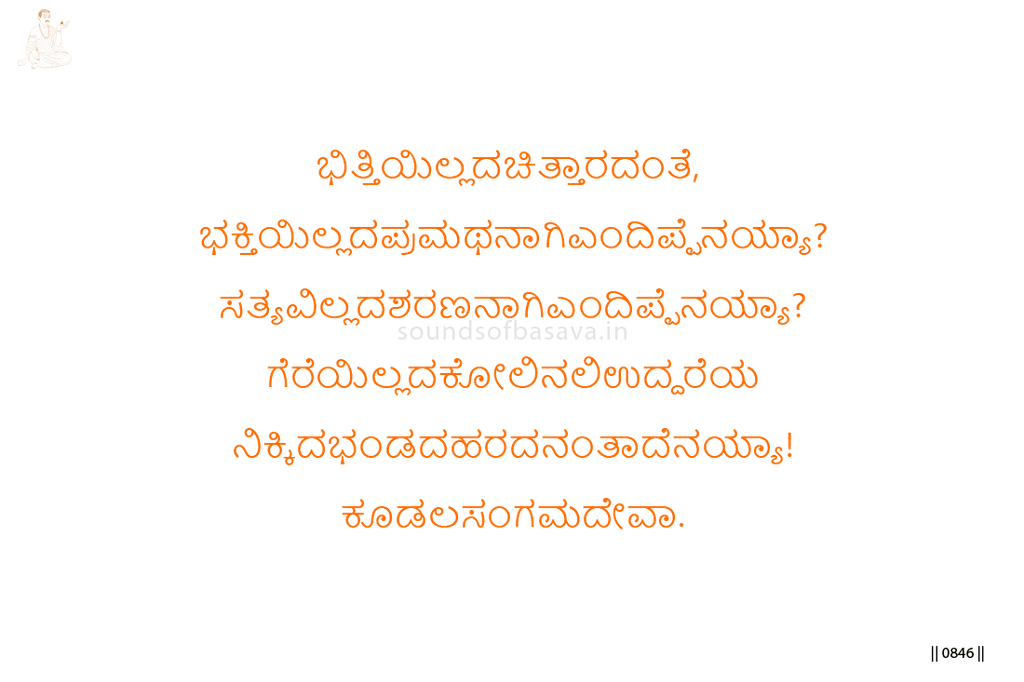
Basavanna confesses that without Bhakti he has become like a picture without a wall. Sacred appearance without devotion has no true support. It may be visible, named, or recognized, but it does not stand in living truth.
He then says that without Satya he has become a Sharana. This is the sharper confession. Even the name “Sharana” becomes false when truth has not entered and transformed the being.
The final image exposes the root of the falsity. Where there is no line, he has tried to draw a mark with a stick. The measureless cannot be marked by self-claim. The Sharana-stage teaching is clear: devotion, truth, and Sharanahood cannot become display, title, or self-inscription before Kudalasangama Deva.
Imagery & Symbolic Relevance
The picture without a wall is the first image. A picture requires a supporting surface. Without that ground, it cannot properly stand or be seen as a living form. In the same way, a sacred identity without Bhakti lacks inward support.
The Pramatha without Bhakti is the first confession. Basavanna does not merely criticize others. He places the danger within himself: one may carry a sacred name or role while devotion itself has not become real.
The Sharana without Satya is the second confession. The title “Sharana” is not enough. If truth is absent, the name becomes hollow, even if the world recognizes it.
The stick and the line form the central image. Basavanna speaks of drawing a mark where no line exists. This shows the subtle movement of self-inscription: the seeker tries to leave a personal mark upon what is measureless.
The false mark is spiritual self-claim. “I am devoted,” “I am a Sharana,” or “I have become this” may become another line drawn by the self. Basavanna sees that such marking does not reveal truth; it creates division.
Kudalasangama Deva stands as the measureless ground before which the confession is made. The seeker’s task is not to decorate identity, but to let false identity fall away.
Lingayoga
In Lingayoga, this vachana teaches that spiritual identity must be tested by living devotion and truth. Appearance, name, role, and recognition cannot replace Bhakti and Satya.
For Sharana Sthala, the practice-point is severe honesty. The Sharana must not hide behind the title “Sharana.” If truth is absent, the title itself becomes a false mark.
This vachana also protects the path from subtle ego. The danger is not only worldly pride, but sacred self-image. When the seeker tries to mark the measureless with personal claim, division is born. True refuge lies in refusing that mark before Kudalasangama Deva.
Editorial Commentary
The key images should remain simple: a picture without a supporting wall, a sacred identity without Bhakti, a Sharana-name without Satya, and a mark drawn where no line exists. Basavanna’s concern is not external religion alone, but the subtle self that turns spiritual life into identity. The confession is itself the correction.
Related Vachana
Supporting Vachana
Pranalingi Sthala Vachana 798 — The Touchstone of Truth
Pranalingi Vachana 798 supports this teaching by asking what fruit comes from thousands of songs, meanings, vows, and observances if the mind has not touched the Linga. It also rejects the false claim, “I have seen the great Linga,” when inward contact has not occurred. This prepares Vachana 939 directly. In Vachana 798, sacred speech and practice are tested by inward Linga-contact; in Vachana 939, even the identities “Pramatha” and “Sharana” are tested by Bhakti and Satya before Kudalasangama Deva.
Advancing Vachana
Aikya Sthala Vachana 935 — Beyond Truth and Untruth: The Primordial Silence of Aikya
Aikya Vachana 935 advances this teaching by carrying the warning against spiritual self-claim into the silence of Sahaja Lingaikya. It says that when truth and purity are still held as things to be possessed, practiced, displayed, taught, or ritualized, separation remains. It then moves beyond both truth and untruth into the natural Lingaikya of Kudalasangama Deva. This is the natural Aikya fulfillment of Vachana 939. In Sharana Vachana 939, Basavanna sees the false mark drawn upon the measureless; in Aikya Vachana 935, even truth and purity as claims dissolve, leaving only the primordial stillness of Kudalasangama Deva.
