

Summary
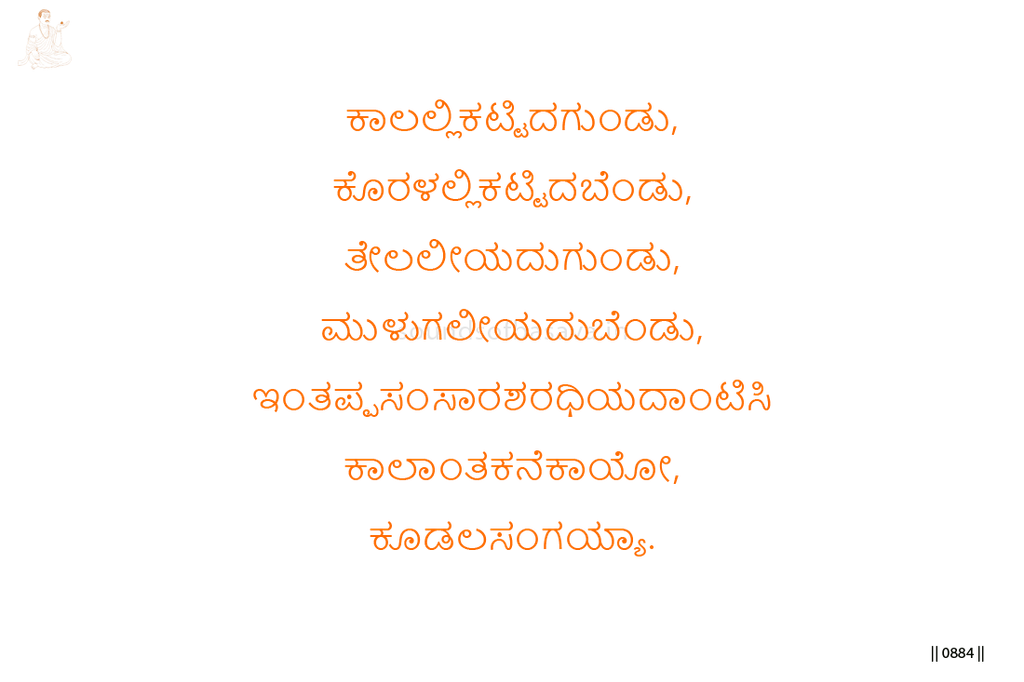
Basavanna gives the image of a heavy stone tied to the foot and a float fastened to the neck. The stone will not float, and the float will not sink. Bound together, each prevents the other from fulfilling its own nature.
This is the seeker’s condition in the ocean of worldly existence. There is a downward pull and an upward pull. Attachment, body-bound habit, and samsaric weight drag the seeker down; longing, devotion, and aspiration pull upward. Yet the two remain tied together.
The result is suspension, not crossing. The seeker does not sink fully, but neither does he reach the other shore. He remains caught in contradiction within samsara.
The final prayer is therefore direct: carry me across, O Kāḷāntaka, O Kudalasangama Deva. Basavanna does not claim that he can resolve the contradiction by his own strength. He turns to the Lord who stands beyond Time and asks to be carried across.
Imagery & Symbolic Relevance
The first image is the stone tied to the foot. A stone is heavy and naturally sinks. Tied to the foot, it becomes the downward burden of embodied existence, attachment, habit, and the weight gathered through bhava.
The second image is the float tied to the neck. A float naturally rises and keeps above water. It suggests aspiration, devotion, remembrance, and the upward movement toward release.
The paradox lies in their being bound together. The stone does not become light because the float is present. The float does not become free because it is tied above. Each remains what it is, yet neither can act freely.
The stone will not float; the float will not sink. This line should remain literal and sharp. Basavanna is not describing simple failure. He is describing obstruction caused by opposing tendencies bound within one life.
The ocean of worldly existence is the next image. The seeker is not standing safely on the shore and thinking about samsara. He is already within it, caught in its unstable field.
The invocation of Kāḷāntaka is crucial. Time governs birth, change, decay, and death. By calling Kudalasangama Deva the Destroyer of Time, Basavanna appeals to the One who alone can carry the seeker beyond the temporal ocean.
The final image is being carried across. The seeker does not say, “I will swim across.” He says, “Carry me across.” This is the heart of the vachana: when contradiction cannot be resolved by the bound self, the crossing must come through Divine grace.
Lingayoga
In Lingayoga, this vachana teaches honest recognition of contradictory tendencies. The seeker should not pretend that aspiration alone has dissolved attachment, nor that devotion alone has removed the weight of bhava.
For Sharana Sthala, the practice-point is direct: when the stone and the float remain tied together, ask to be carried across. Do not turn spiritual longing into self-confidence. Let the contradiction become prayer.
The Sharana does not deny the weight, and does not deny the upward pull. He places both before Kudalasangama Deva and asks the Destroyer of Time to ferry him beyond the ocean of samsara.
Editorial Commentary
The stone and float should not be over-systematized. Their force lies in the physical clarity of the image. One pulls down, one rises, and when both are bound to the same seeker, crossing becomes impossible by ordinary effort. The final plea to Kāḷāntaka must remain the center.
Related Vachana
Supporting Vachana
Pranalingi Sthala Vachana 961 — The Descent of Linga into Prana
Pranalingi Vachana 961 supports this teaching by showing that outer Linga alone does not end bhava. Linga must become inwardly joined with prana; the inner field must be purified; Chennabasavanna must reveal the hidden path of Lingaikya; and Jangama-Mukhalinga must discipline, protect, and cut the nature of samsara. This prepares Vachana 1148 directly. In Vachana 961, the hold of samsara is cut only when Linga enters life itself through grace and living guidance; in Vachana 1148, Basavanna confesses that he remains suspended in the ocean of samsara and asks Kudalasangama Deva, Kāḷāntaka, to carry him across.
Advancing Vachana
Aikya Sthala Vachana 1322 — Gently, Gently Beyond Even the Six Sthalas
Aikya Vachana 1322 advances this teaching by showing the crossing completed without force, claim, or self-display. There, the seeker passes gently through Bhakta, Maheshwara, Prasadi, Pranalingi, Sharana, and Aikya, and then crosses even the Six Sthalas into the Fearless State before Kudalasangama Deva. This is the natural Aikya fulfillment of Vachana 1148. In Sharana Vachana 1148, the seeker cannot cross the ocean while burden and aspiration remain bound together; in Aikya Vachana 1322, the crossing has ripened gently into the state beyond fear, division, and stage-consciousness.
