

Summary
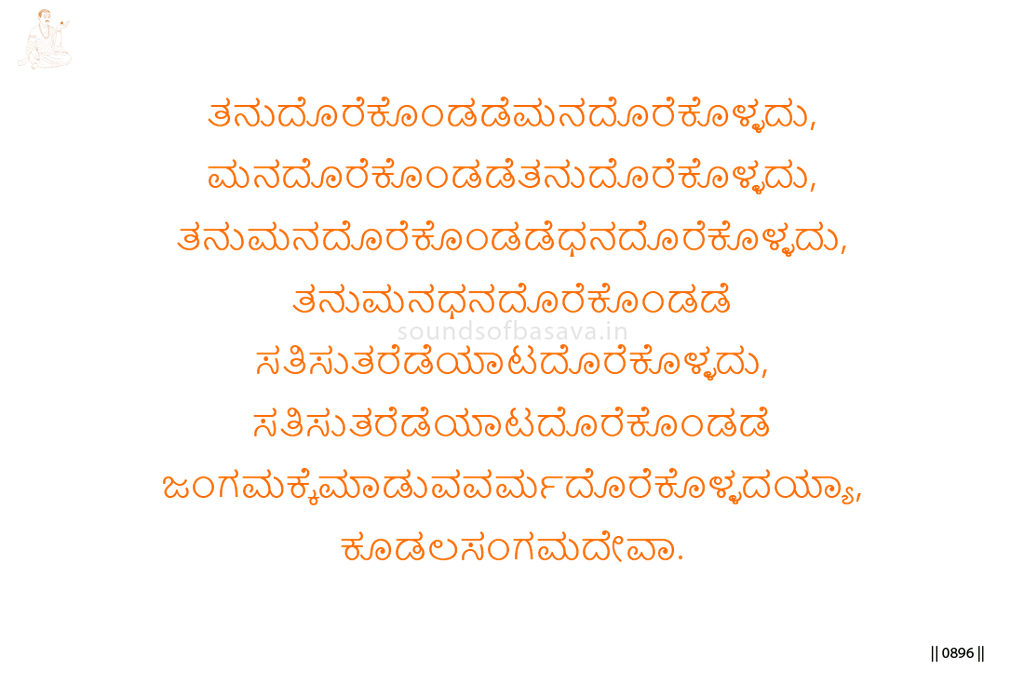
Basavanna describes offering as a sequence that cannot be partial. Without offering the body, the mind cannot be offered. Without offering the mind, the body cannot be offered. Body and mind must become mutually aligned before the next offering can become truthful.
Without offering body and mind, wealth cannot be offered. Wealth does not become sacred merely because it is given outwardly. If the body and mind remain self-owned, wealth remains tied to the same self-ownership.
Even after body, mind, and wealth are offered, a deeper pull remains: the attachment to wife and children. Basavanna is not rejecting family life. He is identifying the possessive tug that turns relationship into bondage.
Only when this pull is crossed does the seeker attain the secret of service to Jangama. Jangama Seva is not merely an act performed with resources. It is the inner mystery that becomes available when body, mind, wealth, and possessive attachment have all been purified before Kudalasangama Deva.
Imagery & Symbolic Relevance
The first image is the body. The body is the field of action, labour, presence, and conduct. If the body remains withheld, the mind’s offering remains incomplete because inward intention has not entered embodied life.
The second image is the mind. The mind is the field of intention, thought, desire, and inward consent. If the mind remains withheld, bodily offering becomes mechanical. The body may act, but the inward being has not agreed.
The mutual dependence of body and mind is central. Basavanna does not allow the seeker to divide practice into outer action and inner feeling. True offering requires both.
The third image is wealth. Wealth is the extended field of capacity, possession, livelihood, and social power. It cannot be truly offered while body and mind remain self-centered. Otherwise giving may still conceal ownership, pride, or calculation.
The fourth image is wife and children. This should be handled carefully. The source does not condemn relationship. It points to the pull of possessive attachment, the binding force that says “mine” even after outward offering has begun.
The fifth image is the tug or pull of attachment. This is subtler than visible possession. Even when wealth is offered, emotional ownership may still bind the seeker through private claims and exclusive concern.
The final image is the varma, the secret or inner mystery of Jangama Seva. Basavanna does not say merely that one cannot perform service. He says one cannot attain its secret. The act may be visible, but its truth remains hidden until possessiveness is crossed.
Lingayoga
In Lingayoga, this vachana teaches integrated offering. Body and mind must not be divided. Wealth must not be offered without inward transformation. Relationship must not become possessive bondage.
For Sharana Sthala, the practice-point is direct: do not offer in fragments. Let body, mind, wealth, and attachment all be examined before Kudalasangama Deva.
The secret of Jangama Seva is reached only when service no longer arises from self-owned life. When the body acts, the mind consents, wealth flows rightly, and attachment loses its possessive hold, service becomes living participation rather than transaction.
Editorial Commentary
The reference to wife and children should not be read as rejection of household life. Basavanna’s concern is the possessive pull that prevents full offering. The vachana is not anti-family; it is against bondage through “mine.” The final word “secret” should also remain central: external service may be performed earlier, but the inner mystery of Jangama Seva opens only after these layers of ownership are crossed.
Related Vachana
Supporting Vachana
Pranalingi Sthala Vachana 963 — Body, Mind, and Being as the Vessels of Linga
Pranalingi Vachana 963 supports this teaching by giving the sacred ordering through which the seeker’s life becomes a fit vessel. There, body, mind, and bhava each receive their proper function in relation to Linga, and Bhakti becomes the vessel fit for sacred receiving before Prabhudeva and Kudalasangama Deva. This prepares Vachana 1198 directly. In Vachana 963, body and mind are not rejected but made proper vessels; in Vachana 1198, that vessel-teaching becomes the Sharana sequence of offering body, mind, wealth, and possessive attachment until the secret of Jangama Seva becomes attainable.
Advancing Vachana
Aikya Sthala Vachana 1192 — Jangama Seva Is the Eternal Path
Aikya Vachana 1192 advances this teaching by revealing the fulfilled state of Jangama Seva. There, service to Jangama is known as Guru-puja, Linga-puja, sustenance, one’s true nature, the Self, and the Eternal State. This is the natural Aikya fulfillment of Vachana 1198. In Sharana Vachana 1198, Basavanna explains the preparation required before the secret of Jangama Seva can be attained; in Aikya Vachana 1192, that secret is fully disclosed as the very path and state of union before Kudalasangama Deva.
