

Summary
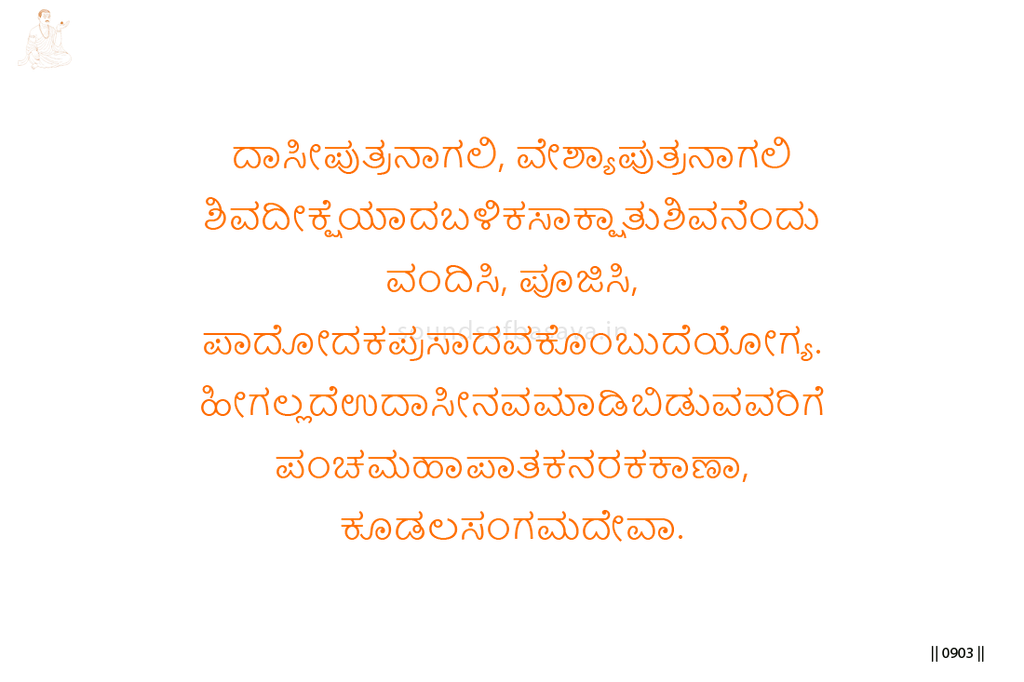
Basavanna rejects birth as the measure of spiritual worth. Whether one is born to a servant woman or to a courtesan, once Shiva-diksha has been received, that person must be honoured, worshipped, and known as Shiva Himself.
The teaching is not mere tolerance. Basavanna does not say that such a person should be quietly accepted. He says they are to be revered as sacred presence and are worthy to receive Padodaka and Prasada.
Shiva-diksha becomes the decisive transformation. Social origin, stigma, lineage, and inherited status lose authority before the initiation that places the seeker in living relation to Shiva.
The warning is severe. Those who treat such an initiated person with indifference, contempt, or rejection fall into the hell of the five great sins. To reject the initiated because of birth is not a social error alone; it is a direct failure to recognize Shiva before Kudalasangama Deva.
Imagery & Symbolic Relevance
The first image is birth from a servant woman. Basavanna deliberately names a socially diminished origin, where inherited status would normally be used to deny honour.
The second image is birth from a courtesan. This intensifies the challenge. He selects an origin that social pride would stigmatize, and then places Shiva-diksha above that stigma.
The third image is Shiva-diksha. Initiation is not a decorative rite. It marks a new sacred relation in which the person can no longer be measured by birth. The initiated one must be seen through Shiva, not through social memory.
The instruction to honour and worship is crucial. Basavanna does not allow a half-hearted equality that merely stops insult. He demands positive reverence. The person who has received Shiva-diksha is to be approached as Shiva Himself.
Padodaka and Prasada mark full sacred participation. The initiated person is not to be excluded from the shared field of grace. To deny Padodaka and Prasada because of birth would be to deny the power of Shiva-diksha itself.
The phrase “turn away with indifference” gives the warning its moral sharpness. The fault is not only open abuse. Cold distancing, refusal, and contempt are also spiritually destructive.
The hell of the five great sins is the final image. Basavanna uses the strongest consequence because the error is grave: one claims devotion to Shiva while refusing Shiva where grace has already entered.
Lingayoga
The first image is birth from a servant woman. Basavanna deliberately names a socially diminished origin, where inherited status would normally be used to deny honour.
The second image is birth from a courtesan. This intensifies the challenge. He selects an origin that social pride would stigmatize, and then places Shiva-diksha above that stigma.
The third image is Shiva-diksha. Initiation is not a decorative rite. It marks a new sacred relation in which the person can no longer be measured by birth. The initiated one must be seen through Shiva, not through social memory.
The instruction to honour and worship is crucial. Basavanna does not allow a half-hearted equality that merely stops insult. He demands positive reverence. The person who has received Shiva-diksha is to be approached as Shiva Himself.
Padodaka and Prasada mark full sacred participation. The initiated person is not to be excluded from the shared field of grace. To deny Padodaka and Prasada because of birth would be to deny the power of Shiva-diksha itself.
The phrase “turn away with indifference” gives the warning its moral sharpness. The fault is not only open abuse. Cold distancing, refusal, and contempt are also spiritually destructive.
The hell of the five great sins is the final image. Basavanna uses the strongest consequence because the error is grave: one claims devotion to Shiva while refusing Shiva where grace has already entered.
Editorial Commentary
This vachana should remain socially concrete. Basavanna names stigmatized births in order to overturn their authority after Shiva-diksha. The teaching should not be softened into general kindness alone. Its sharper point is that the initiated one must be honoured as Shiva Himself, and refusal to do so brings grave spiritual consequence.
The vachana also resonates deeply with the unfolding of the Panchakshari—“Om Namah Shivaya.” The syllables symbolize the soul’s journey from concealment into revelation: • Na — the concealing force • Ma — worldly bondage and limitation • Shi — Shiva, the supreme reality • Va — revealing grace • Ya — the individual soul Through Shiva-diksha, the hidden Shiva-potential within the soul begins to unfold.
Basavanna connects this awakening not merely to inward devotion but to lived transformation through Ariwu (understanding), Achara (conduct), Daya (compassion), Kayaka (sacralized labour), and Dasoha (selfless sharing). Realization therefore becomes visible through equality, humility, and participation in the welfare of all beings.
Related Vachana
Supporting Vachana
Pranalingi Sthala Vachana 606 — The True Mark — Beyond Birth, Beyond Death
Pranalingi Vachana 606 supports this teaching by placing Linga above birth, learning, and social classification. There, Basavanna says that even one learned in the four Vedas lacks true standing without Linga, while one called Shvapacha becomes worthy when Linga is present; that person’s speech is worthy, his Prasada is nectar, and he becomes purifier of the world. This prepares Vachana 1215 directly. In Vachana 606, Linga overturns birth and learned status; in Vachana 1215, Shiva-diksha overturns stigmatized origin, making the initiated one worthy of honour, worship, Padodaka, and Prasada before Kudalasangama Deva.
Advancing Vachana
Aikya Sthala Vachana 770 — The Sacred Trinity That Purifies All
Aikya Vachana 770 advances this teaching by showing the completed dissolution of caste, clan, and impurity in the presence of Linga, Jangama, and Prasada. There, caste cannot remain where Linga is present, clan cannot survive where Jangama dwells, and impurity cannot abide where Prasada is shared; false speech alone becomes the true pollution. This is the natural Aikya fulfillment of Vachana 1215. In Sharana Vachana 1215, Shiva-diksha makes the socially rejected person worthy of honour and sacred participation; in Aikya Vachana 770, the very categories of caste, clan, purity, and exclusion dissolve in the lived unity of Linga, Jangama, and Prasada.
