

Summary
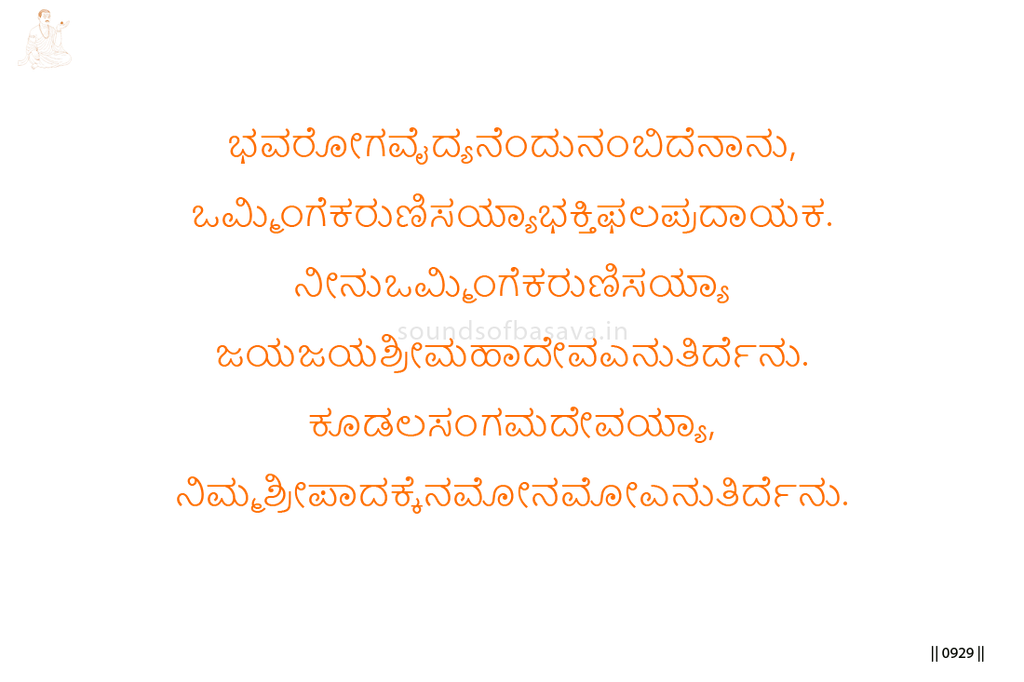
Basavanna places his trust in Kudala Sangama Deva as the physician who cures the disease of becoming. This disease is not ordinary bodily illness, but the affliction of repeated attachment, longing, forgetfulness, and separation. The Sharana does not claim the power to cure himself; he turns completely toward the Divine Physician.
He asks not for worldly benefit, but for grace and for the fruit of Bhakti. The repeated cry for compassion, the praise of Mahadeva, and the final bow at the sacred feet reveal a state of complete dependence upon Divine healing. For the Sharana, the cure lies in grace, trust, praise, and surrender before Kudala Sangama Deva.
Imagery & Symbolic Relevance
The first image is the disease of becoming. Basavanna names the condition of worldly becoming as a disease. This does not condemn life itself. It points to the affliction of being caught in repeated longing, attachment, forgetfulness, and separation from the Divine.
The second image is Kudala Sangama Deva as physician. Basavanna says he has trusted Him as the healer of this disease. A physician does not merely comfort the patient; he removes the illness at its root. Here, the root disease can be healed only by Divine grace.
The third image is the request for compassion from the giver of the fruit of Bhakti. Basavanna does not ask for power, status, or worldly relief. He asks for the fruit of devotion. True Bhakti itself becomes the medicine that heals the disease of becoming.
The fourth image is the repeated plea: “Grant me grace.” The repetition shows dependence, not impatience. The Sharana knows that the cure cannot be produced by self-effort alone. Grace must be continually received.
The fifth image is the cry, “Victory, victory, Śrī Mahadeva.” The victory is not over another person or external enemy. It is the victory of the Divine Physician over the disease of becoming. Praise becomes the sound of trust.
The final image is the repeated bow at the sacred feet of Kudala Sangama Deva. Basavanna ends not with an explanation of healing, but with surrender. The feet are the place of refuge, and “Namo, Namo” becomes the posture of one who has entrusted himself fully to the Divine cure.
Lingayoga
In Lingayoga, this vachana teaches that the root affliction cannot be cured by the seeker’s own strength. Practice, understanding, and effort have their place, but the disease of becoming is healed only through the grace of Kudala Sangama Deva.
For Sharana Sthala, the practice-point is direct: trust the Divine Physician. Ask for the fruit of Bhakti, receive grace, praise the healer, and bow at the sacred feet. The Sharana does not pretend to be self-sufficient; he places his whole being under Divine care.
Editorial Commentary
“Bhava-roga” should be retained as the central term. It means the disease of becoming, not ordinary bodily sickness. Basavanna’s image is medical, but its meaning is spiritual: the affliction is separation and restless becoming; the cure is Divine grace.
Related Vachana
Supporting Vachana
Prasadi Sthala Vachana 1110 — The Physician of the Disease of Becoming
Prasadi Vachana 1110 supports this teaching by naming Kudala Sangama Deva as Bhava-roga Vaidya and Bhava-hara, the physician and remover of the disease of becoming. There, Basavanna refuses all other remedies except the Prasada of Kudala Sangama Deva’s ancient Sharanas. This prepares Vachana 1295 directly. In Vachana 1110, the remedy for bhava-roga is Prasada; in Vachana 1295, the Sharana places complete trust in the Divine Physician and asks for the fruit of Bhakti as the healing grace.
Advancing Vachana
Aikya Sthala Vachana 484 — Victory, Victory to Mahadeva
Aikya Vachana 484 advances this teaching by showing the fulfilled state of the same movement. There too Kudala Sangama Deva is recognized as the healer of the disease of becoming, but the mind itself has surrendered and resounds with “Victory, Victory, Śrī Mahadeva.” In Sharana Vachana 1295, Basavanna cries for grace and bows at the sacred feet; in Aikya Vachana 484, that trust matures into victorious abidance, where the healed mind itself becomes praise.
