

Summary
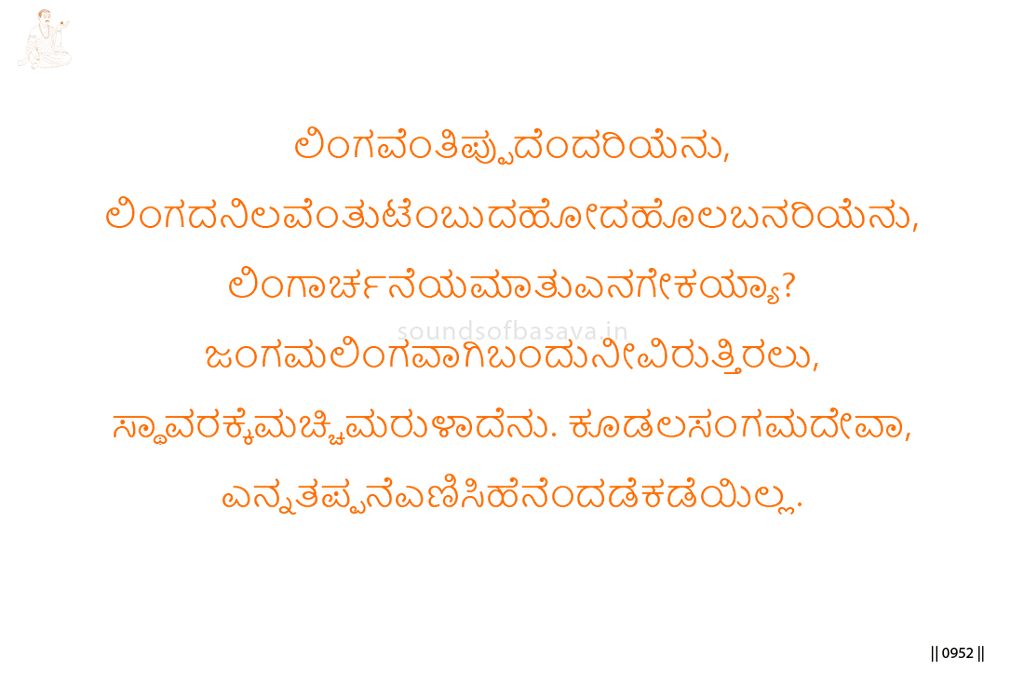
Basavanna confesses that he did not know what the Linga truly is, nor the state in which the Linga abides. Because this living understanding was absent, even speaking of Linga-worship became empty for him.
The central sorrow is that Kudalasangama Deva Himself came as Jangama-Linga and stood before him, yet Basavanna turned toward the stationary form and wandered in delusion. The vachana does not reject the Sthavara-Linga. It laments the failure to recognize the living Linga when it stood directly before him. The closing confession is humble and severe: if he begins to count his mistakes, there is no end.
Imagery & Symbolic Relevance
The first image is not knowing what the Linga is. Basavanna does not begin with certainty. He admits that the word “Linga” had been present, but its living meaning had not been understood.
The second image is not knowing the state in which the Linga abides. The issue is deeper than naming the Linga. Basavanna has not known the condition or reality in which Linga truly stands.
The third movement is the question: what use is speaking of Linga-worship? Worship-language becomes empty when the living truth of the Linga is not recognized. The problem is not worship itself, but speech about worship without true seeing.
The fourth image is Kudalasangama Deva coming as Jangama-Linga. Grace is not distant here. The Lord comes in living, moving presence. Jangama-Linga is the Linga appearing before the seeker as awakened life.
The fifth image is that living presence standing before him. This makes the confession sharper. The Divine was not hidden far away; the Jangama-Linga stood directly in front of the seeker.
The sixth image is turning toward the Sthavara, the stationary form. Basavanna’s error is not that he honoured the fixed form, but that he became attached to it while missing the living revelation before him.
The seventh image is wandering in delusion. Failure of recognition becomes spiritual wandering. What was sought was already present, yet habitual perception turned elsewhere.
The final image is counting mistakes without end. This is not self-hatred. It is the humility that arises when Basavanna sees how often grace was offered and yet not recognized before Kudalasangama Deva.
Lingayoga
The first image is not knowing what the Linga is. Basavanna does not begin with certainty. He admits that the word “Linga” had been present, but its living meaning had not been understood.
The second image is not knowing the state in which the Linga abides. The issue is deeper than naming the Linga. Basavanna has not known the condition or reality in which Linga truly stands.
The third movement is the question: what use is speaking of Linga-worship? Worship-language becomes empty when the living truth of the Linga is not recognized. The problem is not worship itself, but speech about worship without true seeing.
The fourth image is Kudalasangama Deva coming as Jangama-Linga. Grace is not distant here. The Lord comes in living, moving presence. Jangama-Linga is the Linga appearing before the seeker as awakened life.
The fifth image is that living presence standing before him. This makes the confession sharper. The Divine was not hidden far away; the Jangama-Linga stood directly in front of the seeker.
The sixth image is turning toward the Sthavara, the stationary form. Basavanna’s error is not that he honoured the fixed form, but that he became attached to it while missing the living revelation before him.
The seventh image is wandering in delusion. Failure of recognition becomes spiritual wandering. What was sought was already present, yet habitual perception turned elsewhere.
The final image is counting mistakes without end. This is not self-hatred. It is the humility that arises when Basavanna sees how often grace was offered and yet not recognized before Kudalasangama Deva.
Editorial Commentary
This vachana should not be read as a rejection of Sthavara-Linga. Basavanna’s fault is not reverence for the fixed form, but attachment to it while failing to see the Jangama-Linga. The correction is one of recognition: the living Linga had already come and stood before him. The tragedy is not absence of grace, but missed grace.
Related Vachana
Supporting Vachana
Pranalingi Sthala Vachana 821 — The Living Temple
Pranalingi Vachana 821 supports this teaching by distinguishing the perishing fixed structure from the living sacred presence. There, Basavanna says the body itself becomes temple when aligned with Kudalasangama Deva, and the decisive contrast is that Sthavara may perish, while Jangama, the living moving presence, is not reduced to stone. This prepares Vachana 1343 directly. In Vachana 821, the living body becomes the truer field of worship; in Vachana 1343, Basavanna laments that when Kudalasangama Deva came as Jangama-Linga and stood before him, he still turned toward the stationary form and wandered in delusion.
Advancing Vachana
Aikya Sthala Vachana 1334 — Who Showed Me That Linga and Jangama Are One?
Aikya Vachana 1334 advances this teaching by revealing the unity that Vachana 1343 confesses he failed to see. In Sharana Vachana 1343, the Jangama-Linga stands before Basavanna, but he remains attached to the Sthavara and misses the living revelation. In Aikya Vachana 1334, the Jangama comes as Mukhalinga, instructs, protects, and reveals that Linga is Jangama and Jangama is Linga. Thus the Sharana-stage confession of missed recognition advances into Aikya as direct realization that the worshipped Linga and the living Jangama are not separate before Kudalasangama Deva.
