

Summary
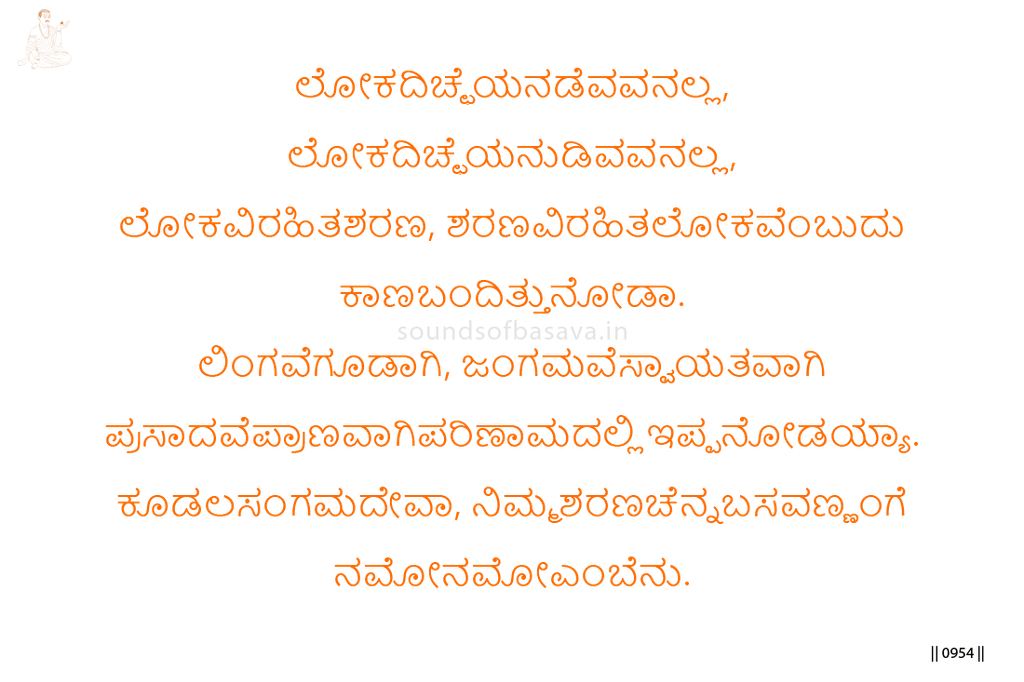
Basavanna describes the Sharana as one who does not walk according to the world’s desire and does not speak according to the world’s desire. The separation between the world and the Sharana is not one of physical distance, but of inward orientation. The world moves by its own desire; the Sharana lives from another center.
In that state, Linga becomes the dwelling, Jangama becomes sovereign, and Prasada becomes the very life-breath. Sacred realities are no longer occasional practices or separate objects; they become the structure of life itself. Seeing this fulfilled in Chennabasavanna, Basavanna bows again and again to Kudalasangama Deva’s Sharana.
Imagery & Symbolic Relevance
The first image is not walking according to the world’s desire. Walking here points to conduct and direction. The Sharana does not allow worldly desire to determine the path of life.
The second image is not speaking according to the world’s desire. Speech too is freed from worldly pressure. The Sharana’s words do not arise from the need to please, conform, or echo the world.
The third image is the world without the Sharana and the Sharana without the world. This does not mean that the Sharana disappears from the world. It means that the world and the Sharana stand apart in orientation. They may occupy the same visible field, but they do not live by the same inner law.
The fourth image is Linga as dwelling. The Linga is no longer merely worshipped in a separate place. It becomes the home in which the Sharana lives.
The fifth image is Jangama as sovereign. Jangama is no longer occasional encounter or external presence. Jangama governs the field of life as the ruling sacred reality.
The sixth image is Prasada as life-breath. Prasada is not simply something received at certain moments. It becomes the very principle by which life is sustained.
The final image is repeated bowing to Chennabasavanna. Basavanna bows not to an abstract idea, but to Kudalasangama Deva’s Sharana in whom this integrated state has become visible.
Lingayoga
In Lingayoga, this vachana teaches freedom from worldly orientation. The Sharana does not merely reject the world outwardly; he ceases to be directed by the world’s desire in movement and speech.
For Sharana Sthala, the practice-point is complete integration. Linga must become dwelling, Jangama must become sovereign, and Prasada must become life-breath. When these are no longer separate supports but the living structure of existence, the Sharana stands apart from worldly desire while remaining fully established before Kudalasangama Deva.
Editorial Commentary
The phrase “world without the Sharana, and Sharana without the world” should not be read as withdrawal from life. The source points to a difference in orientation. The Sharana’s conduct, speech, dwelling, authority, and sustenance no longer arise from worldly desire. Chennabasavanna is honoured here as the living embodiment of that fulfilled state.
Related Vachana
Supporting Vachana
Pranalingi Sthala Vachana 1366 — Rejoicing in the Received Linga
Pranalingi Vachana 1366 supports this teaching by showing the received Pranalinga becoming direct and evident through Guru’s grace. There, the seeker no longer divides the Linga as merely within or without, but becomes absorbed and joyful in the Linga received. This prepares Vachana 1347 directly. In Vachana 1366, the received Linga becomes living experience; in Vachana 1347, that reception matures into Sharana freedom, where Linga becomes dwelling, Jangama becomes sovereign, Prasada becomes life-breath, and worldly orientation falls away.
Advancing Vachana
Aikya Sthala Vachana 1180 — When Fulfillment Comes, Even the Means Are Transcended
Aikya Vachana 1180 advances this teaching by showing Guru, Linga, Jangama, and Prasada becoming fully assimilated. In Sharana Vachana 1347, Linga, Jangama, and Prasada have become the very structure of the Sharana’s life. In Aikya Vachana 1180, these sacred means become so fully one’s own that their separate externality is transcended, and the devotee lives ripened in Guru, Linga, Jangama, and Prasada. Thus the Sharana-stage integration of sacred life advances into Aikya as complete assimilation and effortless devotion before Kudalasangama Deva.
