

Summary
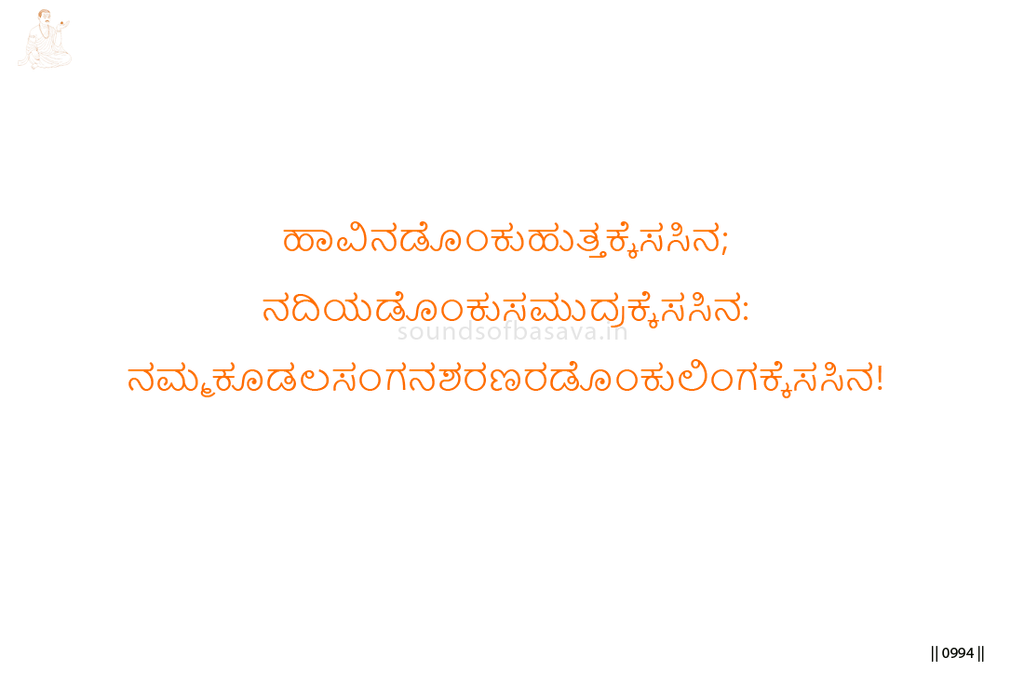
Basavanna gives three images of return. The serpent bends toward its hole. The river bends toward the ocean. In the same way, the Sharana of Kudalasangama bends only toward the Linga.
The teaching is not that movement has no turns. The serpent curves, and the river winds. Yet the turn does not change the destination. The Aikya source explains that movement may appear varied, but its end is not multiple; what departs in appearance returns in essence.
For the Sharana, the Linga is not one option among many. The source states that the Sharana does not choose the Linga as a destination in the ordinary sense; the Sharana ceases to move away, and what always was becomes evident.
Imagery & Symbolic Relevance
The serpent is the first image. Its body may bend and curve, but its movement naturally returns toward its hole. The source explains the serpent as instinctive return, without deliberation.
The hole is not presented as an accidental shelter. It is the serpent’s own place of return. The source calls it origin, not merely refuge, showing that the movement is toward what properly belongs to it.
The river is the second image. A river does not move in a straight line. It bends, turns, and passes through many forms of movement. Yet these bends do not cancel its direction.
The ocean is the river’s destination. The source explains the river as movement through multiplicity and the ocean as undivided totality. The river’s winding therefore does not mean loss; it means movement still resolving into its own completion.
The third line brings the teaching to Kudalasangama’s Sharana. Just as the serpent bends toward its hole and the river bends toward the ocean, the Sharana’s turn is toward the Linga.
The word “bend” is important. Basavanna does not describe a dramatic conquest or a newly invented path. The Sharana’s movement may appear curved, but its inward direction is already determined by the Linga.
The Linga is therefore not a distant goal reached by effort alone. The Aikya source states that in this movement, Linga is not reached as something new; it is what remains when outward dispersion ends.
Together, the three images show one law of return. The serpent, the river, and the Sharana may appear to move through bends, but their movement resolves toward their own proper ground.
Lingayoga
In Lingayoga, this vachana teaches the ending of dispersion. The seeker should not be disturbed merely because movement appears curved or delayed. The real question is whether the movement still turns toward Linga.
The practice-point is direct: do not mistake the bends of life for separation from the Lord. Like the serpent and the river, the Sharana must allow every turn to resolve toward the proper ground.
The source states that the return is not an act of will, but the ending of dispersion. Where this is seen, wandering is no longer sustained.
Editorial Commentary
This vachana should be read as a teaching on direction, not speed. Basavanna does not say that the Sharana moves without turns. He says that even the turn belongs to return.
The serpent’s bend, the river’s bend, and the Sharana’s bend must be kept close to the source image. The point is simple and exact: whatever the appearance of movement, the Sharana of Kudalasangama turns only toward the Linga.
Related Vachana
Supporting Vachana
Sharana Sthala Vachana 153 — The Threefold Wisdom
Sharana Vachana 153 supports this Aikya vachana by naming the true wise one as the one who firmly trusts the Linga, serves the Jangama, and cuts away the tail of attachment. The source states that wisdom begins where the seeker rests in the Linga without wavering, and that the true Sharana is recognized by Linga-trust, Jangama-service, and freedom from attachment.
This prepares the movement of Aikya Vachana 144. In Sharana Vachana 153, the seeker becomes wise by trusting the Linga and cutting attachment. In Aikya Vachana 144, that Linga-trust has become inevitable inward direction: just as the river bends to the ocean, the Sharana of Kudalasangama bends only toward the Linga.
Advancing Vachana
Aikya Sthala Vachana 145 — The Mirror of the Devotee’s Face
Aikya Vachana 145 advances this teaching within Aikya Sthala. In Vachana 144, the Sharana’s movement resolves toward the Linga. In Vachana 145, that return is complete enough that the Linga is seen in the devotee’s face, the Lord stands unblinking in the devotee’s body, and Kudalasangama Deva arises between the devotee’s words.
Thus Vachana 144 shows the inevitable turning toward Linga, while Vachana 145 shows the state where separation no longer governs expression. What returns to Linga in Vachana 144 becomes visible as Linga-presence in the devotee’s face, body, and speech in Vachana 145.
