

Summary
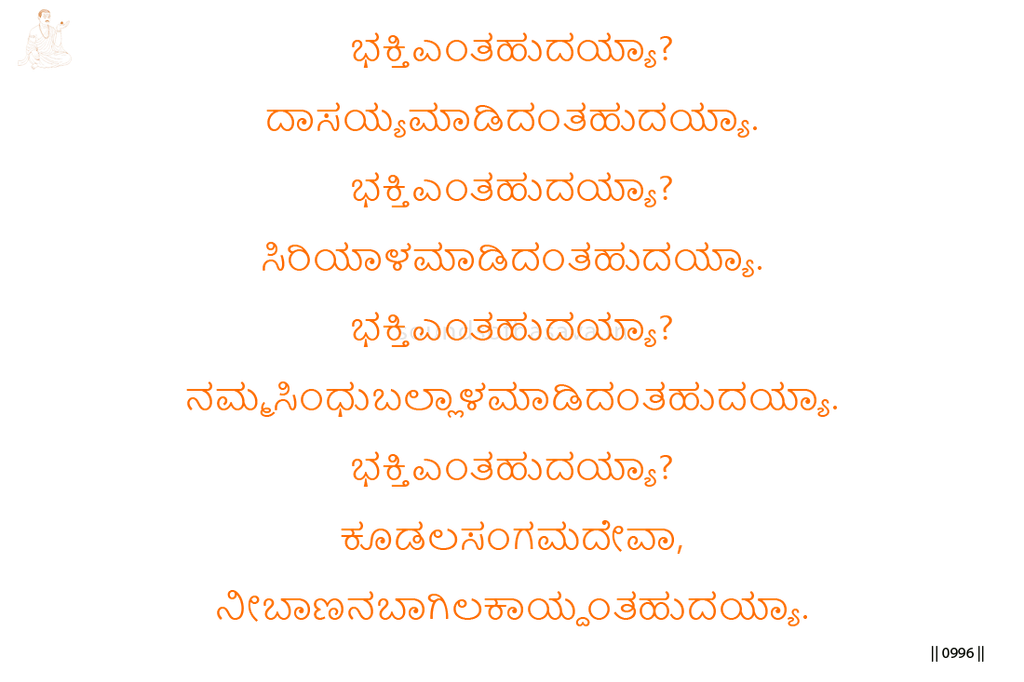
Basavanna asks again and again: “What is Bhakti?” He does not define it through doctrine, speech, display, or self-claim. He points to lives in which devotion was done, lived, and yielded.
Dasayya, Siriyala, and Ballala are invoked as measures of lived devotion. Their names are not used as ornament. The Aikya source states that they indicate lives where self-reference has ended, not as examples to imitate outwardly, but as expressions of total yielding.
The final image is the arrow from Kudalasangama Deva’s bow. Devotion is no longer controlled by personal hesitation, calculation, or return. Once released, it moves from the source that released it. The source explains that the arrow has no agency of its own; its movement is entirely of the source from which it was released.
Imagery & Symbolic Relevance
The repeated question “What is Bhakti?” gives the structure of the vachana. Basavanna does not answer with a theory. Each answer points to devotion as something lived.
“Bhakti is as Dasayya did” gives the first response. Dasayya stands here as a sign of enacted devotion. The point is not the name alone, but devotion that has become action without self-display.
“Bhakti is as Siriyala did” gives the second response. Siriyala is remembered as one whose devotion is tested and revealed through offering. The supporting Sharana source says that Siriyala shows true devotion as not claim, appearance, or speech, but tested offering.
“Bhakti is as our Ballala did” gives the third response. Ballala is placed in the same line of lived surrender. Basavanna’s use of “our” makes the example intimate to the community of Sharanas, not distant or decorative.
The fourth question gathers the earlier examples into one decisive image. Basavanna turns from named devotees to Kudalasangama Deva Himself. Devotion is now shown through the arrow and the Divine bow.
The arrow is the central image. Once released, it does not hesitate, reconsider, or reverse. It does not stop to claim direction for itself. The Aikya source states that there is no calculation and no redirection, only continuation of what has already been set in motion.
The Divine bow signifies the source of movement. The arrow does not move by private intention. Its direction belongs to the one who releases it. In the same way, Bhakti is not self-directed religious effort when it has reached this depth.
The closing address to Kudalasangama Deva completes the teaching. Basavanna does not say, “I perform devotion.” He shows devotion as release from personal doership. What moves is already of Kudalasangama Deva.
Together, the lines show Bhakti as tested, yielded, and irreversible. Dasayya, Siriyala, and Ballala reveal devotion as lived surrender; the arrow reveals devotion as movement without self-claim.
Lingayoga
In Lingayoga, this vachana teaches that devotion must move beyond idea and self-description. The seeker should not ask only, “Do I speak of Bhakti?” but “Has the self-claim fallen away in action?”
The practice-point is direct: let devotion become lived yielding. Do not hold back in calculation, and do not turn devotion into personal achievement. When the arrow is released from the bow, it does not return to ask whether it is moving rightly.
The Aikya source states that devotion is not held as idea; where the sense of doership remains, devotion is partial, and where it falls away, what remains moves without reference to self.
Editorial Commentary
This vachana should be read as a definition of Bhakti through lived surrender. Basavanna deliberately avoids abstract definition. He asks “What is Bhakti?” and answers through persons whose lives stand as offerings, then through the arrow whose movement no longer belongs to itself.
The arrow image should govern the whole reading. Bhakti is not passivity, and it is not self-willed activism. It is action released from Kudalasangama Deva’s bow, without hesitation, self-ownership, or return to separate will.
Related Vachana
Supporting Vachana
Sharana Sthala Vachana 680 — The Sweetness of the Cane
Sharana Vachana 680 supports this Aikya vachana by showing that outer form is not the proof of devotion. The source states that Siriyala is the one who entered the test and prevailed, and that true devotion is not claim, appearance, or speech, but tested offering.
Aikya Vachana 146 carries this directly forward. In Sharana Vachana 680, Siriyala’s surrender is revealed through testing. In Aikya Vachana 146, Siriyala is named as one answer to the question “What is Bhakti?” The tested offering of Sharana becomes, in Aikya, the definition of devotion itself.
Advancing Vachana
Aikya Sthala Vachana 960 — Inner and Outer, Self and World: One Alone
Aikya Vachana 960 advances this teaching within Aikya Sthala. In Vachana 146, devotion moves like the arrow released from Kudalasangama Deva’s bow; personal doership has fallen away, and action is no longer owned.
In Vachana 960, the distinction between inner and outer, self and world, is dissolved into one ground, and Kudalasangama Deva is known as the primal support beyond sound and seed. Thus the action without self-claim in Vachana 146 deepens into the recognition that the field of movement itself is one before Kudalasangama Deva.
