Poetic Rendering

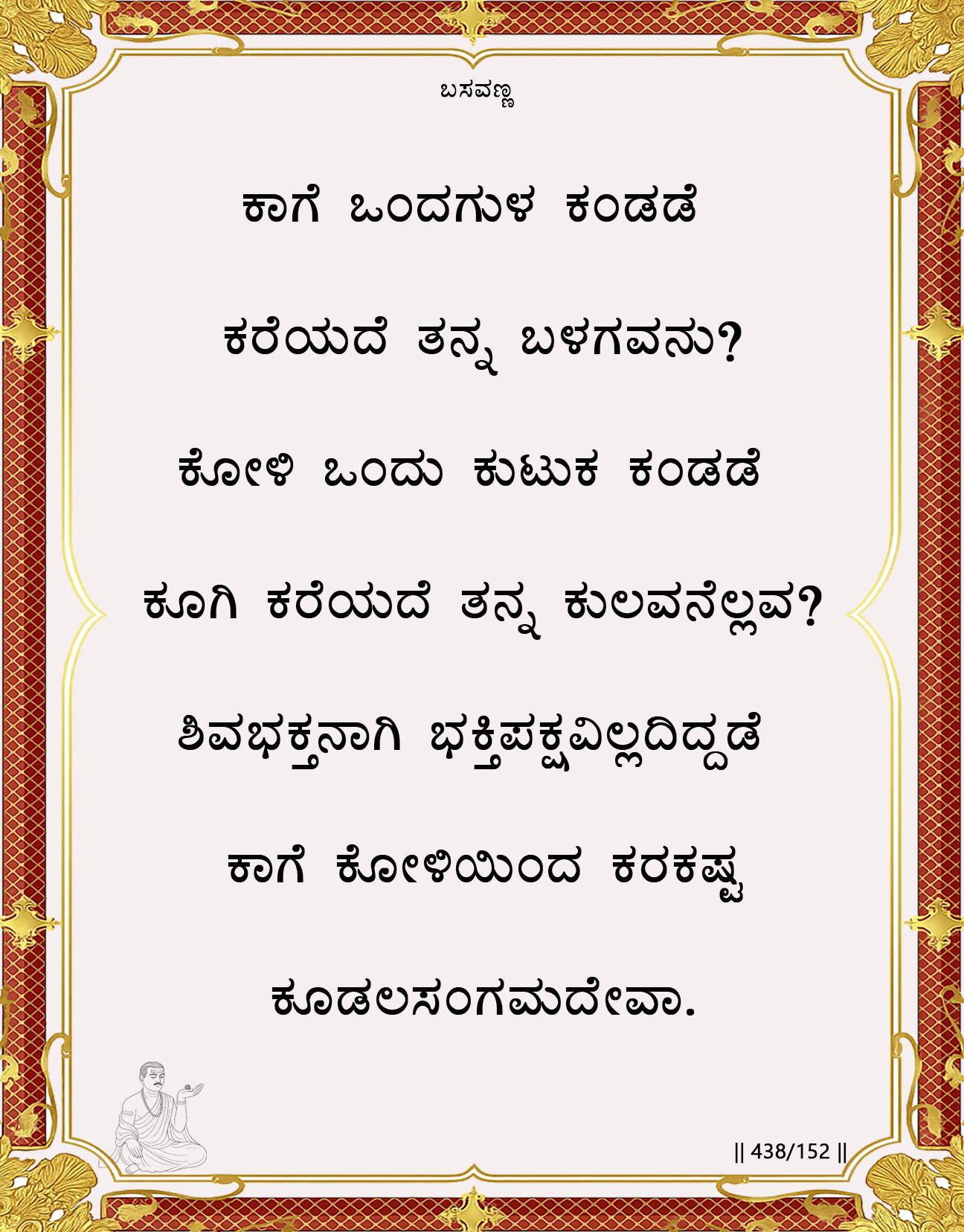
Does not the crow, on finding food,
call out to gather its kin?
Does not the hen, on seeing danger,
cry aloud to shield her chicks?
But the devotee who hoards his joy,
who keeps the taste of Your name
locked in the cage of his own heart
is he not lesser than bird or beast,
O Kudalasangamadeva?
For one who knows You
yet does not share Your grace
has forgotten the very meaning
of devotion.
In this vachana, Basavanna uses simple images from nature to reveal a profound spiritual truth: even the crow and the hen instinctively share and protect their own. A devotee who experiences the presence of Shiva but fails to extend kindness, guidance, or generosity to others is spiritually inferior to these creatures. True devotion (bhakti) must naturally flow outward as compassion and sharing (dasoha). Spiritual knowledge that is hoarded becomes hypocrisy; shared, it becomes grace.
Spiritual Context
Core Spiritual Principle: The authenticity of spiritual experience is validated by its outward flow as compassionate action and shared wisdom. To receive divine grace and not share it is a contradiction that negates the very purpose of devotion.
Cosmic Reality Perspective: In the non-dual system of Lingayoga, the Linga is not a private possession but the universal, all-pervading reality. The individual (Anga) is merely a conduit. To “hoard” the experience is to impose a false sense of ownership and separation on what is inherently communal and boundless. The flow of grace must mimic the flow of the cosmos endlessly giving.
Historical Reality (Anubhava Mantapa Context): This Vachana establishes the core social ethic of the Lingayat community. It directly challenges any tendency toward spiritual elitism or solitary asceticism. It mandates that realization must be socially responsible, transforming the enlightened individual into a public resource for guidance and sustenance, thereby building a truly compassionate and enlightened society.
Interpretation
“Does not the crow… call out to gather its kin?”: The “food” is the sustenance of spiritual insight or the basic necessities of life. The crow’s call represents the innate, natural impulse to share material and spiritual nourishment with the community (Sangha).
“Does not the hen… cry aloud to shield her chicks?”: The “danger” is spiritual ignorance, worldly attachment, or social injustice. The hen’s cry represents the duty of the awakened to protect and guide those who are more vulnerable on the path.
“The devotee who hoards his joy… locked in the cage of his own heart…”: This is the portrait of spiritual failure. The “cage” is the ego, which treats grace as a personal achievement to be guarded. This hoarding stagnates the energy of devotion, turning sweet “joy” into the poison of spiritual pride.
“Has forgotten the very meaning of devotion.”: Basavanna provides the ultimate definition: devotion (Bhakti) is inherently relational and self-effacing. Its meaning is found not in inner feelings alone, but in the outward movement of love and service. To forget to share is to forget to love God.
Practical Implications: The seeker is instructed to use their spiritual practice as a means to become a more compassionate, generous, and helpful presence in the world. The measure of one’s meditation is the depth of one’s kindness. The test of one’s devotion is one’s willingness to serve.
The Cosmic Reality
Anga (Human Dimension): The individual as a potential channel. The Anga is not a reservoir but a riverbed; its purpose is to allow the waters of grace to flow through it to others.
Linga (Divine Principle): Koodalasangamadeva as the infinite source of grace, joy, and protection the “food” and the “safety” that is meant for all.
Jangama (Dynamic Interaction): The act of sharing, calling out, and protecting. This is the true Jangamathe dynamic, compassionate engagement with the world that validates one’s connection to the Linga. The hoarder has a stagnant, non-functional Jangama.
Shatsthala
Primary Sthala: Sharana (The stage of refuge, where the devotee’s life becomes an open vessel for grace, naturally expressing itself in selfless sharing and service to the community).
Supporting Sthala: Bhakta (The stage of devotion, which must mature from personal feeling into the communal offering characteristic of a Sharana).
Practical Integration
Arivu (Awareness Practices): Meditate on the flow of breathreceiving and giving. See your spiritual practice as inhaling grace and exhaling service. Contemplate the ways you might be “hoarding” your peace, time, or knowledge.
Achara (Personal Discipline): Make a conscious vow to share something every daya kind word, a helpful insight, a material resource. Let generosity become your default setting.
Kayaka (Sacred Action): Use your skills and your work to uplift others. Mentor someone, share your knowledge freely, and ensure your labor contributes to the well-being of your community.
Dasoha (Communal Offering): Actively look for opportunities to be the “crow” or the “hen” in your community. Organize sharing, protect the vulnerable, and ensure that the spiritual and material wealth of the Sangha is circulated, not accumulated.
Modern Application
The “self-care” culture turned inward into narcissism; spiritual teachers who commercialize wisdom; the isolation and loneliness of a hyper-individualistic society where people suffer silently, unaware of the support available in community.
This Vachana is a powerful antidote to modern alienation. It calls us to rebuild community based on mutual care and shared spiritual wealth. It challenges the influencer who monetizes enlightenment and validates the simple act of neighborly kindness as the highest spiritual practice. It teaches that our own well-being is inextricably linked to the well-being of all.
Essence
The crow calls out, the hen will warn,
The selfish heart is held in scorn.
For grace received and not made known,
Turns living water into stone.
The Deeper Pattern (The Subtle Body): This Vachana describes the spiritual principle of Open System Thermodynamics. A closed system (the hoarding devotee) eventually succumbs to entropyspiritual stagnation, pride, and isolation. An open system (the sharing devotee) engages in a continuous exchange of energy and information with its environment. The act of sharing (“calling out”) is a negentropic process that creates order, strengthens community bonds, and keeps the spiritual energy of the individual fresh and vibrant. The Linga is the perpetual energy source; the Anga is a transformer, and Dasoha is the current that powers the entire network. To block the current is to cause a system failure.
In Simple Terms (The Gross Body): A candle does not diminish its own flame by lighting another candle. In fact, the first candle’s purpose is fulfilled when its light dispels the darkness for others. The hoarding devotee is like a candle hidden under a bushelit eventually smothers itself. The sharing devotee lights up the entire room, becoming part of a brilliant, collective illumination.
The Human Truth (The Causal Body): Joy multiplies when shared; suffering divides when shared. Your spiritual experience is not truly yours until you have given it away. The deepest fulfillment is found not in what you keep for yourself, but in what you become for others. A life of quiet, solitary bliss is a half-lived life; a life spent amplifying the joy and easing the burdens of those around you is a life that truly sings the name of God.

Views: 5