Poetic Rendering

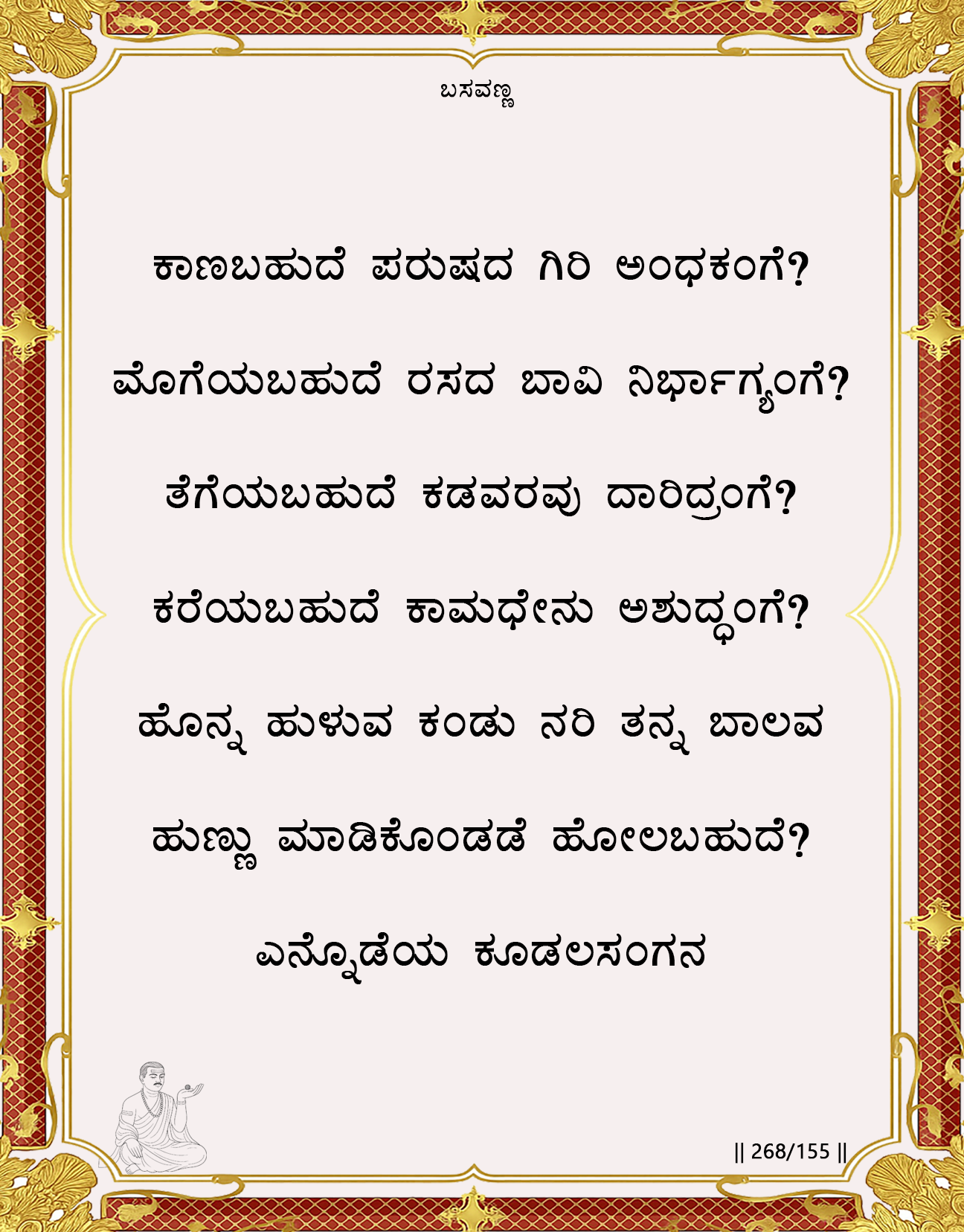
Can the blind behold the mountain
and measure the height of its peak?
Can the nectar of immortality
flow into a heart closed by its own fate-bound beliefs?
How shall he see
the treasure of gold hidden within himself?
How can he draw milk
from the wish-fulfilling cow
when he knows not her true nature?
Like the fox who sees a tree heavy with fruit,
yet hurts its own tail in vain attempts,
and blames the pain instead of its folly
are we any different?
Without the company of true sharanas,
without their grace to open our inner eyes,
how shall we walk beside You,
O Kudalasangamadeva?
This vachana explains that spiritual realization requires inner preparedness. Just as the blind cannot measure a mountain or a foolish fox cannot reach the fruit it desires, the unprepared seeker cannot perceive the divine treasure within. Rigid beliefs, ego, and ignorance act like blindness. Only through the company of realized souls (sharanas)whose grace opens our inner visioncan one recognize the divine within and truly walk the spiritual path. The essence: Without inner clarity and the guidance of enlightened beings, the treasures of spiritual life remain unseen and unreachable.
Spiritual Context
Core Spiritual Principle: Spiritual perception is a faculty that must be awakened. The Divine, though omnipresent, remains invisible to a consciousness clouded by ignorance (avidya) and ego. The grace of a realized being (Guru, Jangama) is the necessary catalyst for this awakening.
Cosmic Reality Perspective: In Lingayoga, the Linga is the ever-present reality, the “mountain” and the “gold.” The individual’s consciousness (Anga) is the “blind” perceiver. The Guru (Jangama) is not an external agent but the manifest expression of the Linga’s own power to reveal itself. They are the lens that corrects the soul’s astigmatic vision.
Historical Reality (Anubhava Mantapa Context): This Vachana establishes the centrality of the Guru-Shishya (Master-Disciple) relationship and the Sangha (community) in the Lingayat path. It validates the role of the Jangama and the enlightened community as living conduits of grace, essential for guiding individuals beyond the limitations of their own conditioned minds.
Interpretation
“Can the blind behold the mountain…?”: The “mountain” is the vast, immovable reality of the Divine. The “blind” is the intellect (buddhi) clouded by ignorance, which cannot perceive spiritual truths no matter how evident they are.
“Can the nectar… flow into a heart closed by fate-bound beliefs?”: “Fate-bound beliefs” (daiva) are the deep-seated samskaras and vasanas that create a rigid, closed identity. This closed vessel cannot receive the “nectar” (amrita) of liberating grace.
“How can he draw milk from the wish-fulfilling cow…?”: The “wish-fulfilling cow” (Kamadhenu) is the heart, the Anahata chakra, which is the source of all spiritual fulfillment. One who does not know how to “milk” itthrough meditation, devotion, and servicewill remain spiritually starved despite sitting next to the source.
“Like the fox… blames the pain instead of its folly…”: The fox symbolizes the ego’s futile and self-destructive efforts to attain fulfillment through worldly means (jumping for fruit). It then blames external circumstances (the tree, the height) for its failure, never its own lack of understanding. This is the plight of the unguided seeker.
Practical Implications: The seeker is urged to humble themselves and actively seek the company of the wise (Satsangha). The primary effort is to become a receptive vessel by cultivating humility, dissolving rigid beliefs, and opening oneself to the transformative grace that flows through the Guru.
The Cosmic Reality
Anga (Human Dimension): The seeker with potential but impaired perceptionthe blind man, the closed heart, the ignorant farmer, the foolish fox.
Linga (Divine Principle): Koodalasangamadeva as the hidden treasure, the mountain, the nectarthe objective reality that is not perceived.
Jangama (Dynamic Interaction): The true Sharana or Guru, who embodies the dynamic function of the Linga. Their presence, words, and grace perform the “surgery” that opens the inner eyes, initiating the transformative connection between the Anga and the Linga.
Shatsthala
Primary Sthala: Bhakta. This Vachana describes the fundamental predicament and need of the Bhakta. It is the stage of recognizing one’s own “blindness” and developing the yearning for a guide and the grace that alone can illuminate the path.
Supporting Sthala: Prasadi. The grace received from the Sharana that opens the inner eyes is the defining characteristic of the Prasadi stage. The Bhakta’s sincere seeking makes them a fit vessel for this grace.
Practical Integration
Arivu (Awareness Practices): Meditate on your own “blind spots.” Contemplate the ways your beliefs and ego might be preventing you from seeing a higher truth. Pray for the grace of inner illumination.
Achara (Personal Discipline): Cultivate humility and openness. Actively seek out books, talks, and most importantly, the company of those who embody wisdom. Practice being a “student” in all situations.
Kayaka (Sacred Action): Offer your service to a true teacher or spiritual community. This service is not menial; it is a way to be near the transformative energy of the Jangama and to learn through humble action.
Dasoha (Communal Offering): Once you have received guidance, become a source of support for other seekers. Help create a nurturing Sangha where the “inner eyes” of all can be opened together.
Modern Application
Spiritual consumerism collecting information from books and the internet without a living guide; the “DIY” approach to enlightenment that ignores the need for transmitted grace and corrective wisdom; intellectual arrogance that believes reading is equivalent to realizing.
This Vachana is a crucial corrective in the information age. It affirms that true knowledge is not informational but transformational, and this requires a living transmission. It guides seekers away from the isolation of solo practice and toward the sacred container of a authentic lineage and community, which is essential for navigating the inner pitfalls of the path.
Essence
The blind eye sees no mountain vast,
The closed heart lets no nectar past.
The Guru’s grace, the seeing eye,
To find the gold for which we sigh.
The Deeper Pattern (The Subtle Body): This Vachana describes the necessity of a Catalytic Agent in the reaction of spiritual awakening. The Anga and the Linga are like two stable chemical compounds that do not react under normal conditions. The seeker’s own efforts are like adding heat or pressure, which often leads to futile activity (the fox). The True Sharana (Jangama) is the enzyme or catalysta substance that is not consumed in the reaction but whose presence alone lowers the activation energy required for the transformation to occur. Their grace reorganizes the seeker’s psychic structure, making the “reaction” of recognition between the individual self and the Divine Self not only possible but spontaneous.
In Simple Terms (The Gross Body): You can have all the ingredients for a firewood, oxygen, and the potential for heatbut without a spark, there is no flame. You can rub sticks together for a long time (self-effort), but a single match (the Guru’s grace) ignites it instantly. Basavanna says: stop exhausting yourself rubbing sticks. Humbly seek the match.
The Human Truth (The Causal Body): We cannot solve a problem with the same mind that created it. Our own ignorance is the very barrier that prevents us from seeing beyond ignorance. Therefore, we need a mirror outside of our own distorted perceptiona wise friend, a true guideto show us who we really are. The greatest wisdom is knowing what you do not know, and the greatest intelligence is seeking the one who can show you.

Views: 15