Poetic Rendering
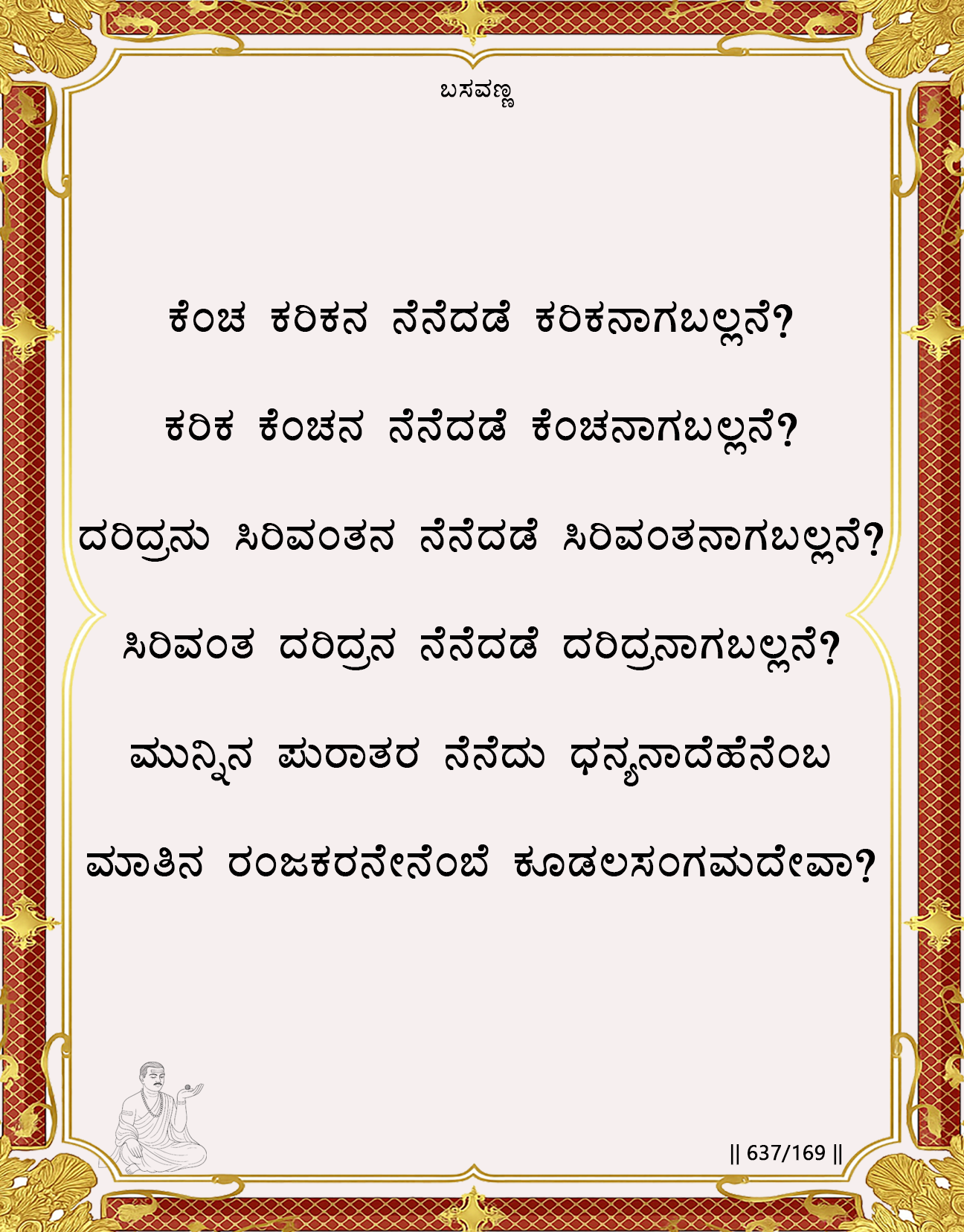
By thinking of the red serpent,
will the black snake turn red?
By recalling the wealthy,
will the poor man become rich?
By remembering a pauper,
will the rich lose his gold?
If memory alone cannot change the nature of things,
how can past lineage make me blessed today?
O Kudalasangamadeva,
I reject this empty boasting
mere claims without inner truth.
This vachana teaches that true spiritual worth cannot be inherited, borrowed, or claimed through association. Just as a snake does not change color by imagining another, and poverty does not vanish by thinking of wealth, merely recalling ancestry, tradition, or divine lineage does not transform one’s inner state. Basavanna rejects empty claims of spiritual status rooted in birth or family prestige, insisting that only authentic inner practice and lived realization carry value. For him, spirituality is personal transformation, not inherited privilege, and any boast without inner change is meaningless before Kudalasangamadeva.
Spiritual Context
Core Spiritual Principle: The Law of Authentic Causality. Spiritual state is a direct effect of present consciousness and practice, not of memory, association, or inheritance. Reality is non-transferable; one cannot live off the spiritual capital of another. Grace responds to what you are, not what you claim to be.
Cosmic Reality Perspective: This vachana highlights the absolute immediacy of the Shiva-Shakti relationship. Shiva (as pure consciousness) perceives only the current vibrational state of Shakti (the individual soul). If Shakti is identified with a borrowed, conceptual identity (lineage), it is not in its true state and cannot resonate with Shiva. The union requires the authentic, unadorned presence of the seeker.
Historical Reality (Anubhava Mantapa Context): This is a direct and logical extension of Basavanna’s war on caste and hereditary privilege. It attacks the very mechanism of Brahminical authority, which relied on the “spiritual capital” of birth (janma) and lineage (gotra). Basavanna declares this currency worthless in the divine economy. In the Anubhava Mantapa, your seat was earned by your realization (anubhava), not your pedigree.
Interpretation
“By thinking of the red serpent, will the black snake turn red?” This addresses the fallacy of essential transformation through thought. Your nature (swabhava) is your nature. Imagining yourself to be something else is a cognitive error that leaves your fundamental being unchanged.
“By recalling the wealthy, will the poor man become rich?” This addresses the fallacy of transferred merit. The spiritual wealth of a sage or an ancestor is their own; recalling it does not deposit it into your account. Poverty or richness of spirit is an internal condition.
“If memory alone cannot change the nature of things, how can past lineage make me blessed today?” This is the logical conclusion. Lineage is a story, a memory. If memory cannot change the color of a snake or the wealth of a man, it cannot change your spiritual status. Blessing (anugraha) is a present-moment event, contingent on present-moment qualifications.
Practical Implications: The practitioner must focus all energy on generating their own spiritual “wealth” through sincere practice. Time spent boasting of one’s guru, lineage, or community is time stolen from the actual work of self-purification and devotion.
The Cosmic Reality
Anga (Human Dimension): The Anga is the actual, present-moment entity that must be worked upon. It is the “black snake” or the “poor man” in its current state. Its transformation requires direct action (sadhana), not indirect recollection.
Linga (Divine Principle): The Linga is the ultimate arbiter of truth, perceiving only the raw, unvarnished reality of the Anga. It is not impressed by resumes or genealogies. It responds to the authentic cry of the heart and the genuine light of realization, here and now.
Jangama (Dynamic Interaction): The true Jangama is the dynamic process of the “black snake” undertaking the disciplines to actually become red, or the “poor man” engaging in “sacred work” (Kayaka) to actually generate wealth. It is the movement from a state of lack to a state of fulfillment through direct, personal effort and grace.
Shata Sthala
Primary Sthala: Bhakta (Devotee) The vachana defines the authentic Bhakta as one who understands this principle. A true devotee does not rest on the laurels of their tradition but is passionately engaged in the personal, often difficult, work of becoming a worthy vessel for grace.
Supporting Sthala: Prasadi (Recipient of Grace) The vachana clarifies that one becomes a Prasadi not by association but by meeting the conditions for grace through authentic self-preparation. Grace fills the vessel that has been cleaned and made ready by its own effort.
Practical Integration
Arivu (Awareness Practices): Cultivate fierce self-honesty. Constantly watch for moments where you derive a sense of spiritual status from your associationsyour teacher’s fame, your tradition’s antiquity, your family’s piety. See these as the “black snake thinking of the red one,” and return your focus to your own immediate state of awareness.
Achara (Personal Discipline): Let your discipline be intensely personal and present-focused. Your practice is for the transformation of this mind, this heart, right now. Reject any discipline performed for external validation or to uphold a familial or communal image.
Kayaka (Sacred Action): Let your work be the primary means of generating authentic spiritual worth. The dignity and integrity you bring to your labor is the “wealth” you actually create. It cannot be borrowed or inherited.
Dasoha (Communal Offering): In community, value and celebrate individuals for their authentic qualitiestheir kindness, their wisdom, their servicenot for their titles, lineage, or who they know. Foster a culture where real merit is recognized over inherited status.
Modern Application
We live in an age of “name-dropping” and credentialism, which has seeped into spirituality. People often define their spiritual identity by the famous guru they’ve met, the expensive retreat they’ve attended, or the ancient tradition they’ve joined. This leads to a culture of spiritual materialism where the appearance of depth is mistaken for depth itself, and personal transformation is neglected.
This vachana is a powerful call to spiritual authenticity and self-reliance. It liberates us from the need to borrow legitimacy from external sources. It empowers the individual, stating that the only thing that truly matters is the sincere work you do on yourself. Your path is valid not because of its label, but because of the authenticity with which you walk it.
Essence
Think of red, the black stays black.
Dream of gold, it won’t fill your sack.
A borrowed name, a claimed line,
Can’t make your soul with the Divine align.
So burn the resume, still the boast,
And make your inner self the host.
The Deeper Pattern: This vachana describes the principle of locality in spiritual mechanics. Just as in physics, you cannot affect a local system (your consciousness) by non-local information (a memory of lineage) without a mediating force or interaction. The only forces that can transform your local spiritual state are your own present-moment practices (sadhana) and the direct, non-local grace of the Divine, which operates outside of linear causality.
In Simple Terms: It is the difference between looking at a picture of a sun-drenched beach and actually lying on the sand feeling the sun’s warmth. The picture (the claim of lineage) provides information about warmth, but it generates no heat. Only by placing your own body (your consciousness) directly in the sun (engaging in practice and opening to grace) will you actually feel the transformative warmth. The Human Truth: The universal human tendency is to seek shortcuts and to bask in reflected glory. It is easier to talk about the greatness of our tradition than to embody a fraction of that greatness ourselves. The timeless truth here is that there are no proxies for personal realization. The spiritual journey is utterly non-transferable. Your liberation is a do-it-yourself project, and its only valid currency is the authentic gold of your own transformed being.

Views: 4