
Summary
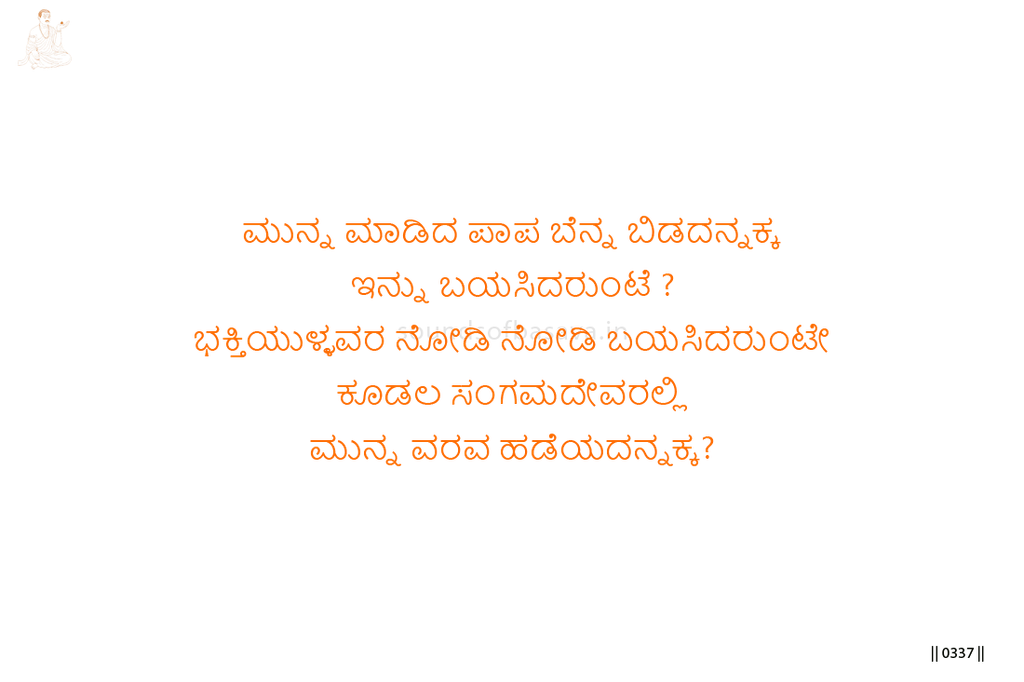
In this vachana, Basavanna asks whether longing can become fruitful while the burden of former sin still follows. The speaker does not deny desire for devotion. He sees the devotees, longs as they long, and feels drawn toward their condition. Yet he questions whether such longing can ripen if what was done before has not fallen away.
The teaching turns on the difference between desire and grace. Seeing devotees may awaken longing, but longing itself does not guarantee realization. Before Kudalasangama Deva, Basavanna asks whether the seeker can truly attain what he desires without first receiving the Divine boon.
Imagery & Symbolic Relevance
The first image is former sin following behind. Basavanna presents past action not as something left behind, but as something that continues to accompany the speaker. It remains near, like a burden that has not released its hold.
The second image is desire arising after seeing devotees. The speaker does not desire in isolation. He sees those who possess devotion and longs for that state. This image shows both attraction and comparison: the devotee becomes visible, and the speaker recognizes what he lacks.
The third image is fruitfulness. The question is not whether longing exists, but whether it can bear fruit. Basavanna asks whether desire can mature when the needed grace has not yet been received.
The final appeal to Kudalasangama Deva brings the whole vachana into prayerful honesty. The speaker does not claim readiness. He places the unresolved relation between past sin, present longing, and Divine grace before the Lord.
Lingayoga
In Lingayoga, this vachana shows that longing must be examined. Desire for devotion is not dismissed, but it is not treated as sufficient by itself. The seeker may be moved by seeing devotees, yet the old burden must still be acknowledged.
For Prasadi Sthala, the relevance lies in receiving grace without self-claim. The seeker cannot make longing fruitful by imitation or wish alone. He must receive what only Kudalasangama Deva can give.
Editorial Commentary
The vachana should be read as an honest question, not as despair. Basavanna is not saying that longing for devotion is useless. He is asking whether longing can mature when the inner condition remains burdened by what has not yet fallen away. The phrase “seeing the devotees” is important. The devotees awaken desire in the speaker, but they also reveal his own incompleteness. Their presence becomes a mirror. Basavanna therefore turns to Kudalasangama Deva and asks whether the desired fruit can arise without the prior gift of grace.
Related Vachana
Supporting Vachana
Maheshwara Sthala Vachana 65 — The Cry of the Ego and the Silence of Grace
Maheshwara Vachana 65 supports this vachana by deepening the question of grace. In Vachana 24, Basavanna asks whether longing can bear fruit if the Divine boon has not first been received. In Maheshwara Vachana 65, the seeker similarly recognizes that correctness, effort, and spiritual self-identity cannot compel grace. The support is direct: realization is not secured by desire or practice alone; it depends upon the descent of grace before Kudalasangama Deva.
Advancing Vachana
Pranalingi Sthala Vachana 994 — The Incomprehensible State of the Sharana
Pranalingi Vachana 994 advances this movement by carrying the desire awakened through devotees into the deeper wish to know the state of the Sharanas. In Vachana 24, the speaker sees devotees and longs, while questioning whether such longing can become fruitful without grace. In Vachana 994, that longing matures into a higher recognition: unless one knows the state of Kudalasangama Deva’s Sharanas, all other knowing remains incomplete. Thus the desire for devotion in Prasadi advances into Pranalingi inquiry into the realized Sharana-state.
