

Summary
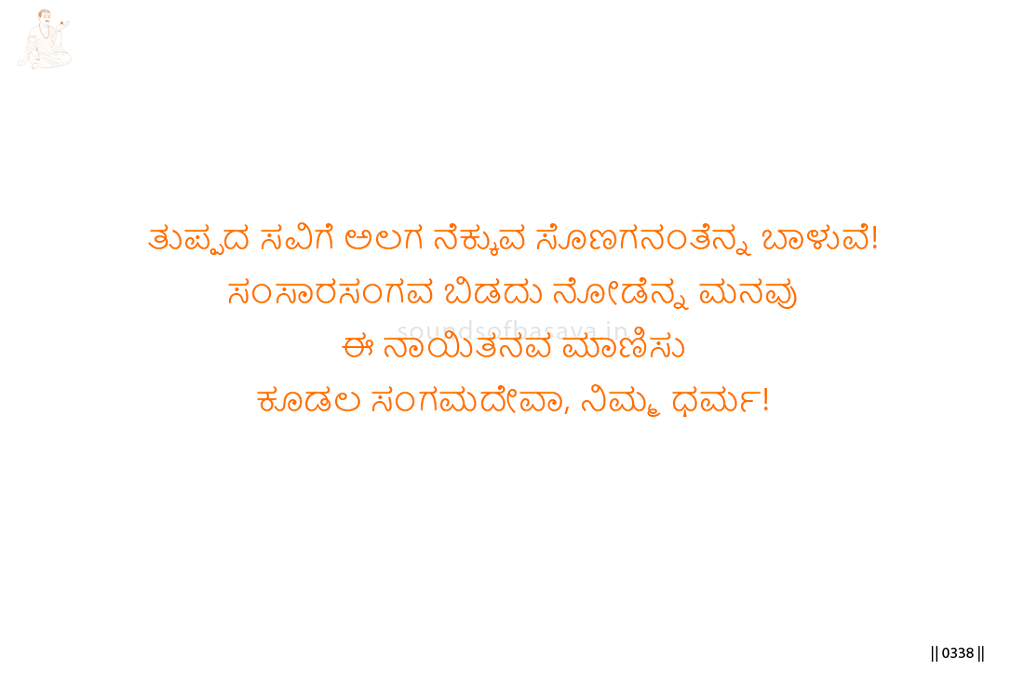
In this vachana, Basavanna compares a dog’s tongue returning again and again to the taste of ghee. The image shows repeated craving, not a single fall. The mind sees the spread of samsara and does not leave it.
The speaker does not conceal this condition. He names it as “dog-nature” and places it before Kudalasangama Deva. The prayer is not for explanation, but for release. Basavanna asks Kudalasangama Deva to remove this craving; that alone is the Divine dharma toward him.
Imagery & Symbolic Relevance
The first image is the dog’s tongue. A dog’s tongue returns instinctively to taste. Basavanna uses this image to show craving as repeated movement. The problem is not only that the mind is attracted once, but that it keeps returning.
The ghee represents sweetness and attraction. It is not shown as something harsh or frightening, but as something pleasant enough to draw the tongue again and again. This makes the bondage subtler: the mind is bound not only by pain, but also by what it enjoys.
The “spread of samsara” is the field toward which the mind keeps moving. The speaker sees that the mind does not leave it. Samsara is therefore not presented merely as an outer world, but as the condition to which the mind repeatedly attaches itself.
The “dog-nature” is the speaker’s own confessed condition. Basavanna does not blame the object alone. He asks that the recurring tendency within him be removed.
Lingayoga
In Lingayoga, this vachana shows the need to see craving as repetition. The mind may know that samsara binds, yet still return to its taste. The danger is therefore not only ignorance, but recurring attraction.
For Prasadi Sthala, the relevance lies in the manner of receiving. What is sweet must not be received through craving. Basavanna asks Kudalasangama Deva to remove the dog-like return to taste, so that the seeker may no longer receive the world through compulsion.
Editorial Commentary
The ghee image is important because it shows why craving continues. The mind returns not because the object is frightening, but because it is pleasing. Basavanna’s honesty lies in recognizing that attraction can become bondage precisely through sweetness.
The prayer “remove this dog-nature” is therefore the heart of the vachana. The speaker does not ask merely to be advised or warned. He asks Kudalasangama Deva to end the recurring tendency itself.
Related Vachana
Supporting Vachana
Maheshwara Sthala Vachana 314 — The Dog Drawn to Foul Stench
Maheshwara Vachana 314 supports this vachana through the same dog imagery of misplaced taste. In Vachana 35, the dog’s tongue returns to ghee, showing repeated craving for the sweetness of samsara. In Vachana 314, the dog drawn toward foul stench cannot know the taste of nectar. Both vachanas expose how repeated attraction conditions the mind and prevents true tasting of Kudalasangama Deva.
Advancing Vachana
Pranalingi Sthala Vachana 359 — The Faithful Dog at the Door of Remembrance
Pranalingi Vachana 359 advances this movement by transforming the dog image from craving into fidelity. In Vachana 35, the dog represents compulsive return to worldly taste. In Vachana 359, Basavanna asks to remain like a faithful dog in the house of remembrance. Thus the dog-nature that must be removed in Prasadi is purified in Pranalingi into unwavering nearness to Kudalasangama Deva.
