

Summary
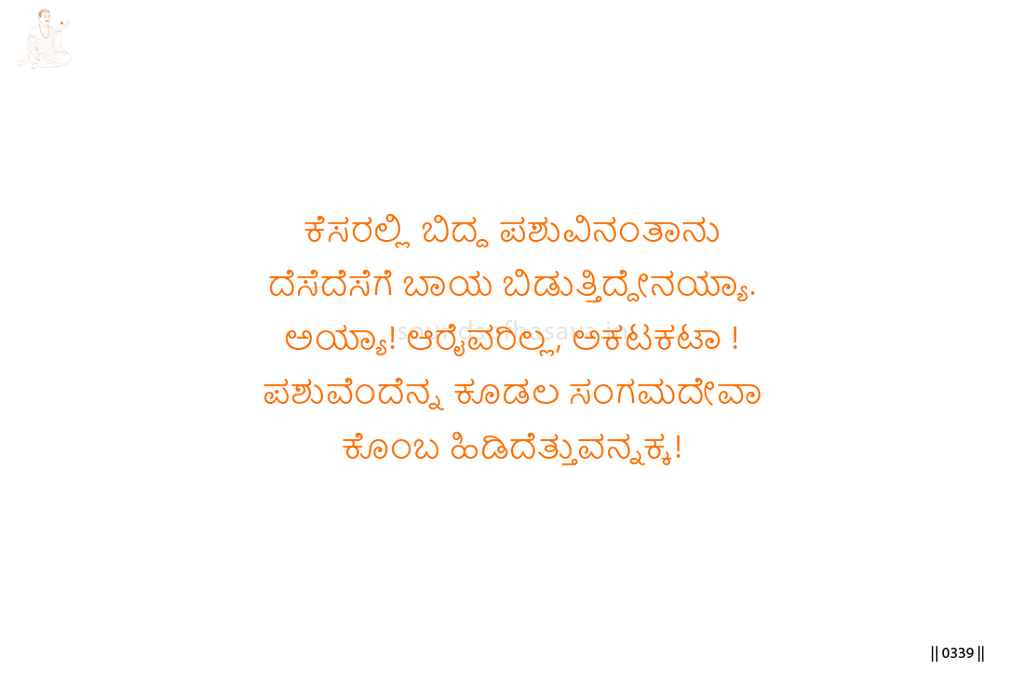
In this vachana, Basavanna compares his condition to a beast fallen in mire. The speaker is caught, unable to rise by himself, and cries out in every direction. The image is one of helpless entrapment rather than ordinary wandering.
The speaker then confesses that there is no one to rescue him. His appeal turns fully toward Kudalasangama Deva. He asks the Lord to take hold of him, like one grasping a beast by the horn and lifting it from the mire.
The teaching is direct: when the seeker is sunk in the mire of becoming, self-effort cannot free him. The need is for Divine intervention. Basavanna places his helpless condition before Kudalasangama Deva and asks to be drawn out.
Imagery & Symbolic Relevance
The first image is the beast fallen in mire. Mire does not merely surround; it holds. A beast caught in it may struggle, but struggle itself does not guarantee release. The image shows a condition where movement continues, yet freedom does not come.
The second image is crying or opening the mouth in every direction. This does not show composed prayer. It shows distress, confusion, and helpless appeal. The speaker is not standing firmly and calling from one place; he is caught and turning everywhere.
The statement that there is no one to rescue intensifies the isolation of the condition. Basavanna does not present human support, social strength, or personal skill as sufficient here. The speaker has reached the point where only Kudalasangama Deva can act.
The final image is being taken by the horn. This is concrete and forceful. The beast cannot lift itself from the mire, but one who has authority over it can take hold and draw it out. Basavanna asks Kudalasangama Deva for that direct intervention.
Lingayoga
In Lingayoga, this vachana shows the limit of self-directed effort when the seeker is already caught in the mire of samsara. The speaker does not describe a method or claim inner steadiness. He admits that he is stuck and unable to release himself.
For Prasadi Sthala, the relevance lies in receiving rescue rather than claiming capacity. The seeker receives his own helplessness truthfully and turns it into appeal. He does not hide the condition, nor does he convert it into spiritual confidence. He asks Kudalasangama Deva to take hold.
Editorial Commentary
The beast-in-mire image should be kept central. It is not merely an image of weakness, but of being caught in a ground that gives no traction. This is why the prayer is not for advice alone, but for being lifted.
The horn image is equally important. It shows that grace is not abstract consolation here. It is the act of being seized, steadied, and drawn out by Kudalasangama Deva when the speaker cannot free himself.
Related Vachana
Supporting Vachana
Maheshwara Sthala Vachana 59 — The Prayer for Sacred Sensory Gates
Maheshwara Vachana 59 supports this vachana by addressing the same danger of scattering in many directions. In Vachana 52, the speaker cries out from the mire, unable to steady himself or find rescue. In Maheshwara Vachana 59, Basavanna prays not to wander here and there, not to look or hear what pulls him away, and asks Kudalasangama Deva to hold him near the feet of the Sharanas. The support is direct: scattered movement must be restrained by Divine holding.
Advancing Vachana
Pranalingi Sthala Vachana 837 — The Offering That Is the Mind
Pranalingi Vachana 837 advances this movement by transforming helpless scattering into gathered inward offering. In Vachana 52, the speaker is like a beast in mire, crying in all directions and asking Kudalasangama Deva to take hold. In Vachana 837, the mind itself becomes the true vessel for the Linga, and the life-force is not allowed to scatter. Thus the helpless plea of Prasadi advances into Pranalingi steadiness, where what was dispersed is gathered and offered wholly to Kudalasangama Deva.
