
Summary
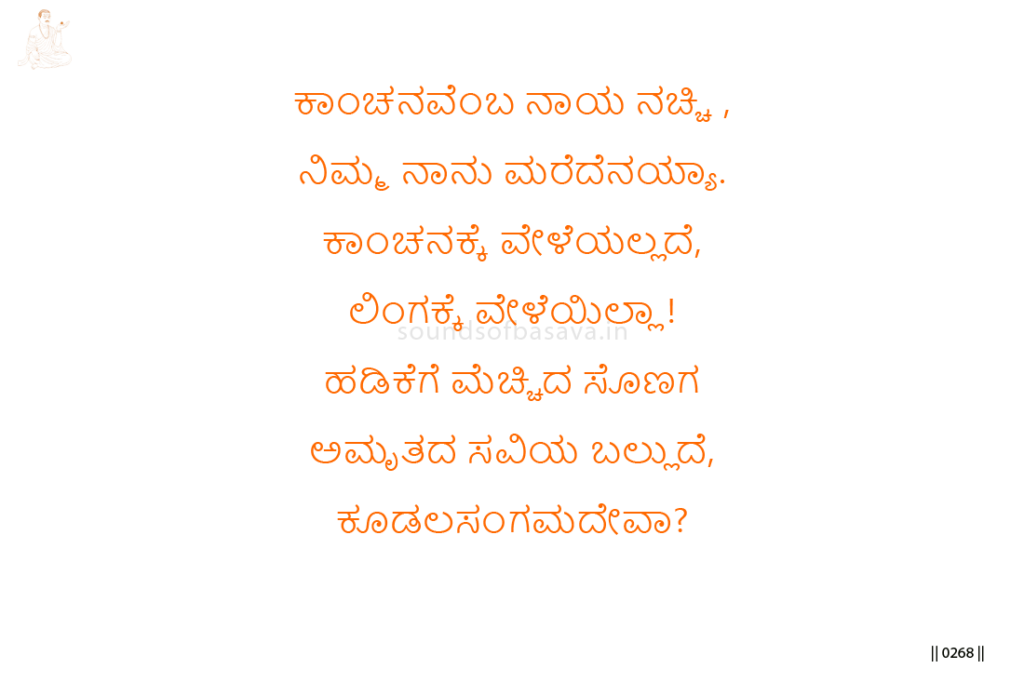
In this vachana, Basavanna confesses that the illusion of gold pulled him like a dog toward wealth, and in that pull he forgot Kudalasangama Deva. The fault is not merely the existence of gold, but the mind’s low attachment to it.
He then names the practical sign of this forgetfulness: there was time for gold, but no time for Linga. What the mind valued received attention; what should have been central was neglected.
The final image is severe. A dog attached to foul smell cannot know the taste of nectar. In the same way, a mind drawn by the illusion of wealth cannot taste the sweetness of Linga.
Imagery & Symbolic Relevance
The first image is the illusion of gold pulling like a dog. The seeker is not shown as master of wealth, but as one dragged by the attachment it creates.
The second image is forgetting Kudalasangama Deva. The danger of wealth-attachment is that it displaces remembrance.
The third image is time for gold. Time reveals value. The seeker makes room for what the mind desires.
The fourth image is no time for Linga. This exposes the inward disorder. Linga is neglected not because time is absent, but because attention has been captured elsewhere.
The fifth image is the dog drawn to foul smell. The dog’s taste is conditioned by what it seeks. It runs toward what is low and cannot receive what is higher.
The final image is the taste of nectar. Nectar represents the sweetness that cannot be known by one whose taste has been degraded by lower attachment.
Together, these images show how wealth-illusion changes the direction of the seeker. The mind is pulled toward gold, forgets Kudalasangama Deva, gives time to wealth, neglects Linga, and loses the capacity to taste nectar.
Lingayoga
In Lingayoga, this vachana tests the direction of attention. The seeker may speak of Linga, but if time and energy are spent on wealth, the practice has already been displaced.
The issue is not wealth as an object alone. The danger is the illusion that pulls the mind toward wealth like a dog and trains it away from remembrance.
The practical movement here is reordering of time and taste. Basavanna asks the seeker to see what the mind is actually following: the pull of gold, or the Linga.
Editorial Commentary
This vachana should be read as a warning about misdirected attraction. Basavanna does not merely condemn gold. He exposes the illusion that makes the seeker run after gold like a dog drawn by a lower scent.
The line about time is important. Attachment is revealed by time. If there is always time for gold and no time for Linga, the seeker’s real orientation has already been disclosed.
The dog and nectar image clarifies the condition of spiritual taste. A dog accustomed to foul smell cannot recognize nectar. Likewise, a mind trained by wealth-attachment loses sensitivity to the sweetness of Linga. The problem is not that nectar is absent, but that taste has been degraded.
Basavanna’s confession therefore turns the reader inward. What the mind repeatedly follows becomes what it is able to taste. If the mind is pulled toward gold, Linga-remembrance weakens. If the mind returns to Linga, the capacity to taste nectar can be restored.
Related Vachana
Supporting Vachana
Bhakta Sthala Vachana 34 — The Restless Monkey and the Plea for Grace
Bhakta Sthala Vachana 34 supports this vachana by showing the mind pulled downward like a dog that leaps toward scraps and runs toward the senses, unable to remain in Kudalasangama Deva. Vachana 314 carries the same movement into attachment to gold: the seeker is pulled by the illusion of wealth, forgets Kudalasangama Deva, and loses time for Linga.
Advancing Vachana
Prasadi Sthala Vachana 507 — Free of All Wanting
Prasadi Sthala Vachana 507 advances this movement by showing the correction to wealth-centered attachment. Vachana 314 shows the mind captured by the illusion of gold and unable to taste nectar. Vachana 507 carries this into Prasadi Sthala, where sacred action becomes pure only when desire, return-seeking, and inward claim fall away before Kudalasangama Deva.
