
Summary
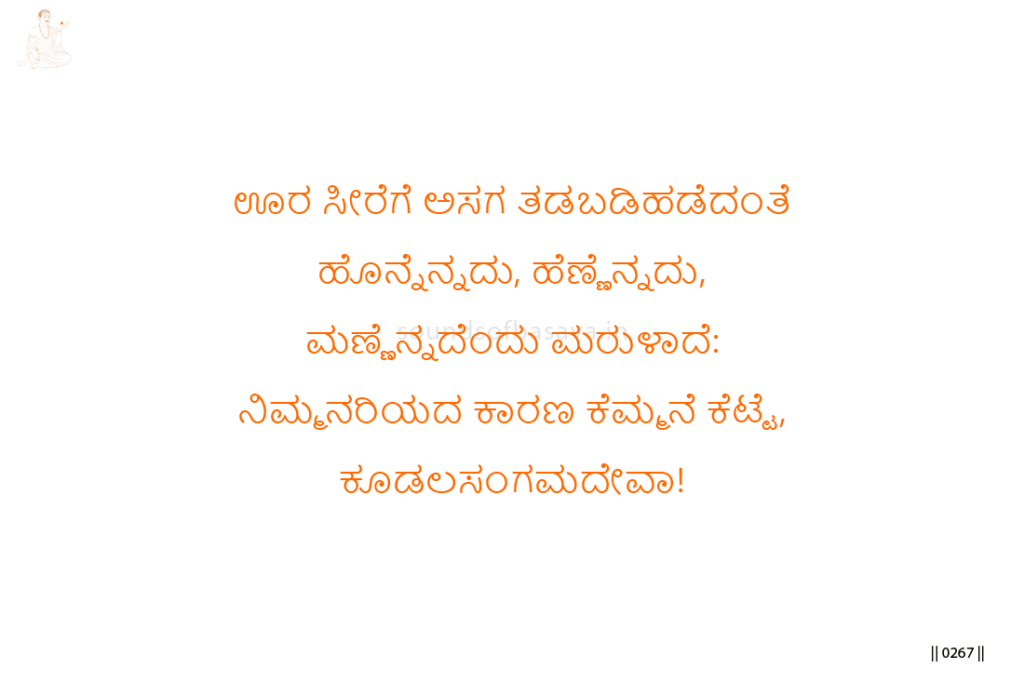
In this vachana, Basavanna compares himself to a washerman beating clothes that are not his own. The action is intense, but the cloth does not belong to him.
He then names the attachments that carried him into delusion: gold, woman, and land. Wealth, sensual attachment, and possession made him foolish.
Before Kudalasangama Deva, he confesses the cause: because he did not know Him, he was ruined. The teaching is direct: one exhausts oneself over what cannot truly be possessed when the Divine is not known.
Imagery & Symbolic Relevance
The first image is the washerman beating clothes. The washerman works hard upon garments, yet they are not his own. Basavanna uses this image to show wasted effort upon what does not finally belong to the seeker.
The second image is gold. Gold represents wealth, accumulation, and the attraction of possession.
The third image is woman. Here it represents sensual attachment and the pull of desire.
The fourth image is land. Land represents ownership, territory, and the claim of possession.
The fifth image is delusion. Basavanna says he became foolish over these things. The objects themselves are not praised; the attachment to them is exposed.
The final image is not knowing Kudalasangama Deva. This is the root of the fall. Because the true source was not known, the mind ran after gold, woman, and land.
Together, these images show misdirected effort. Like the washerman beating clothes that are not his own, the seeker spends himself on wealth, desire, and possession, and becomes ruined through not knowing Kudalasangama Deva.
Lingayoga
In Lingayoga, this vachana tests where the seeker’s attention and effort are being spent. Practice cannot mature if the mind remains absorbed in wealth, desire, and ownership.
The body may work, the mind may plan, and life may be spent in pursuit, but if the pursuit is for what cannot truly be held, the path turns outward.
The practical movement here is recognition of misdirected effort. Basavanna asks the seeker to see the exhaustion of attachment and return to the knowing of Kudalasangama Deva.
Editorial Commentary
This vachana is not a general rejection of the world. Its force lies in the illusion of ownership. The washerman’s labor is real, but the garment is not his; likewise, the seeker’s effort may be intense, yet gold, sensual attachment, and land cannot become lasting possession.
The three attachments are important because they cover the main fields of worldly claim: wealth, desire, and ownership. Basavanna’s confession shows that the deeper problem is not merely touching these fields, but becoming deluded by them while Kudalasangama Deva remains unknown.
The vachana therefore corrects misplaced seriousness. The seeker has treated passing things as though they were final. True correction begins when the mind recognizes that it has spent itself on what cannot remain its own.
Related Vachana
Supporting Vachana
Bhakta Sthala Vachana 165 — The Unshakable Rank
Bhakta Sthala Vachana 165 supports this vachana by warning that time passes, moonlight changes, and wealth does not remain steady. Vachana 310 carries that warning into Maheshwara Sthala through the image of the washerman and the attachments to gold, woman, and land. Both vachanas turn the seeker away from unstable supports and toward Kudalasangama Deva.
Advancing Vachana
Prasadi Sthala Vachana 507 — Free of All Wanting
Prasadi Sthala Vachana 507 advances this movement by showing the correction to the delusion exposed in Vachana 310. Vachana 310 shows the seeker ruined by attachment to gold, woman, and land because Kudalasangama Deva is not known. Vachana 507 carries this into Prasadi Sthala, where desire, return-seeking, and inward claim fall away, and purity arises through action free from wanting.
