Poetic Rendering

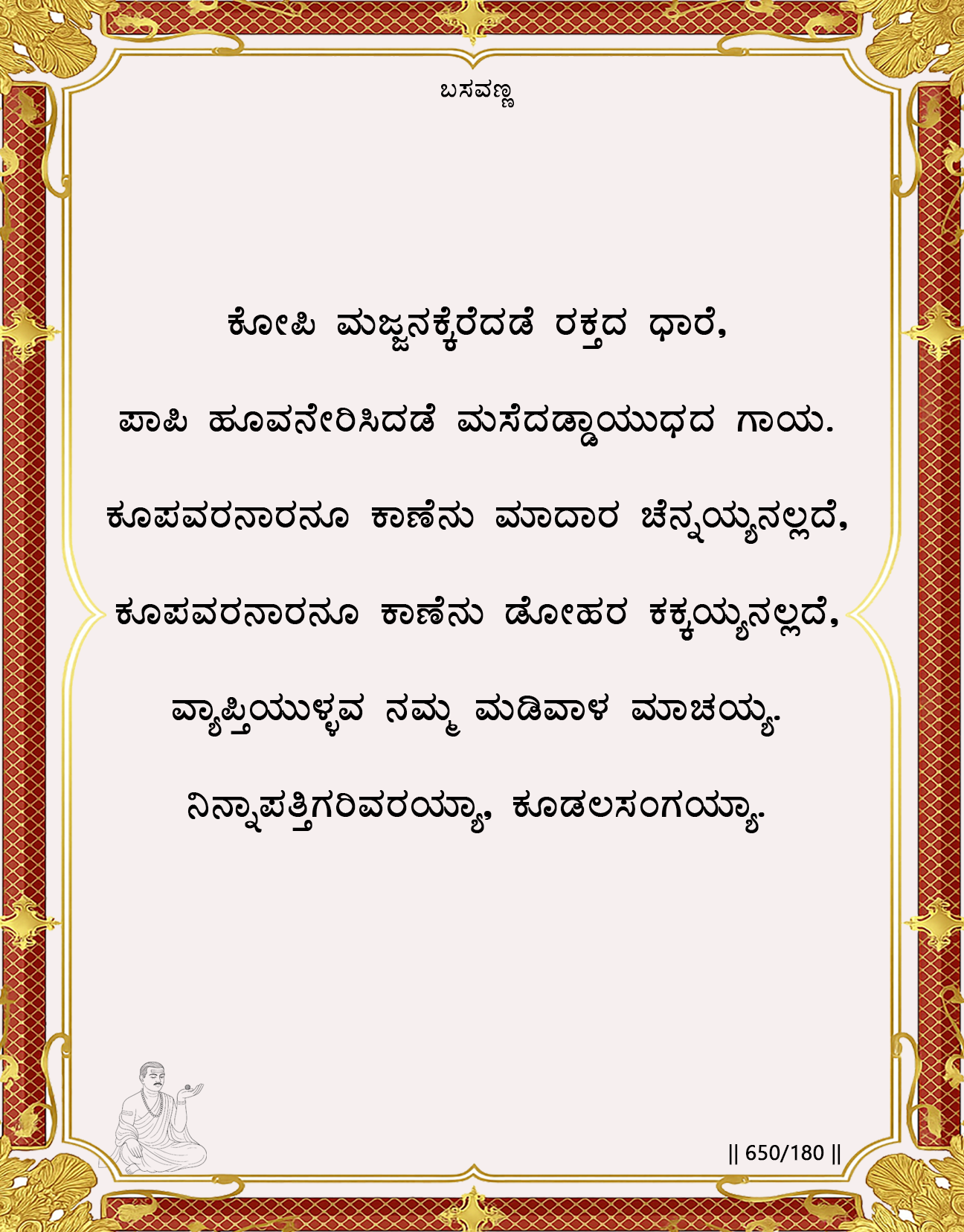
If a man with anger burning in his heart
pours water upon the Linga,
it is like blood dripping from an open wound.
If one steeped in sin offers a flower,
it is like striking the Linga
and leaving a scar upon its face.
But the one who has conquered anger
that is sharana Chennayya.
The one who has conquered anger
that is sharana Dohara Kakkayya.
And the one who has mastered intimacy,
compassion in every relationship
that is sharana Madiwala Machayya.
Only such sharanas,
pure in heart and free from inner violence,
can truly understand the suffering
seen and unseen
of the companions of Kudalasangama.
Basavanna teaches that when the mind is turbulent, even the holiest action becomes impure. Water offered with anger feels like blood to the divine; flowers offered with sin become blows instead of worship. He then points to three great sharanas Chennayya, Dohara Kakkayya, and Madiwala Machayya whose inner purity, humility, and compassion make their devotion authentic. Such souls, free from inner conflict, are the ones capable of understanding and supporting the visible and invisible burdens of the devotees of Kudalasangama.
Spiritual Context
Core Spiritual Principle: The primacy of bhava (inner feeling) over dravya (external substance). The essence of worship is the consciousness behind the act. A disturbed mind pollutes the most sacred ritual, while a purified mind sanctifies even the most mundane action. The ultimate offering is not an object, but a transformed self.
Cosmic Reality Perspective: This vachana describes the vibrational nature of the Shiva-Shakti relationship. Shiva (Linga) is pure consciousness. When Shakti (the individual’s energy) is agitated (angry, sinful), its vibrational offering is dissonant and jarring. When Shakti is calm, compassionate, and integrated, its vibration is harmonious and unifying. The vachana states that God “feels” the offering as the devotee feels it in their heart.
Historical Reality (Anubhava Mantapa Context): This vachana serves as a crucial qualifier for the Lingayoga community’s radical social inclusivity. While the Linga was given to all, this teaching ensures that the community’s spiritual integrity is maintained by valuing inner transformation above mere initiation. It holds up specific historical sharanas as living benchmarks, providing tangible ideals of conductconquering anger, humble service, and compassionate intimacyfor all members to aspire to.
Interpretation
“If a man with anger… pours water… it is like blood…” Anger (krodha) is a destructive, fiery energy. When this energy infuses an act of cooling, nurturing offering (water), it inverts its nature. The offering carries the energy of the giver, not just the substance.
“If one steeped in sin offers a flower, it is like striking the Linga…” Sin (papa) here implies a consciousness of separation, greed, or harm. A flower is a symbol of beauty, openness, and surrender. When offered from a closed, selfish heart, the gesture becomes a hypocrisy that is experienced as an assault.
“But the one who has conquered anger that is sharana Chennayya…” By naming specific sharanas, Basavanna makes the ideal concrete and achievable. “Conquering anger” is not an abstract concept but the lived reality of a community elder. It represents the state where the ego’s reactive nature has been subdued.
“The one who has mastered intimacy, compassion in every relationshipthat is sharana Madiwala Machayya.” This defines the positive quality that replaces the negative. “Intimacy” (sambandha) here means seeing the divine connection in all relationships. “Compassion” is the active expression of that recognition.
“Only such sharanas… can truly understand the suffering… of the companions…” A purified consciousness has the clarity and empathy to perceive subtle suffering in others. They form the true supportive core of the spiritual community.
Practical Implications: The practitioner must prioritize inner purification through self-awareness and ethical living. The focus should be on conquering one’s own anger and cultivating compassion, understanding that this inner work is the real worship that makes all other rituals meaningful.
The Cosmic Reality
Anga (Human Dimension): The Anga is the alchemical crucible. When filled with the base metals of anger and sin, it produces toxic offerings. When purified and alloyed with virtues like patience and compassion, it produces the gold of genuine devotion.
Linga (Divine Principle): The Linga is the ultimate touchstone that reveals the true nature of the metal. It cannot be deceived by gilding; it responds only to the authentic substance of the devotee’s heart.
Jangama (Dynamic Interaction): The Jangama is the process of purification itself. It is the dynamic relationship where the devotee, inspired by the examples of the great sharanas, actively works to transform their inner state so that their every interaction with the world and the Divine becomes a true offering.
Shata Sthala
Primary Sthala: Sharana (Total Refuge) The vachana defines the mature Sharana. Taking refuge means offering not just external obedience but one’s entire inner land scape one’s emotions, intentions, and relationships to be purified and aligned with the Divine.
Supporting Sthala: Aikya (Union) The state of the perfected sharanas like Chennayya points toward Aikya. When the inner turbulence of anger and separation is completely stilled, the devotee’s consciousness resonates in perfect harmony with the divine consciousness, achieving a state of union where compassion flows naturally.
Practical Integration
Arivu (Awareness Practices): Before any act of worship or service, perform an “inner scan.” Check for the presence of anger, resentment, or selfish motive. If found, postpone the external act and first work on calming the mind through breath or remembrance.
Achara (Personal Discipline): Make the conquest of anger a central discipline. Practice patience, pause before reacting, and cultivate forgiveness. Study the lives of saints like Chennayya as practical guides.
Kayaka (Sacred Action): Let your work be an offering of compassion. Interact with colleagues and clients with the mindfulness and care exemplified by Madiwala Machayya, seeing the divine in every transaction.
Dasoha (Communal Offering): Value and seek out the company of those who embody these qualities. In your community, celebrate not just scholarly knowledge or ritual proficiency, but above all, the virtues of a peaceful heart and compassionate action.
Modern Application
We live in a culture of performative spirituality and “virtue signaling,” where people often engage in charitable or religious acts for social media validation while harboring inner judgment, competition, or resentment. This leads to inauthenticity and spiritual burnout.
This vachana calls for a spirituality of deep integrity. It liberates us from the pressure to perform and invites us into the more demanding but fulfilling work of inner transformation. It teaches that the greatest service we can offer the world is to become a peaceful, compassionate presence. Our authentic inner state is our most powerful contribution.
Essence
With angry heart, the water poured,
Becomes like blood, by God abhorred.
The sinful hand that gives the flower,
Strikes the Divine with toxic power.
But those who’ve stilled the inner storm,
Can keep all beings safe and warm.
The Deeper Pattern: This vachana describes the quantum principle of observer effect in spirituality. The devotee’s consciousness (the observer’s state) collapses the wave function of the ritual into a specific reality. An angry consciousness collapses the ritual into a reality of “violence.” A compassionate consciousness collapses the same ritual into a reality of “union.” The offering itself is in a superposition of all possible meanings until it is observed (offered) by a consciousness in a specific state.
In Simple Terms: It is the difference between a gifted bottle of wine from a friend who loves you and an identical bottle left on your doorstep by a stalker. The object is the same, but the consciousness behind it defines the reality of the experience one is a gift, the other is a threat. God receives the consciousness, not the object.
The Human Truth: We often focus on the external forms of goodness while neglecting the inner source. We think that saying the right words or doing the right deeds is enough. The timeless truth here is that the universe and God responds to the energy we emit from our core. Our inner world is not a private affair; it is the very substance of our interaction with reality. To change our world, we must first change the quality of our own being.

Views: 7