Poetic Rendering
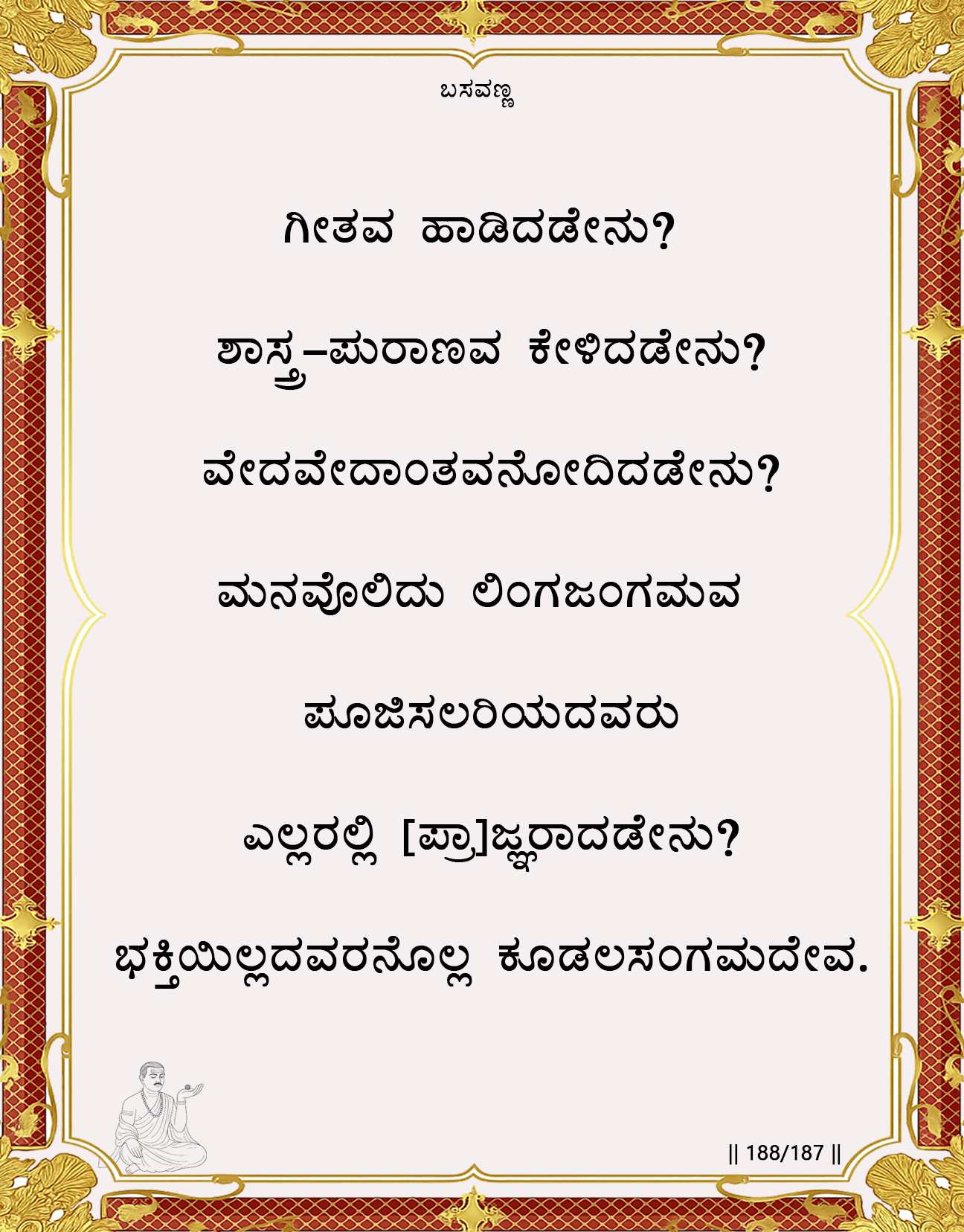
What worth are songs that rise with no soul within?
What worth the chants that echo hollow from the tongue?
Of what use is scripture, read and recited,
when the heart gives no shelter to Linga or Jangama?
Learning without love is but clamor in the air;
ritual without devotion is dust upon the page.
Only the fire of bhakti becomes true knowing
so declares Koodalasangama,
the witness in every heart.
This vachana strikes at the very root of religious conflict and spiritual emptiness. Basavanna exposes how religion, when divorced from authentic devotion, becomes a source of division rather than unity. He systematically deconstructs the external forms of spirituality songs, chants, scriptures to reveal that without the living presence of divine love (bhakti), these become empty shells that breed sectarianism and hypocrisy. The vachana represents the essential Liṅgāyata revolution: the shift from religion as external performance to spirituality as internal transformation.
Spiritual Context
Core Spiritual Principle: Bhakti (devotion) as the soul of religion. All external forms of worship are empty shells unless they are animated by the inner fire of sincere love and surrender. Without this, religion degenerates into sectarian conflict, intellectual pride, and spiritual sterility.
Cosmic Reality Perspective: This vachana describes the dissonance between the form and essence of Shakti. The songs, chants, and rituals are movements of Shakti, but when they are not consciously offered to and united with Shiva (the Linga), they are just chaotic energy (“clamor in the air”). True worship occurs when Shakti’s movement is a conscious flow of love back toward its source.
Historical Reality (Anubhava Mantapa Context): This is the core of Basavanna’s rebellion against Brahminical orthodoxy. He directly challenges the priestly class whose authority was based on mastery of empty ritual and Sanskrit recitation, which was inaccessible to the common person. By declaring that a heartfelt connection to the Linga is the only true qualification, he democratizes spirituality and establishes the Lingayoga path on the foundation of inner experience, not external pedigree or learning.
Expanded Interpretation
“What worth are songs that rise with no soul within?” The “soul” is bhava the feeling of devotion. A song without this is just a sequence of notes, a body without life.
“What worth the chants that echo hollow from the tongue?” This targets mechanical japa or Vedic recitation. The “hollow echo” signifies a lack of the resonant power that comes only when the chant is charged with the chanter’s conscious intent and love.
“Of what use is scripture, read and recited, when the heart gives no shelter to Linga or Jangama?” This is the ultimate indictment of mere scholarship. The “heart” must become a “shelter” a living temple for the divine principle (Linga) and its dynamic expression in the world (Jangama). If it is not, scripture is just “dust upon the page.”
“Only the fire of bhakti becomes true knowing” This is the revolutionary conclusion. Jnana (knowledge) is not intellectual but experiential. It is not acquired but ignited. The “fire of bhakti” is the catalytic force that burns away the ego and reveals the truth of non-dual unity.
Practical Implications: The practitioner must constantly infuse their practices with feeling and presence. The quality of attention and love brought to a five-minute prayer is more important than the mechanical performance of an hour-long ritual. The goal is to make the heart itself the primary site of worship.
The Cosmic Reality
Anga (Human Dimension): The Anga as a “closed shelter” is a fortress of the ego, keeping the Divine out. Its transformation involves opening the doors of the heart so that every song, chant, and action becomes an invitation to the Linga.
Linga (Divine Principle): The Linga is the “witness in every heart.” It is the silent knower that perceives the authenticity of the offering. It is also the “fire of bhakti” it self the divine energy that, when invited, consumes all that is false.
Jangama (Dynamic Interaction): The Jangama is the process of opening the shelter and kindling the fire. It is the dynamic relationship where external form (song, chant) and internal essence (love, devotion) unite, creating a living spirituality that transcends empty ritual.
Shata Sthala
Primary Sthala: Bhakta (Devotee) This vachana is the definitive guide for the Bhakta. It corrects the path away from empty performance and toward the cultivation of genuine, heartfelt devotion as the sole criterion of spiritual progress.
Supporting Sthala: Sharana (Total Refuge) To make the heart a “shelter” for the Linga and Jangama is the very act of taking refuge. The Sharana is one who has moved beyond external religion to offer their entire inner being as a dwelling place for the Divine.
Practical Integration
Arivu (Awareness Practices): Before any spiritual practice, pause and check the “temperature” of your heart. Is it warm with devotion or cold and mechanical? If the latter, spend a few moments in silent remembrance of the Divine until a genuine feeling of connection arises.
Achara (Personal Discipline): Let your primary discipline be the cultivation of a devotional heart. This may mean choosing to sing one bhajan with full feeling rather than reciting a long scriptural passage without attention.
Kayaka (Sacred Action): Infuse your work with the spirit of devotion. See your labor as a service to the Divine present in those you serve, transforming mundane activity into a continuous “shelter” for the Jangama.
Dasoha (Communal Offering): Build a community that prioritizes heartfelt satsang and service over doctrinal debates or ritual one-upmanship. Create an environment where the “fire of bhakti” is valued above all else.
Modern Application
Modern spirituality is often commodified and performative. We see “mindfulness” as a productivity tool, spiritual practices as items on a wellness checklist, and religious identity as a tribal marker for social or political conflict. This leads to a “hollow echo” people going through the motions without any transformative inner experience.
This vachana is the ultimate antidote to spiritual consumerism and religious fundamentalism. It liberates us to pursue a faith that is deeply personal, authentic, and rooted in love. It assures us that we don’t need the right credentials or the perfect ritual; we only need to open our hearts sincerely. This makes true spirituality accessible to everyone, everywhere.
Essence
The song sans soul, the chant sans fire,
The scriptured page, a dead desire.
A heart that’s shut, a hollow rite,
That keeps the Linga from its light.
But one true tear, one loving sigh,
Is all it takes to reach the sky.
The Deeper Pattern: This vachana describes the difference between a system going through a pre-programmed routine and a system engaging in a conscious, real-time communication. Empty religion is like a robot sending pre-written packets of data into the void. True devotion is a live, authenticated connection where the “heart” (the system’s core) opens a port to receive and transmit the data of divine love, creating a two-way, transformative exchange.
In Simple Terms: It is the difference between mailing a pre-printed, mass-produced greeting card and writing a personal, heartfelt letter. The card (empty ritual) has the correct form but carries no personal essence. The letter (sincere bhakti), even if scribbled on scrap paper, carries the true substance of the relationship. God collects the letters, not the greeting cards.
The Human Truth: We are often afraid that we are not “good enough” or “learned enough” for God. We hide behind rituals and doctrines. The timeless truth here is that God does not want our performance; He wants our heart. The most profound spiritual connection is made in the vulnerable, authentic offering of our simple, loving attention. This is the revolution that sets every soul free.
This vachana is humanity’s antidote to religious conflict: “Do not worship words, worship through love. Do not fight in the name of God, live as God’s own.”

Views: 2