

Summary
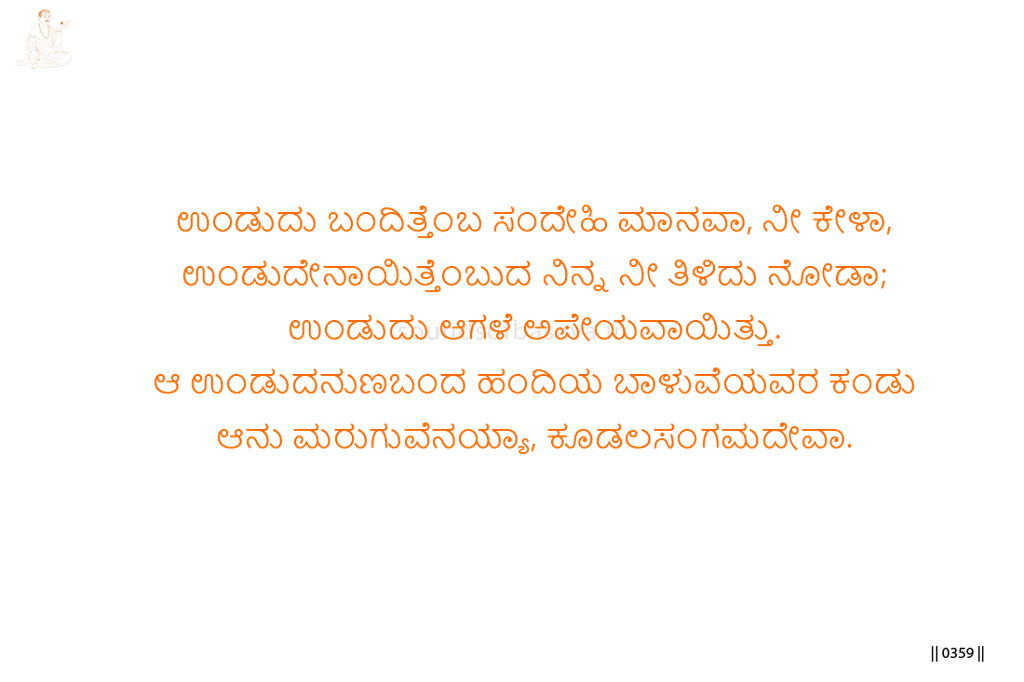
In this vachana, Basavanna addresses the doubtful person who asks whether the experience has come. The answer is not to look outside for confirmation, but to know for oneself. What is truly tasted is self-evident.
Basavanna then says that when it is truly received, it becomes beyond measure. It cannot be weighed, counted, or proved by another. The one who tastes knows; the one who has not tasted remains in question.
The final image is one of grief. Basavanna grieves for those who live around what must be tasted, yet do not taste it. They remain near, but not entered. They circle the experience, speak of it, or ask about it, but the direct knowing has not become their own.
The teaching is direct: in Lingayoga, realization is not borrowed knowledge, outer nearness, or another’s confirmation. It is direct taste. Until it is tasted within, doubt continues; when it is tasted, measurement falls away.
Imagery & Symbolic Relevance
The first image is the doubtful person. Basavanna does not treat doubt as mere intellectual questioning. Here doubt shows distance from direct experience. One who has tasted does not ask whether taste has come.
The second image is self-knowing. “Know for yourself” is central. Taste cannot be transferred by report. Another person may speak of sweetness, but that does not become one’s own taste. The seeker must recognize directly.
The third image is what becomes immeasurable. Once tasted, the experience does not remain an object to be measured. Its certainty is not numerical, social, or verbal. It is known by direct inner contact.
The final image is those who remain around it without tasting. Their condition brings grief. They are close enough to hear, see, and move around the truth, but they have not entered its living essence. Nearness without taste remains incomplete.
Lingayoga
In Lingayoga, this vachana points to direct inner experience. The seeker may hear teachings, observe others, or ask whether realization has come, but these do not replace tasting.
The flavour of Lingayoga here is immediacy. The Linga is not to be known only through question, comparison, or explanation. It must be tasted in one’s own awareness. When this taste arises, the need for outward confirmation ends.
For Prasadi Sthala, the relevance lies in receiving the experience without turning it into claim or measure. What is received from Kudalasangama Deva is known inwardly, not displayed outwardly. The seeker receives the taste and lets doubt fall away.
Editorial Commentary
The word “taste” carries the force of the vachana. Taste is direct, intimate, and non-transferable. No one can taste for another. No one can prove taste to one who refuses to taste. Basavanna uses this image to distinguish direct realization from discussion about realization.
The phrase “know for yourself” sharpens the teaching. Lingayoga is not satisfied with second-hand certainty. The seeker must turn inward and see whether the taste has truly arisen. When it has, it is beyond measure; when it has not, one remains outside, circling what must be entered.
Related Vachana
Supporting Vachana
Maheshwara Sthala Vachana 764 — The Warrior’s Resolve
Maheshwara Vachana 764 supports this vachana by distinguishing nearness from real tasting. In Vachana 200, Basavanna grieves for those who remain around what must be tasted, yet do not taste it. In Maheshwara Vachana 764, the sheep wanders in the sugarcane field but never tastes the sweetness, while the elephant presses the cane and drinks the living essence. The support is direct: spiritual nearness is incomplete unless the essence is actually tasted.
Advancing Vachana
Pranalingi Sthala Vachana 871 — Where Bondage Ends Through Guru’s Grace
Pranalingi Vachana 871 advances this movement by carrying direct taste into stabilized witnessing. In Vachana 200, the doubtful person is told to know for himself, because what is truly tasted becomes beyond measure. In Vachana 871, doubt and determination fall silent through the grace of witnessing, and the seeker no longer depends on sequential measures of practice or attainment. Thus the Prasadi taste beyond measure advances into Pranalingi as steady witnessing in which doubt has no ground before Kudalasangama Deva.
