

Summary
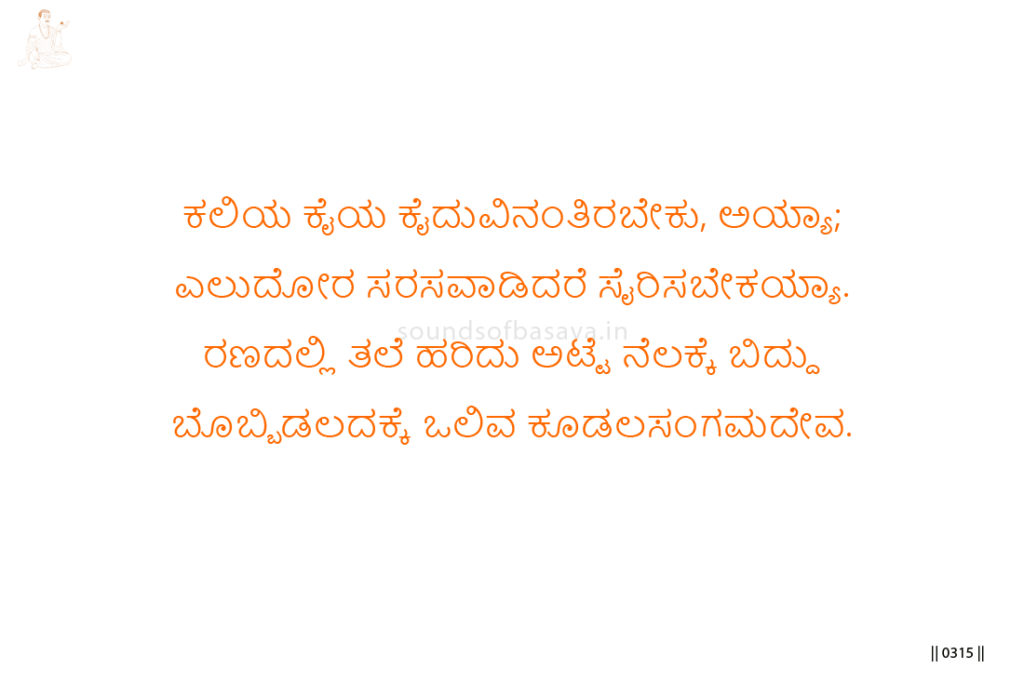
In this vachana, Basavanna prays for the firmness of a warrior’s hand. The seeker must hold to Kudalasangama Deva with the grip and steadiness of one trained for battle.
He then asks for endurance when bones are struck and broken. Devotion must not retreat when pain, fear, or injury arises.
The final image is the battlefield. Even if the head is cut and falls to the ground, the last cry must still be directed to Kudalasangama Deva. The teaching is severe: true devotion remains unbroken even at the point of bodily defeat.
Imagery & Symbolic Relevance
The warrior’s hand is the opening image. It suggests grip, training, steadiness, and readiness. A warrior does not hold loosely in battle; likewise, the seeker must not hold devotion casually.
The breaking of bones gives the next test. Basavanna does not imagine a path without hardship. He asks whether devotion can endure when the body itself is struck.
The battlefield is the field of testing. It should not be read as outward conquest. Its force lies in the exposure of firmness when danger becomes immediate.
The severed head is the strongest image. Even when the body falls and life is at its edge, the final movement must remain toward Kudalasangama Deva.
Together, these images show devotion tested at its most extreme point: the hand must remain firm, the body must endure, and the last cry must not turn elsewhere.
Lingayoga
In Lingayoga, this vachana teaches unbroken remembrance under extreme testing. The seeker must hold to Kudalasangama Deva not only in quiet practice, but also when pain, fear, and loss arise.
The body may be struck, but remembrance must not be severed. The path demands firmness, endurance, and final inward direction.
Practice matures when the last movement of consciousness still turns toward Kudalasangama Deva. Devotion becomes complete when even bodily defeat does not break remembrance.
Editorial Commentary
The battlefield imagery should not be expanded into physical violence or external conquest. Basavanna uses the warrior image to show intensity of resolve.
The key point is the final cry. If the head itself falls, what remains should still call Kudalasangama Deva. The vachana is therefore a teaching on final remembrance, not battle for its own sake.
Related Vachana
Bhakta Sthala Vachana 75 — The Name That Conquers All
Vachana 75 supports this teaching by showing the power of Kudalasangama Deva’s Name. The elephant yields to the goad, the mountain to the thunderbolt, darkness to light, and the forest to fire; the five great sins yield to the Name. Vachana 764 carries this power into the battlefield of testing: even when the body is struck down, the final cry must remain fixed on Kudalasangama Deva.
Advancing Vachana
Prasadi Sthala Vachana 633 — The Broken Spine and the Silent Devotee
Vachana 633 advances this teaching by testing whether strength remains active when trial comes. It asks what value remains if a lion’s spine is broken, an elephant’s trunk is broken, or a warrior trembles in battle. It then applies the same measure to Bhakti: if true-filled devotion does not overflow into steadiness, courage, conduct, and living presence, what is the worth of such company?
Vachana 764 teaches that devotion must remain firm even when the body is struck and the final cry is tested. Vachana 633 carries this into Prasadi Sthala by showing that received Bhakti must become active strength. The movement is from final remembrance under bodily defeat to devotion that does not tremble when tested before Kudalasangama Deva.
