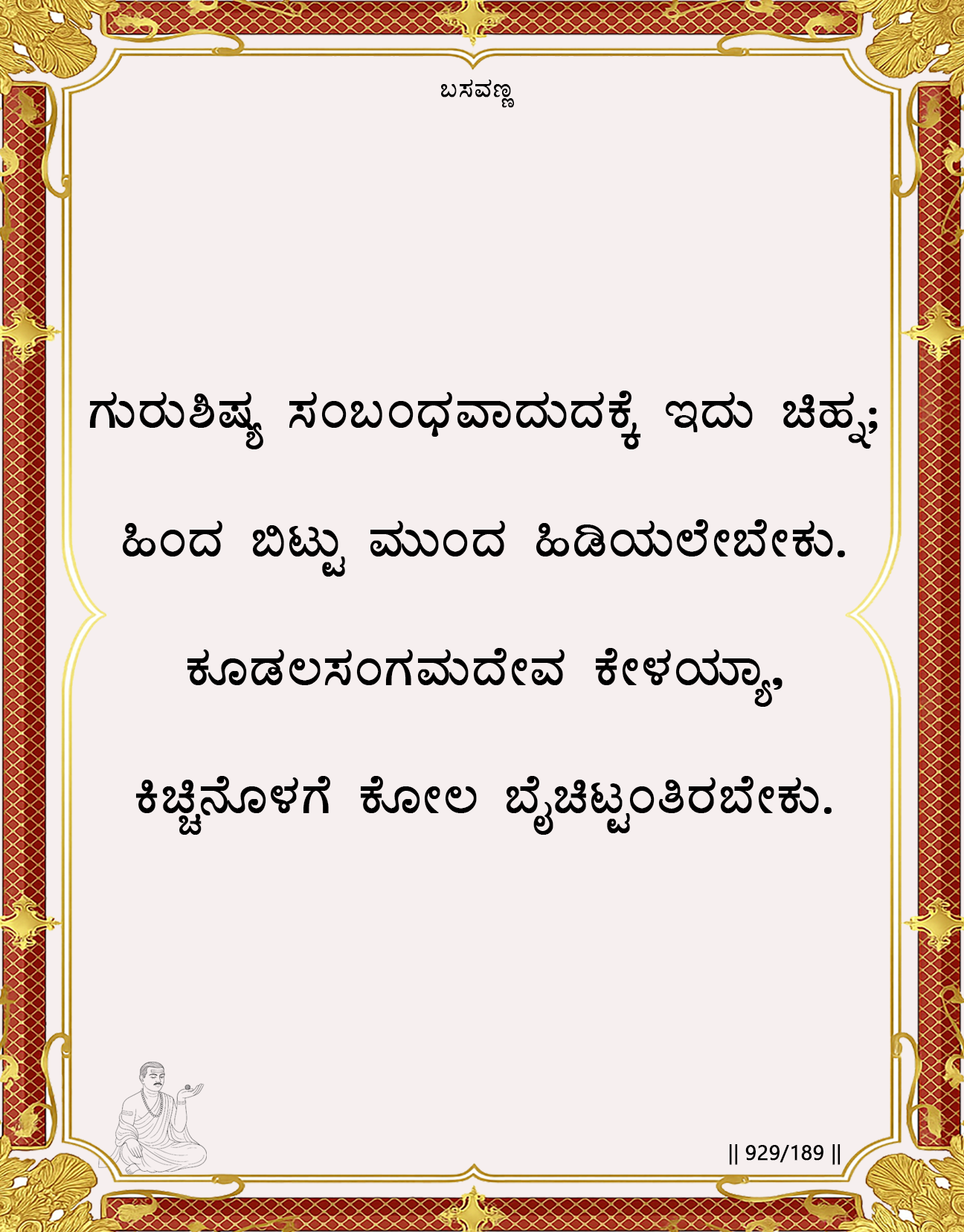
Poetic Rendering

This is the true bond of Guru and disciple
the Guru walks ahead,
leaving the disciple to rise in his own flame.
Hear me, O Kudalasangama!
Like bamboo thrust deep into burning embers,
the Guru too must offer himself
letting every last attachment burn away,
until he becomes one with the fire
from which all light flows.
Basavanna teaches that authentic transmission between Guru and disciple requires detachment and inner strength. The Guru must guide, uplift, and then move forward releasing even the attachment to disciples. Through the metaphor of bamboo placed in fire, Basavanna shows that the Guru must ultimately surrender his identity and relationships to be completely consumed in divine realization. True guidance ends not in possession, but in liberation of both Guru and disciple.
Spiritual Context
Core Spiritual Principle: The Guru’s role is to make the disciple self-reliant, not dependent. The highest teaching is the transmission of autonomy. Furthermore, the true Guru is not a permanent personality but a temporary function that must ultimately dissolve back into the formless source. Any attachment to the role is a final barrier to the Guru’s own liberation.
Cosmic Reality Perspective: This vachana illustrates the final stage of the Shiva-Shakti dynamic from the Guru’s perspective. The Guru is Shakti that has become a conscious conduit for Shiva’s power (the flame). They transmit this power to another Shakti (the disciple). However, for the conduit itself to achieve final union with Shiva, it must be consumed the separate identity of the “conduit” must be burned away in the very fire it carries, leaving only Shiva.
Historical Reality (Anubhava Mantapa Context): This vachana served as a crucial ethical guideline for the teachers and leaders within the Lingayoga movement. It prevented the rise of cults of personality and spiritual authoritarianism. It established that a true Jangama or Guru was one who worked towards their own obsolescence in the disciple’s life, fostering a community of spiritually autonomous individuals rather than dependent followers.
Interpretation
“the Guru walks ahead, leaving the disciple to rise in his own flame.” This defines a non-possessive pedagogy. The Guru provides the spark and the example, but does not hover. The disciple must internalize the teaching and generate their own spiritual heat and light.
“Like bamboo thrust deep into burning embers…” The “bamboo” is the Guru’s individual self, including their identity as a teacher, their attachment to disciples, and their spiritual achievements. The “embers” are the intense fire of divine consciousness.
“the Guru too must offer him selfletting every last attachment burn away…” This is the Guru’s own sadhana. The final attachment to renounce is the egoic identity as “the enlightened one” or “the teacher.” This is the ultimate dasoha (offering).
“until he becomes one with the fire from which all light flows.” The culmination is non-dual unity. The Guru ceases to be a separate entity transmitting the light and becomes the light itself. The distinction between source, channel, and recipient dissolves.
Practical Implications: For a disciple, this means taking responsibility for one’s own awakening and not clinging to the teacher. For a teacher, it means constantly examining one’s motivations, avoiding the trap of spiritual pride, and remembering that one’s highest duty is to point beyond oneself to the formless Divine.
The Cosmic Reality
Anga (Human Dimension): The Anga of the Guru is the “bamboo”a useful, hollow instrument that must ultimately be sacrificed. Its holiness is in its utility and its eventual dissolution.
Linga (Divine Principle): The Linga is the “fire “the impersonal, transformative reality that consumes all forms and identities. It is the sole source of the “light.”
Jangama (Dynamic Interaction): The Jangama is the dual process: the act of the bamboo igniting another substance, and the bamboo itself being consumed. It is the dynamic of teaching and the simultaneous dynamic of the teacher’s self-surrender.
Shata Sthala
Primary Sthala: Aikya (Union) The state of the Guru who has become “one with the fire” is the very definition of Aikya. This is the final stage, where no separation remains.
Supporting Sthala: Maheshwara (Lord of the Cosmic Play) The Guru who skillfully guides disciples and understands the necessity of this entire processigniting, releasing, and self-immolatingoperates from the Maheshwara stage, consciously playing the role of a lord in the cosmic drama of liberation.
Practical Integration
Arivu (Awareness Practices): For anyone in a teaching or guiding role, regularly contemplate: “Am I helping this person find their own inner authority, or am I creating dependency? Am I attached to being seen as their guide?”
Achara (Personal Discipline): For a teacher, the discipline includes the practice of “divine irrelevance” the ability to offer guidance and then step back completely, without needing credit or a specific outcome.
Kayaka (Sacred Action): See mentoring and teaching as a sacred labor whose success is measured by the student’s independence, not their perpetual loyalty.
Dasoha (Communal Offering): The highest Dasoha for a teacher is to offer their own role and identity back to the Divine. The community should honor teachers but also hold them to this standard of fostering freedom, not followers.
Modern Application
The spiritual marketplace is rife with gurus who cultivate dependency, foster personality cults, and are entangled in scandals arising from their attachment to power, money, or disciples. This creates traumatized followers and damages the credibility of genuine spiritual paths.
This vachana provides a clear criterion for discerning a true teacher from a false one. A true teacher empowers you and points beyond themselves. This understanding liberates seekers from unhealthy guru-disciple dynamics and empowers teachers to fulfill their role without ego, ensuring the transmission remains pure and liberating for all involved.
Essence
The Guru walks on, lights the way,
Then steps back to let the flame self-sway.
And as the disciple’s fire grows tall,
The Guru becomes the fuel for all.
So burns the bamboo, fierce and free,
Till only Fire for all to see.
The Deeper Pattern: This vachana describes a perfectly efficient energy transfer and system integration. The Guru is a step-up transformer that receives high-voltage energy from the source (Linga) and makes it usable for the disciple’s system. However, a transformer is not the power plant; it is an intermediary. The ultimate goal is for the disciple’s system to connect directly to the grid. The transformer itself (the Guru) must eventually be bypassed and reconsumed by the grid’s core energy, leaving no residual, separate infrastructure.
In Simple Terms: It is like a parent teaching a child to ride a bike. The parent runs alongside, holding the seat to provide balance and confidence (the transmission). But the true moment of success, for both parent and child, is when the parent lets go, and the child rides on independently. The parent’s joy is in that release, not in perpetual control. The ultimate fulfillment for the parent is in the shared freedom, not in being forever needed as a stabilizer.
The Human Truth: We often confuse love and guidance with control and ownership, in spiritual relationships as in personal ones. The timeless truth here is that the greatest gift one can give is the gift of self-reliance. The most profound teaching ends not in a permanent hierarchy of teacher and student, but in a shared, equal standing in the light of liberation. The true Master’s goal is to create other masters, not eternal disciples.

Views: 4