Poetic Rendering
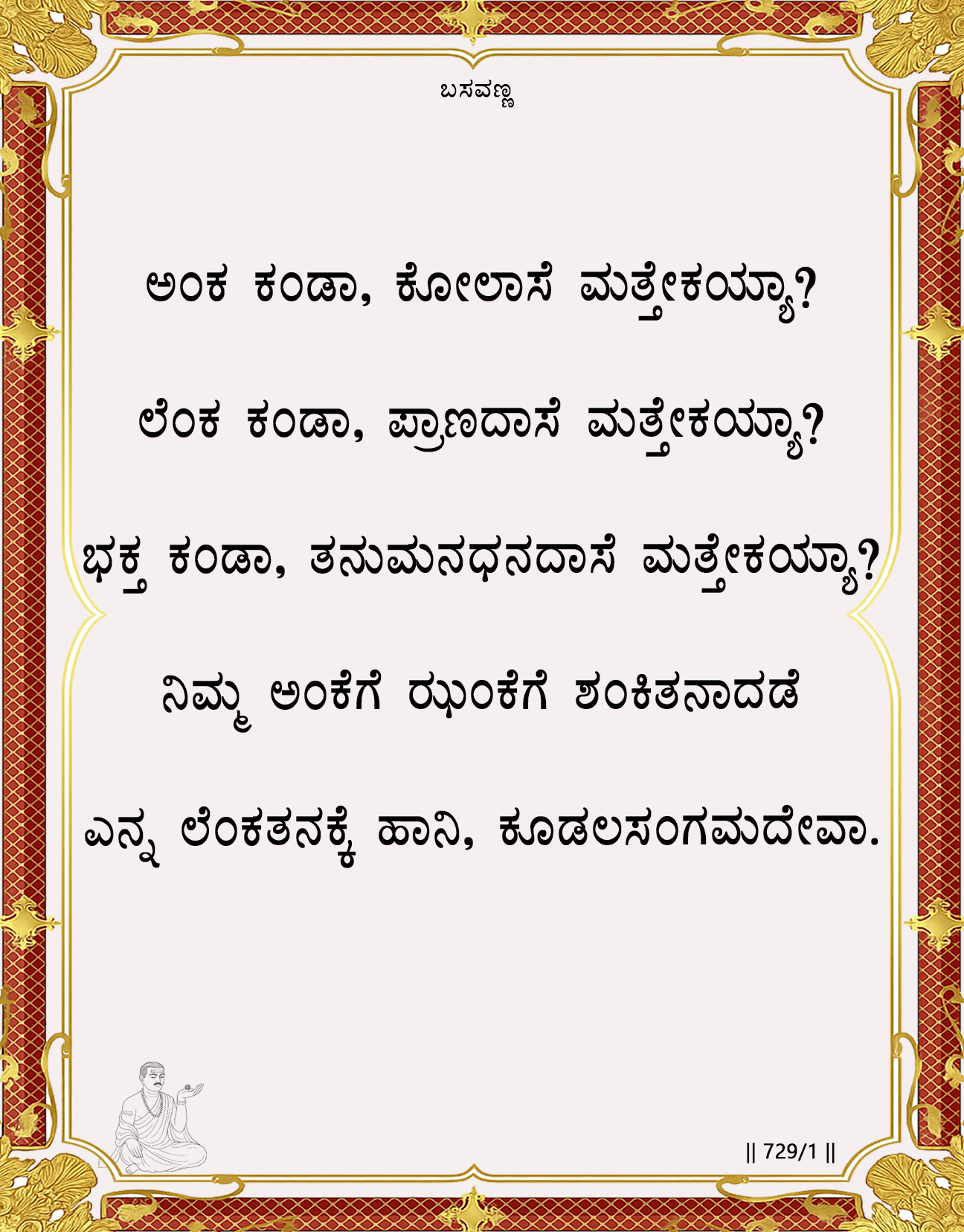
O warrior in the battlefield,
Why cling with greed to your arrows?
O servant of the Divine,
Why yearn so much for your life?
O true devotee,
Why desire the wealth of body,
mind, and gold?
O Kudalasangama Deva,
I shall not bow before the roar of fear.
For if I turn away in cowardice,
All my deeds are rendered useless.
Basavanna questions the logic of a warrior hoarding arrows, a servant clinging to life, or a devotee desiring material wealth. He declares to his Lord, Kudalasangama, that he will not yield to fear or anger, for to do so would invalidate his entire spiritual practice.
Spiritual Context
Core Spiritual Principle: True devotion requires the absolute renunciation of all dependencies on external tools, on life itself, and on personal identity culminating in fearless surrender to the Divine.
Cosmic Reality Perspective: The cosmos is a dynamic field (a battlefield) where consciousness (the devotee) engages with the Divine (Kudalasangama). Attachment to any transient form (body, life, wealth) is a failure to recognize the eternal, formless reality behind the play of existence.
Historical Reality (Anubhava Mantapa context): This vachana is a radical call for spiritual integrity, challenging the ritualistic and materialistic religiosity of 12th-century Karnataka. It embodies the Anubhava Mantapa’s ethos where inner conviction and fearless commitment were valued above all else.
Interpretation
1. “O warrior… why cling with greed to your arrows?”: The “warrior” is the seeker on the path. “Arrows” symbolize external supports rituals, scriptures, or even spiritual credentials. Hoarding them indicates a lack of trust in the Divine’s grace.
2. “O servant of the Divine… why yearn so much for your life?”: The “servant” has entered a sacred contract. Clinging to biological life (“Anna Maya Kosha”) contradicts the promise of total surrender. The true self is beyond the mortal body.
3. “O true devotee… why desire the wealth of body, mind, and gold?”: This targets the innermost attachment to the ego-identity (body and mind) and the security of material possessions (“Ananda Maya Kosha” distorted by ego). This is the final barrier to liberation.
4. “I shall not bow before the roar of fear…”: “Fear” and “anger” represent the primal energies of the ego that arise when its attachments (arrows, life, wealth) are threatened. The declaration is the triumph of faith over the survival instincts of the lower self.
Practical Implications: A seeker must constantly examine their attachments, not just to physical objects, but to their ideas, self-image, and even their spiritual practices. The goal is to act with duty and devotion, but remain detached from the fruits and tools of action.
The Cosmic Reality
Anga (Human Dimension): The human as a disciplined, committed, and fearless devotee. The Anga is purified through the resolute refusal to let the ego reassert itself through dependencies.
Linga (Divine Principle): Kudalasangama Deva as the ultimate, non-dual truth that tests the devotee’s sincerity by presenting situations that provoke fear and attachment. The Linga is the focal point that demands absolute integrity.
Jangama (Dynamic Interaction): The dynamic here is the fierce internal battle where the devotee’s unwavering resolve (Anga) confronts the temptations and fears of worldly existence, holding fast to the Divine principle (Linga). This active, living commitment is the Jangama.
Shata Sthala
Primary Sthala: Bhakta. This vachana epitomizes the Bhakta stage, which is defined not by soft emotion but by unwavering, fierce devotion and the initial burning away of gross attachments (to weapons, long life, and wealth).
Supporting Sthala: Maheshwara. The courage and resolute determination (“I shall not bow…”) required to stand firm reflect the qualities of the Maheshwara stage, where the devotee develops immense inner strength.
Practical Integration
Arivu (Awareness): Practice mindful awareness to catch moments where you cling to “arrows” (e.g., over-preparing due to anxiety) or “life” (e.g., resisting necessary change out of fear). Witness these attachments without judgment.
Achara (Personal Discipline): Cultivate a discipline of non-hoarding, both materially and mentally. Let go of one unnecessary possession or one cherished opinion regularly.
Kayaka (Sacred Action): Perform your daily work to the best of your ability, but offer the results and the tools you use back to the Divine. See your work as worship, not as a means for personal accumulation.
Dasoha (Communal Offering): Share your knowledge, resources, and strengths selflessly with the community. If you have “arrows,” give them to those who need to fight their battles. This breaks the ego of ownership.
Modern Application
The “Useless Treasure” today is our obsessive accumulation career capital, social media validation, material wealth, and even self-help techniques all as a buffer against existential insecurity and the fear of failure or obscurity.
This vachana liberates by teaching us to invest our energy not in accumulating defenses, but in cultivating inner fearlessness. True success lies in doing what is right without being paralyzed by the fear of loss loss of reputation, financial stability, or even life itself. It calls for a life of authentic purpose over mere preservation.
Essence
Why clutch the tools, the breath, the gold,
When the Battle calls for a spirit bold?
For if fear turns the heart to stone,
The seed of devotion remains un sown.
This vachana maps the metaphysical journey from dependence on the manifest (Prakriti) to establishment in the pure witness consciousness (Purusha). The “arrows,” “life,” and “wealth” represent the five sheaths (Koshas). The final declaration is the moment the consciousness (Chit) breaks identification with these layers and stands firm in its own timeless nature.
Ultimate freedom is found not in securing more resources for the self, but in the courageous decision to act with integrity, detached from the need for any reward or guarantee. It is a call to live a life of principle, not preservation.

Views: 162