

Summary
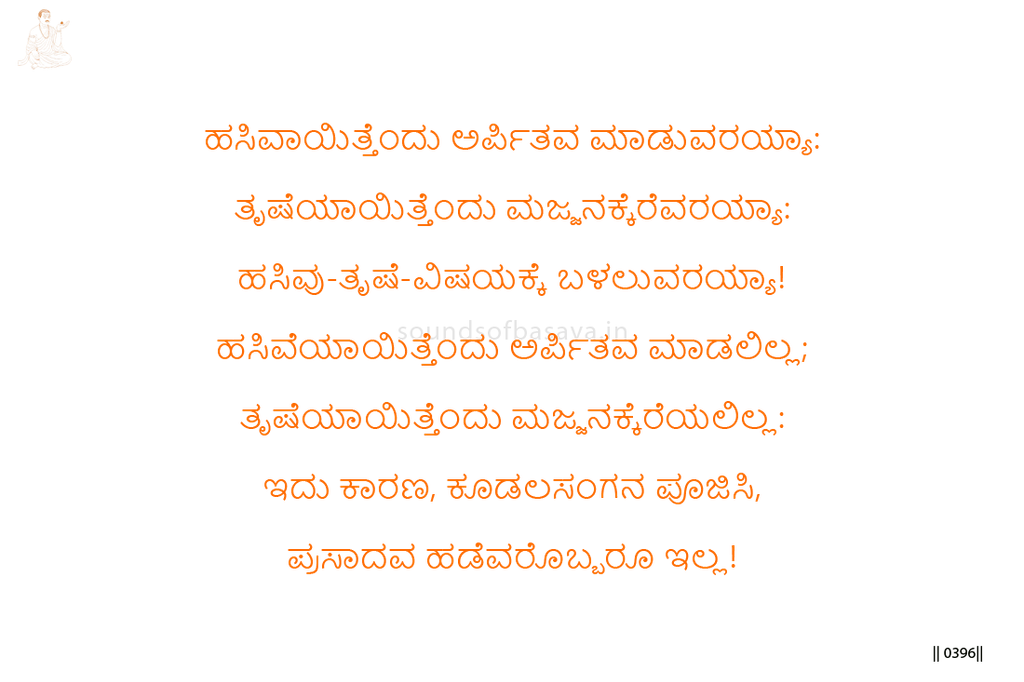
In this vachana, Basavanna questions worship that remains only outward.
People say, “It is hungry,” and place food before the Linga. They say, “It is thirsty,” and pour water in worship. But Basavanna says that this hunger and thirst remain tied to sense-objects.
When the real hunger of the path arises, true offering is not made. When the real thirst of the path arises, true bathing is not performed. Therefore, though many worship Kudalasangama Deva, none truly receive Prasada.
The teaching is that ritual action does not become worship merely because food is offered or water is poured. Unless the act turns inward and releases sense-bound intention, Prasada is not received.
Imagery & Symbolic Relevance
The images are simple: hunger, thirst, offering, bathing, and Prasada.
Food is offered because hunger is imagined. Water is poured because thirst is imagined. Basavanna uses these acts to expose a deeper problem. Worship is being shaped by bodily need and sensory habit.
Hunger and thirst should point the seeker inward. Hunger should become the need to offer oneself. Thirst should become the need for inner cleansing.
But when the seeker remains bound to sense-objects, the outer act does not reach its purpose. The food is placed, the water is poured, yet the inner state remains unchanged.
Prasada is therefore not truly received. Prasada is not only the material remainder after worship. It is grace-filled reception, where offering, worship, and inner alignment meet before Kudalasangama Deva.
Lingayoga
In Lingayoga, this vachana teaches that worship must pass beyond bodily habit and outer performance.
Offering to Linga must carry inward surrender. Pouring water must signify inner cleansing. Receiving Prasada must mean more than taking what remains after ritual.
For Prasadi Sthala, the teaching is that grace is received only when the act becomes inwardly true. The seeker must not confuse ritual completion with spiritual fulfillment.
Editorial Commentary
Basavanna does not reject offering, bathing, or Prasada. He corrects the way they are misunderstood.
The problem is not the ritual act itself. The problem is that the act remains bound to hunger, thirst, and sense-objects.
The vachana therefore asks the seeker to examine whether worship has touched the inner condition. If hunger and thirst remain only bodily, the offering remains incomplete.
True Prasada arises when outward worship and inward transformation become one movement.
Related Vachana
Supporting Vachana
Maheshwara Sthala Vachana 282 — The Outer Ablution and the Inner Darkness
Maheshwara Vachana 282 supports this vachana by showing that outer bathing cannot remove inner darkness, deceit, and dividedness. In Vachana 767, food is offered and water is poured, yet Prasada is not truly received because the act remains outward. Both vachanas warn that sacred action must touch the inner state.
Advancing Vachana
Pranalingi Sthala Vachana 1062 — Beyond the Offering and the Meal
Pranalingi Vachana 1062 advances this teaching by asking whether worship and sacred eating have become Prāṇa-Lingasthala and Prasādasthala within. In Vachana 767, Basavanna exposes outward offering without true reception. In Vachana 1062, the question deepens: has the act entered inner realization?
