

Summary
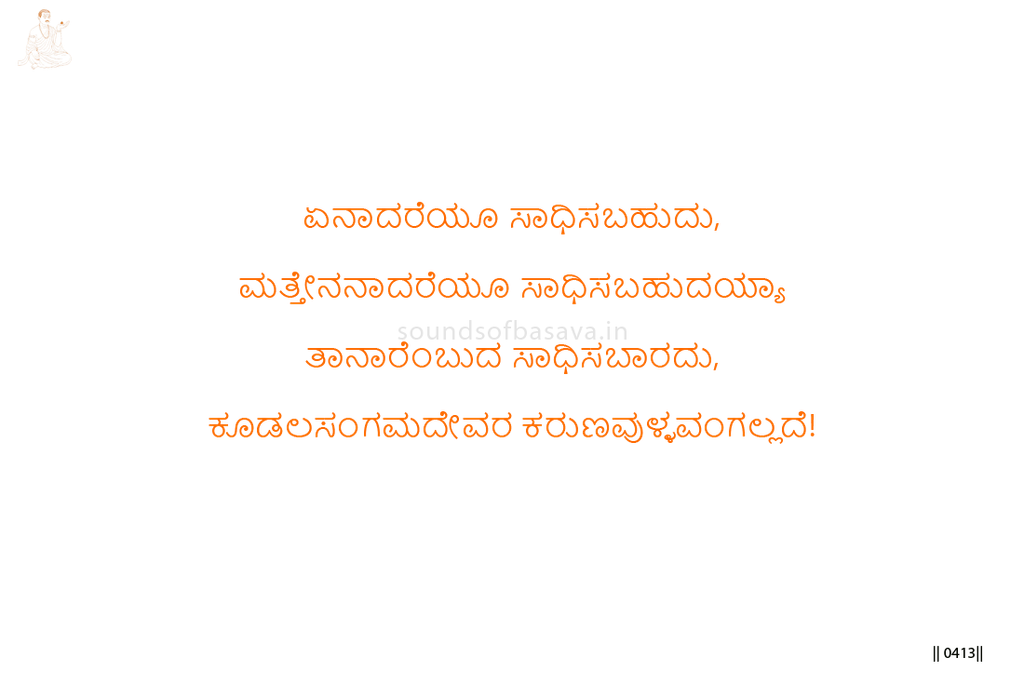
In this vachana, Basavanna distinguishes ordinary accomplishment from the mastery of the “I.”
This may be achieved. That may be achieved. Many things may be achieved. But the one who says “I” cannot be mastered by ordinary effort.
Only the one who has the compassion of Kudalasangama Deva can overcome this “I.”
The teaching is that pride does not end merely because one has gained skill, knowledge, discipline, or spiritual practice. The deepest obstacle is the claimant within: the one who says, “I have achieved.”
Imagery & Symbolic Relevance
The vachana is built on repetition. Basavanna first allows that many things can be accomplished. The word “achieved” or “mastered” points to what can be gained through effort.
Then he turns inward. The real problem is not the thing achieved, but the one who claims achievement.
The phrase “the one who says ‘I’” is the heart of the vachana. It points to the self-claiming center that takes ownership of action, knowledge, virtue, and devotion.
This “I” cannot be conquered like an outer task. If the seeker says, “I have mastered the I,” the same I has returned in subtler form.
Basavanna therefore turns to compassion. The ego is not dissolved by pride in effort. It softens only through the grace of Kudalasangama Deva.
Lingayoga
In Lingayoga, effort has its place, but effort alone cannot remove the root of self-claim.
The seeker may discipline the body, train speech, perform worship, serve, and learn. Yet the hidden “I” may still stand behind these acts and claim them.
For Prasadi Sthala, this is essential. Prasada cannot be possessed by the ego. Grace must be received in humility, not turned into spiritual ownership.
The true movement is from achievement to surrender. What cannot be mastered by self-effort must be yielded into Kudalasangama Deva’s compassion.
Editorial Commentary
The Kannada vachana repeats the possibility of accomplishment before introducing the impossibility of mastering the “I.”
This contrast should be preserved. Basavanna is not rejecting discipline or achievement. He is showing their limit.
The “I” here is not ordinary self-reference alone. It is the subtle pride that says, “I did,” “I know,” “I attained,” or “I mastered.”
The final line gives the correction: only through the compassion of Kudalasangama Deva can this self-claiming center be overcome.
Related Vachana
Supporting Vachana
Maheshwara Sthala Vachana 327 — The Impurity Hiding in the Mind
Maheshwara Vachana 327 supports this vachana by warning that the moment one says, “I have known the truth,” realization hardens into possession and spiritual pride. The impurity hides in the corner of the mind.
In Vachana 926, Basavanna says that many things may be mastered, but the one who says “I” cannot be mastered without Kudalasangama Deva’s compassion. Both vachanas expose the subtle ego that survives inside knowledge and attainment.
Advancing Vachana
Pranalingi Sthala Vachana 1081 — The Counsel Given to the Mind
Pranalingi Vachana 1081 advances this teaching by showing that many can advise the body, but the mind itself requires the counsel of Kudalasangama Deva.
In Vachana 926, the “I” cannot be mastered by ordinary effort. In Vachana 1081, this matures into Pranalingi dependence on inner divine guidance: the mind that cannot be governed from outside receives counsel from Kudalasangama Deva Himself.
