
Summary
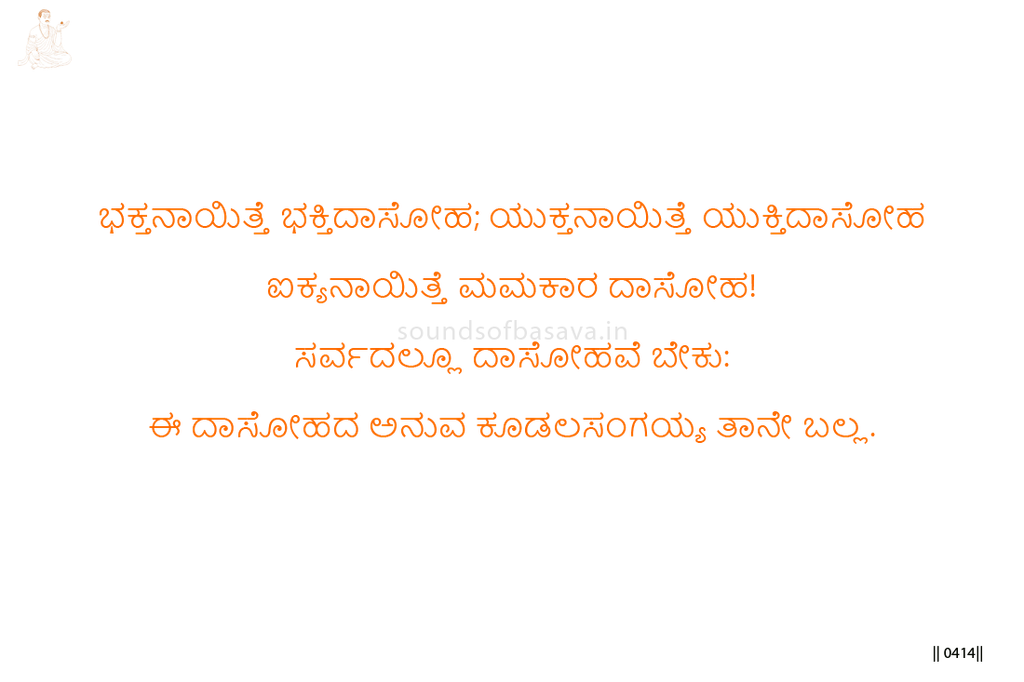
In this vachana, Basavanna teaches that Dasoha must remain present at every stage.
When one is a Bhakta, there must be Bhakti-Dasoha. When one becomes Yukta, there must be Yukti-Dasoha. When one becomes Aikya, there must be Mamakaara-Dasoha.
In every state, Dasoha alone is required.
Basavanna concludes that the Anubhava of this Dasoha is known only to Kudalasangayya.
The teaching is that no stage of the path permits possession. Devotion must be offered. Discernment must be offered. Even in union, the sense of “mine” must be offered.
Imagery & Symbolic Relevance
The vachana has no external image. Its force lies in its threefold progression.
The first stage is Bhakta. Here Dasoha appears as Bhakti-Dasoha. Devotion should not remain as private feeling or inward sweetness alone. It must become offering.
The second stage is Yukta. Here Dasoha appears as Yukti-Dasoha. Yukti means right discernment, fitness, or proper understanding. Even understanding must not become personal possession. It too must be offered.
The third stage is Aikya. Here Dasoha appears as Mamakaara-Dasoha. Mamakaara means the sense of “mine.” At the stage of union, the final residue to be offered is this mine-making tendency.
Basavanna then gives the rule: in all states, Dasoha alone is needed. The seeker must not abandon Dasoha after devotion, after discernment, or even after union.
The final line protects the depth of the teaching. The Anubhava of this Dasoha cannot be fully reduced to explanation. Kudalasangayya alone knows its measure.
Lingayoga
In Lingayoga, this vachana teaches continuity.
At the beginning, the seeker offers devotion. As understanding deepens, the seeker offers discernment itself. At the height of Aikya, the seeker offers even the claim of possession.
For Prasadi Sthala, this is central. Prasada cannot be received as “mine.” What is received through grace must move as Dasoha.
Thus Dasoha is not only charity or distribution. It is the refusal to hold devotion, knowledge, realization, or Prasada as private property.
Editorial Commentary
The sequence : Bhakta, Yukta, Aikya.
Bhakti-Dasoha means devotion expressed as offering. Yukti-Dasoha means discernment or right understanding expressed as offering. Mamakaara-Dasoha means the offering of “mine-ness.”
The phrase “Sarvadale Dasohave beku” means that in every state, Dasoha is necessary.
The final phrase says that the Anubhava of this Dasoha is known only to Kudalasangayya. This should be understood as a limit placed on explanation. The teaching can be described, but its full experience belongs to Kudalasangama Deva.
Related Vachana
Supporting Vachana
Maheshwara Sthala Vachana 252 — The Fire That Burns the “I”
Maheshwara Vachana 252 supports this vachana by identifying Aham, the egoic “I,” as the hidden fault behind speech, knowledge, and spiritual expression. It asks Kudalasangama Deva to burn that claimant.
In Vachana 936, even at the stage of Aikya, Mamakaara must become Dasoha. Both vachanas teach that the final obstruction is not outer action, but the subtle self-claim that says “I” and “mine.”
Advancing Vachana
Pranalingi Sthala Vachana 1272 — Established in Prāṇa-Linga
Pranalingi Vachana 1272 advances this teaching by showing a life established in Prāṇa-Linga, abiding in Prasada, free from possessiveness, and consecrating every act before receiving it.
In Vachana 936, Dasoha is required in Bhakti, Yukti, and Aikya, ending in the offering of Mamakaara. In Vachana 1272, this matures into Pranalingi living: nothing is held as one’s own, and all life moves through offering, Prasada, and continuous consecration.
