

Summary
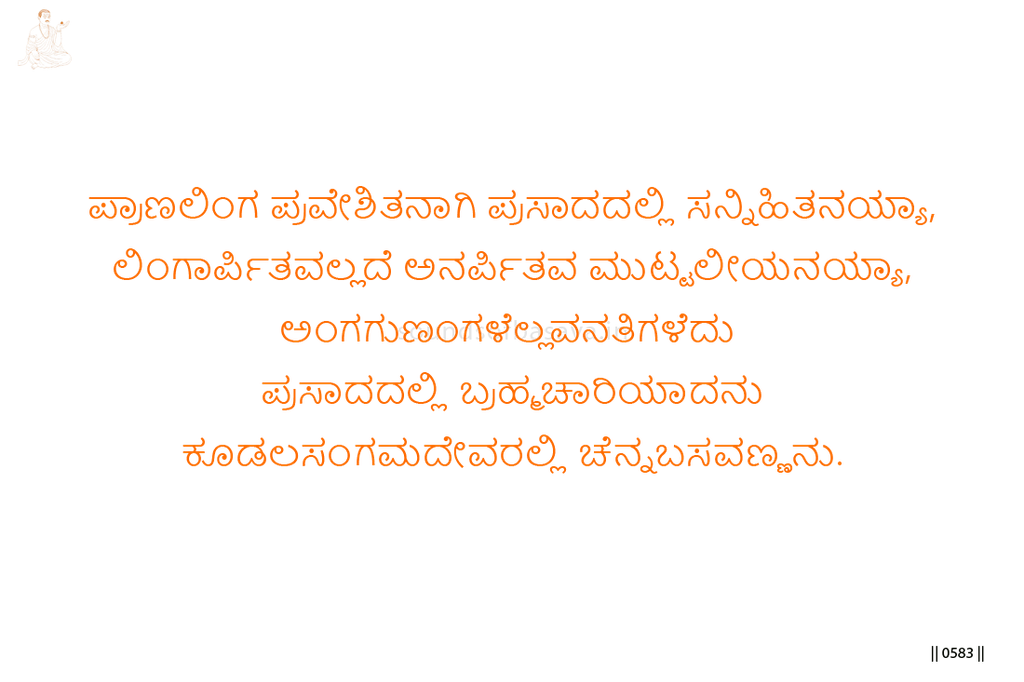
In this vachana, Basavanna presents Chennabasavanna as one who has entered Prāṇa-Linga and abides in Prasada. This is not occasional worship, but a settled mode of consecrated life.
Chennabasavanna touches nothing that has not first been offered to the Linga. Nothing is taken as private possession or ordinary enjoyment. What is received must first become Lingārpita, and only then is it received as Prasada.
Basavanna then says that Chennabasavanna has cast off the Anga-guṇas and become a brahmachari in Prasada. The teaching is total consecration: body, receiving, touch, and conduct are governed by Prāṇa-Linga and absorbed in Kudalasangama Deva’s Prasada.
Imagery & Symbolic Relevance
Entering Prāṇa-Linga is the first image. Basavanna does not describe Chennabasavanna as one who worships from outside, but as one inwardly established in the living Linga.
Abiding in Prasada is the second image. Prasada is not treated merely as food or object received after offering. It becomes the state in which Chennabasavanna lives.
The refusal to touch the unoffered is the center of the vachana. Touching here includes receiving, using, eating, and participating. Nothing enters life as “mine.”
Lingārpita gives the rule of sacred receiving. What is offered to Linga loses private ownership. What returns from that offering is Prasada.
The abandonment of Anga-guṇas shows freedom from bodily self-claim. Becoming a brahmachari in Prasada means disciplined purity within receiving, not rejection of life.
Lingayoga
In Lingayoga, this vachana teaches that realization must govern ordinary receiving. It is not enough to speak of Prāṇa-Linga while continuing to take things through possession.
For Pranalingi Sthala, every act of receiving must pass through consecration. Food, action, experience, and bodily participation must become Lingārpita before they are received as Prasada.
The practice-point is direct: do not touch the unoffered. Offer first to Linga, receive only as Prasada, and let bodily tendencies of appetite, possession, and self-claim fall away.
Editorial Commentary
The sequence should remain central: entry into Prāṇa-Linga, abidance in Prasada, refusal to touch the unoffered, abandonment of Anga-guṇas, and brahmacharya in Prasada.
Basavanna is not praising external restraint alone. He shows a consecrated life in which Chennabasavanna receives nothing as private possession and lives only through what has become Prasada.
Related Vachana
Supporting Vachana
Prasadi Sthala Vachana 1346 — Nothing Is Truly Received Until It Is Offered
Prasadi Vachana 1346 supports this vachana by warning that food, water, and taste must not be received without Linga-Arpita. It teaches that receiving becomes degraded when it is separated from Linga, but becomes sacred when first offered.
Vachana 1272 carries that Prasadi teaching into Pranalingi Sthala. What Prasadi 1346 gives as the rule of right receiving becomes here the mature life of Chennabasavanna: nothing is touched, received, used, or enjoyed unless it has first passed through Linga and become Prasada.
Advancing Vachana
Sharana Sthala Vachana 1271 — Salutations to Chennabasavanna, the Embodiment of Prasada
Sharana Vachana 1271 advances this teaching by showing Chennabasavanna not merely as one who receives Prasada, but as one established within Prasada itself. Basavanna cannot fully describe him and finally bows with “Namo, Namo.”
In Vachana 1272, Chennabasavanna lives through Prāṇa-Linga, Lingārpita receiving, and Prasada-abidance. In Vachana 1271, this matures into Sharana Sthala as reverence before Chennabasavanna as the living embodiment of Prasada. Thus Pranalingi consecrated receiving advances into Sharana recognition of realized grace before Kudalasangama Deva.
