

Summary
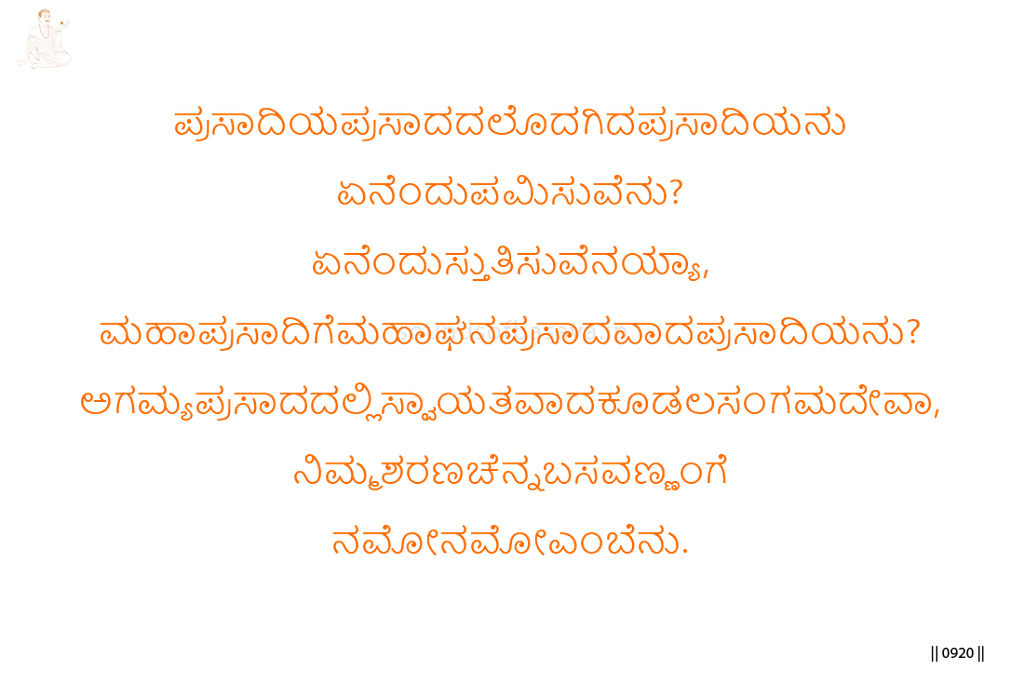
Basavanna stands in reverent wonder before Chennabasavanna, recognizing him not merely as one who has received Divine Prasada but as one in whom Prasada has become fully manifest. As he attempts to describe such greatness, words prove inadequate, and praise gives way to repeated salutation.
The vachana teaches that the highest realization is not something that can be measured or explained. It is recognized through humble reverence before the realized Sharana. At the Sharana stage, devotion matures into grateful recognition of the living embodiment of Divine grace.
Imagery & Symbolic Relevance
The first image is the Prasadi arising within Prasada. Basavanna asks how one can describe the Prasadi who has arisen within Divine grace itself. The image presents the realized one not as a recipient standing apart from grace, but as one whose life has unfolded within it.
The second image is “the Prasada of the Mahaprasadi.” Basavanna deepens the praise by declaring Chennabasavanna to be the Prasada of the Mahaprasadi. The progression moves from Divine grace to the one established in grace, and finally to one who has become its living expression. Language begins to fail before such realization.
The third image is Agamya Prasada. Basavanna speaks of the immeasurable grace in which Kudala Sangama Deva abides. This grace lies beyond ordinary reach and beyond conceptual understanding. Chennabasavanna is honoured because his life reveals that unfathomable grace.
The final image is the repeated salutation, “Namo, Namo.” Having found no words sufficient to describe the realized Sharana, Basavanna ends with repeated prostration. Reverence becomes the only fitting response where explanation reaches its limit.
Lingayoga
In Lingayoga, this vachana teaches that realization culminates in reverence for the living Sharana through whom Divine grace is manifest. The seeker no longer seeks personal greatness but learns to recognize and bow before realized grace wherever it appears.
For Sharana Sthala, the practice-point is direct: when the presence of Divine Prasada is recognized in the realized Sharana, the proper response is humble salutation rather than intellectual description. Thus devotion ripens into grateful surrender before the living embodiment of grace.
Editorial Commentary
This vachana should not be understood as the glorification of an individual person. Basavanna honours Chennabasavanna because he has become the transparent manifestation of Divine Prasada. The repeated salutations are directed to the grace revealed through the realized Sharana.
Related Vachana
Supporting Vachana
Pranalingi Sthala Vachana 1004 — Chennabasavanna Revealed the Hidden Fire
Pranalingi Vachana 1004 presents Chennabasavanna as the active revealer and establisher of the living Linga within Basavanna.
He brings forth the hidden fire of Shiva, reveals Sujñāna-Linga within Nija-prāṇa, brings the Linga into the palm, and establishes it throughout Sarvāṅga, the whole embodied being. He reveals the path of Nitya-Nijalingaikya and proclaims the greatness of Pranalinga.
Advancing Vachana
Aikya Sthala Vachana 1177 — You Alone Are the Doer
Aikya Vachana 1177 directly advances this teaching by carrying reverence for Chennabasavanna’s Prasada-state into complete entrustment. In Sharana Vachana 1271, Chennabasavanna is recognized not merely as one who receives Prasada, but as one in whom Mahaprasada has become fully manifest, leaving Basavanna able only to offer repeated salutations. In Aikya Vachana 1177, Basavanna recognizes Chennabasavanna as the karta through whom Guru, Linga, Jangama, Prasada, and Upadesha become effective, and entrusts his own spiritual direction to him before Kudalasangama Deva. Thus reverence for embodied Prasada in Sharana advances into Aikya as complete surrender of personal preference to Chennabasavanna’s realized guidance.
