

Summary
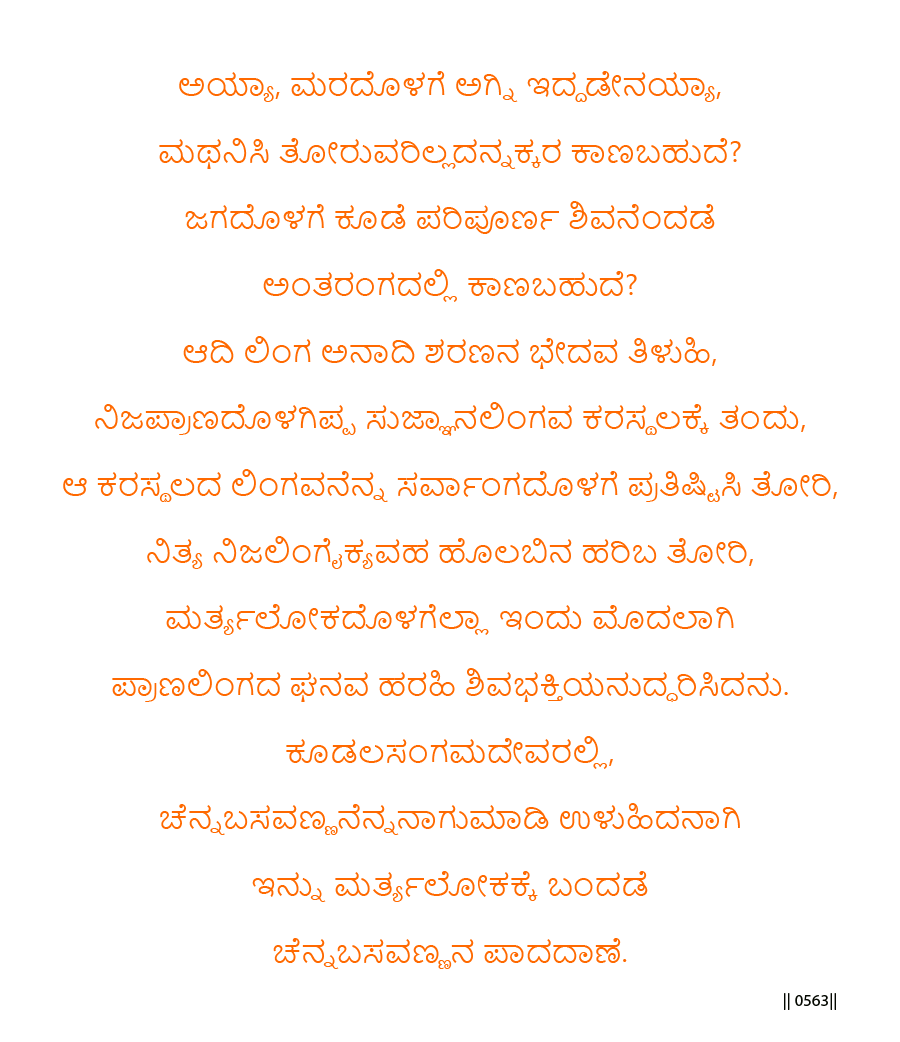
In this vachana, Basavanna begins with the image of fire hidden within wood. Fire may be present, but unless it is churned and brought forth, it cannot be seen. In the same way, even if Shiva is complete within the world, He must be seen in the antaranga, the inner field.
Basavanna then says that Chennabasavanna revealed the distinction between Adi-Linga and Anādi-Sharana. Adi-Linga is the primal Linga, while Anādi-Sharana points to the beginningless Sharana. By making this distinction clear, Chennabasavanna brought the Sujñāna-Linga, the Linga of true knowledge present within nija-prāṇa, into Basavanna’s palm.
The Linga brought into the palm was then established throughout Basavanna’s Sarvāṅga, the whole embodied being. Chennabasavanna revealed the path of Nitya-Nijalingaikya, the continuous union with the true Linga, and proclaimed the ghana, the depth and greatness, of Pranalinga.
Basavanna finally says that Chennabasavanna awakened Shiva-bhakti in the mortal world, made him what he is in Kudalasangama Deva, and protected him. If Basavanna has come into the mortal world at all, it is for the sake of Chennabasavanna’s feet.
Imagery & Symbolic Relevance
The first image is fire hidden within wood. The fire is not absent, but it is not visible until it is brought forth through churning. Basavanna uses this image to show that the presence of Shiva must become inwardly seen, not merely spoken of as all-pervading.
The second image is seeing Shiva in the antaranga. Antaranga means the inner field. If Shiva is complete within the world, the seeker must see that completion inwardly. Outer assertion alone is not enough.
The third image is the distinction between Adi-Linga and Anādi-Sharana. Basavanna says that Chennabasavanna made this distinction known. This keeps the relation between primal Linga and beginningless Sharana clear, without confusing their roles in realization.
The fourth image is Sujñāna-Linga in nija-prāṇa. Sujñāna means true knowledge or right knowing. Nija-prāṇa means the true life-force. Chennabasavanna brings this Sujñāna-Linga from within true life into the palm, making inner knowledge directly receivable.
The fifth image is the palm. The Linga brought to the palm is not left as an outer object only. The palm is the place of direct receiving and worship, but the movement must continue inward.
The sixth image is Sarvāṅga establishment. Sarvāṅga means all limbs or the whole embodied being. Chennabasavanna establishes the palm-held Linga throughout Basavanna’s whole body-field.
The seventh image is Nitya-Nijalingaikya. Nitya means continuous or eternal. Nija-Linga means the true Linga. Aikya means union. Chennabasavanna reveals the path by which the seeker remains in continuous union with the true Linga.
The eighth image is the ghana of Pranalinga. Ghana means depth, weight, or greatness. Pranalinga is the Linga joined with life-force. Chennabasavanna proclaims its greatness and raises Shiva-bhakti in the mortal world.
The final image is Chennabasavanna’s feet. Basavanna does not claim the realization as his own achievement. He says that if he has come into the mortal world, it is for the sake of Chennabasavanna’s feet.
Lingayoga
In Lingayoga, this vachana teaches that the Linga must move from hidden presence to inward recognition, from palm to Sarvāṅga, and from knowledge to Pranalinga. The path is not completed by saying that Shiva pervades the world; the hidden fire must be brought forth in the inner field.
For Pranalingi Sthala, the point is direct. Chennabasavanna reveals Sujñāna-Linga within nija-prāṇa and establishes the Linga throughout the whole being. Pranalinga is then not merely named, but shown as a living greatness to be realized and proclaimed.
The practice-point is clear: do not leave Shiva as a general idea of all-pervasion. Let the hidden fire be awakened inwardly. Receive Sujñāna-Linga, allow it to be established in Sarvāṅga, and recognize the path of Nitya-Nijalingaikya through the grace of Chennabasavanna.
Editorial Commentary
Antaranga is the inner field. Adi-Linga is the primordial or original Linga, the first and foundational manifestation of Shiva as Linga. Anādi-Sharana is the beginningless Sharana. Sujñāna-Linga is the Linga of true knowledge. Nija-prāṇa is true life-force. Sarvāṅga is the whole embodied being. Nitya-Nijalingaikya is continuous union with the true Linga. Pranalinga is the Linga joined with life-force, whose ghana is proclaimed by Chennabasavanna.
The final line should remain central. Basavanna’s realization is presented with gratitude, not self-claim. Chennabasavanna made him what he is, protected him, and gave meaning to his coming into the mortal world.
Related Vachana
Supporting Vachana
Prasadi Sthala Vachana 945 — The Light Within Light
Prasadi Vachana 945 supports this teaching by presenting Chennabasavanna as Mahaprasadi, one whose state is known through the Great Light, Mahaprasada, Paramananda, and supreme refuge. Basavanna says that Chennabasavanna’s state is beyond the reach of speech and mind.
Vachana 1004 carries this into Pranalingi Sthala. The hidden fire of Shiva is brought forth through Chennabasavanna, who reveals Sujñāna-Linga within nija-prāṇa, brings it into the palm, establishes it throughout Sarvāṅga, and proclaims the greatness of Pranalinga. What Prasadi 945 shows as Chennabasavanna’s immeasurable Prasadi radiance becomes, here, Chennabasavanna’s active revelation of Pranalinga.
Advancing Vachana
Sharana Sthala Vachana 1271 — Salutations to Chennabasavanna, the Embodiment of Prasada
Sharana Vachana 1271 advances this teaching by showing Chennabasavanna as the living embodiment of Prasada. Basavanna does not merely describe him as one who receives grace, but as one who has arisen within Prasada and become its visible expression.
In Vachana 1004, Chennabasavanna reveals the hidden fire, brings Sujñāna-Linga into Basavanna’s palm, establishes it throughout Sarvāṅga, shows the path of Nitya-Nijalingaikya, and proclaims the greatness of Pranalinga. In Vachana 1271, this matures into Sharana Sthala as reverence before Chennabasavanna himself, the Guru-Sharana through whom Prasada becomes embodied, visible, and worthy of repeated salutation before Kudalasangama Deva.
