

Summary
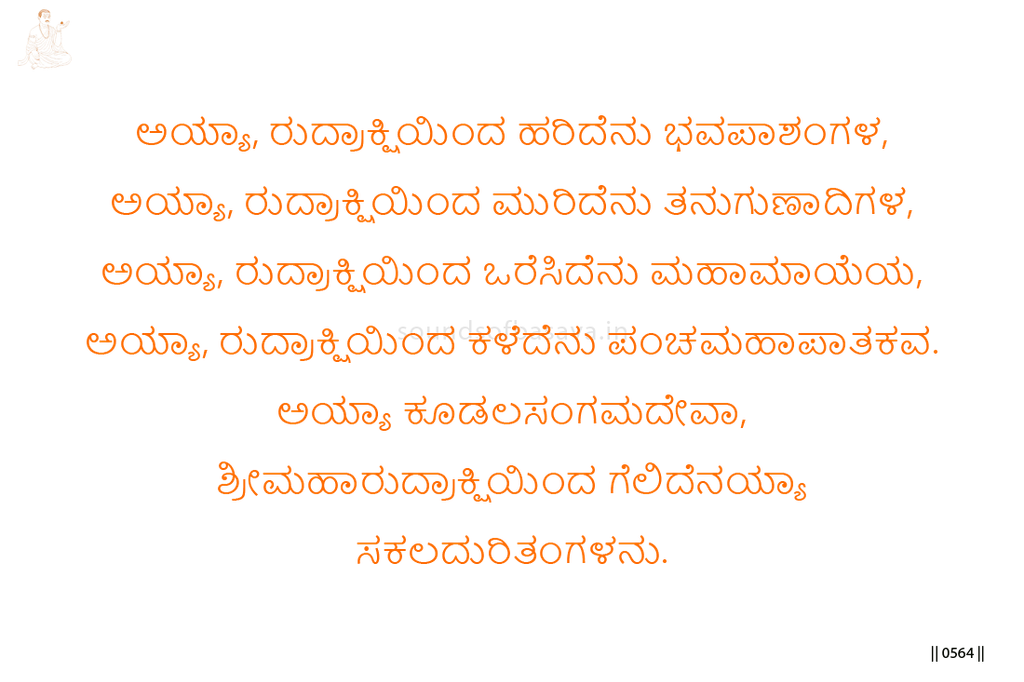
In this vachana, Basavanna presents Rudrākṣi as a sacred power of purification. Rudra means Shiva. Akṣi means eye, and in this sacred usage Rudrākṣi points to the tear of Rudra-Shiva. It is therefore not only an external bead or mark, but also the sign of Shiva’s grace flowing through the purified eye.
Basavanna says that through Rudrākṣi he cut the bhava-pāśa, the bonds of becoming. He then says that through Rudrākṣi he broke the tanu-guṇas, the body-bound tendencies and qualities that hold the seeker to limitation.
He further says that through Rudrākṣi he overcame Mahāmāyā, the great covering power of illusion, and removed the pañca-mahā-pātakas, the five great sins or grave impurities. Finally, through Śrī Mahā-Rudrākṣi, he conquered all duritas — afflictions, wrongs, evils, or accumulated spiritual burdens.
The spiritual concern placed before Kudalasangama Deva is therefore purification through Rudrākṣi. The source presents Rudrākṣi as the sacred means by which bondage, bodily tendency, illusion, great sin, and all affliction are overcome.
Imagery & Symbolic Relevance
The first image is Rudrākṣi cutting bhava-pāśa. Bhava-pāśa means the noose or bond of becoming. These are the ties that hold the seeker within repeated becoming, attachment, and inward bondage. Basavanna says that through Rudrākṣi these bonds are cut.
The second image is Rudrākṣi breaking tanu-guṇas. Tanu means the body, and guṇas are qualities, tendencies, or binding characteristics. The body has its own tendencies and pull. Through Rudrākṣi, these limiting body-bound qualities are broken.
The third image is Rudrākṣi overcoming Mahāmāyā. Mahāmāyā is the great covering power that makes the seeker remain bound in illusion, misidentification, and outward entanglement. Rudrākṣi is shown as the sacred aid through which this covering loses its force.
The fourth image is Rudrākṣi removing the pañca-mahā-pātakas. These are the five great sins or grave impurities. Basavanna’s concern here is deep purification, not merely outward correction.
The final image is Śrī Mahā-Rudrākṣi conquering all duritas. Durita means affliction, evil, wrong, or accumulated spiritual burden. Basavanna gathers the whole sequence into one declaration: through Śrī Mahā-Rudrākṣi, all duritas are overcome before Kudalasangama Deva.
Lingayoga
In Lingayoga, this vachana has special relevance to Dṛṣṭi-Yoga. In Dṛṣṭi-Yoga, the seeker fixes the gaze upon the Ishtalinga with steadiness, devotion, and inward attention. As the gaze becomes absorbed in the Linga, the eye is no longer only an organ of outward seeing. It becomes a doorway of inner Linga-awareness.
Here Rudrākṣi may be understood in two connected ways. First, it is the sacred Rudrākṣi associated with Rudra-Shiva. Second, it is the inner Rudrākṣi of Dṛṣṭi-Yoga, where the eye purified by Linga-gaze becomes softened by grace. Tears may arise in such inward absorption. These are not ordinary tears of worldly sorrow. They are the sign of inner melting before the Linga, the softening of ego, and the movement of Rudra’s grace through the devotee’s own eyes.
For Pranalingi Sthala, the point is precise. The purification is not merely external. The bonds of becoming, body-bound tendencies, Mahāmāyā, grave impurity, and duritas must be loosened within the living field of prana and awareness. Rudrākṣi shows how Dṛṣṭi-Yoga becomes inwardly transformative: the gaze fixed on the Linga opens the inner eye, and the grace of Rudra releases the seeker from bondage.
The practice-point is clear: hold Rudrākṣi not as ornament, but as a sacred means of purification. Let the Linga-gaze become steady. Let the eye become inwardly softened. Let Rudra’s grace cut bhava-pāśa, break tanu-guṇas, overcome Mahāmāyā, remove grave impurity, and conquer all duritas before Kudalasangama Deva.
Editorial Commentary
The word Rudrākṣi should remain central. Rudra means Shiva. Akṣi means eye; in sacred usage it points to the tear flowing from the eye of Rudra-Shiva. Therefore Rudrākṣi is not merely a bead worn on the body. It carries the meaning of Shiva’s compassionate tear and the purifying eye of Rudra.
This meaning is important for Dṛṣṭi-Yoga. The seeker gazes upon the Ishtalinga until seeing becomes inwardly absorbed. In that absorption, the eye is purified. The gaze no longer remains scattered among outer objects. It becomes joined to Linga-awareness. When tears arise from such absorbed seeing, they may be understood as Rudrākṣi in the inner yogic sense — the tears of Shiva’s grace moving through the devotee.
Basavanna’s repeated phrase “through Rudrākṣi” should therefore be read with this depth. Rudrākṣi is the sacred emblem of Rudra, and it is also the inner purification of the eye through Linga-gaze. Through this Rudrākṣi, bhava-pāśa is cut, tanu-guṇas are broken, Mahāmāyā is overcome, pañca-mahā-pātaka is removed, and all duritas are conquered.
Related Vachana
Supporting Vachana
Prasadi Sthala Vachana 983 — The Rudrakshi as the Path of Liberation
Prasadi Vachana 983 supports this teaching by presenting Rudrākṣi as the complete sacred means on the path of liberation. Rudrākṣi is all purification, all cause, all practice, all attainment, and the destruction of all sin. It is also the means for Mukti before Kudalasangama Deva.
Vachana 1005 carries this into Pranalingi Sthala with greater inward force. Through Rudrākṣi, bhava-pāśa is cut, body-bound tendencies are broken, Mahāmāyā is overcome, grave impurity is removed, and all duritas are conquered. What Prasadi 983 names as Rudrākṣi’s liberating power becomes, here, the direct Pranalingi purification of body, bondage, illusion, sin, and affliction.
Advancing Vachana
Sharana Sthala Vachana 5 — The Eye-Opening Conduct
Sharana Vachana 5 advances this teaching by showing how the inner eye opens through the lived conduct of Kudalasangama Deva’s Sharana. Truth is no longer understood only through symbol, mark, or sacred means; it becomes visible through the life of the realized Sharana.
In Vachana 1005, Rudrākṣi purifies the eye of awareness and cuts the bonds of becoming. In Vachana 5, this matures into Sharana Sthala as opened seeing. The purified vision brought about through Rudrākṣi advances into the inner eye opened by beholding the Sharana’s conduct before Kudalasangama Deva.
