
Summary
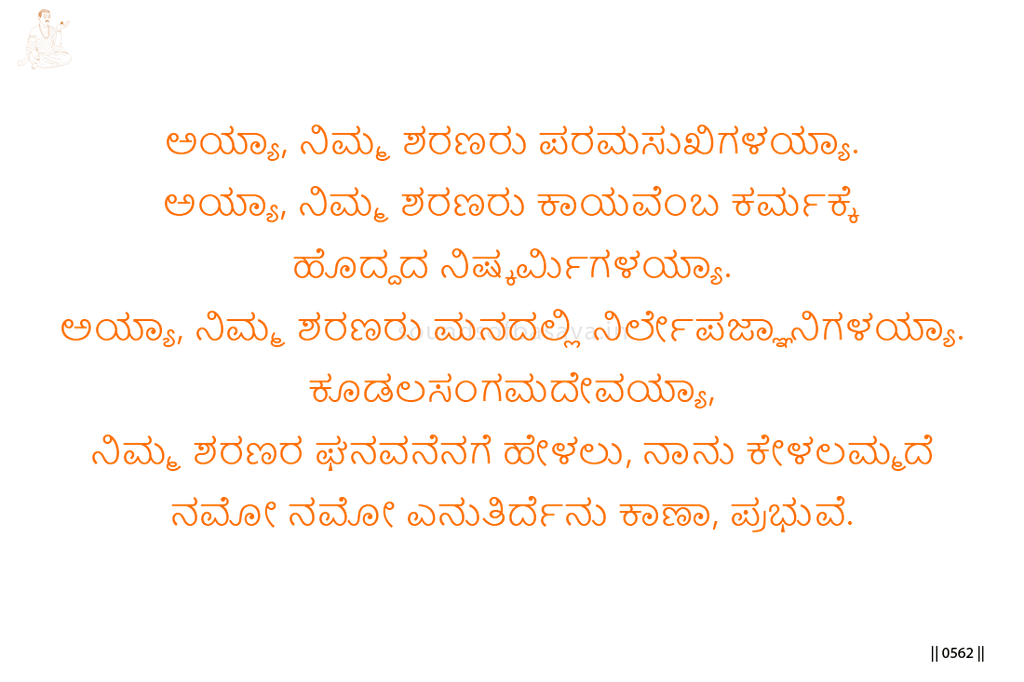
In this vachana, Basavanna praises Kudalasangama Deva’s Sharanas as beings of supreme joy. Their joy is not passing pleasure, but the settled state of realized life.
He then describes a paradox: the Sharanas remain covered by the body called karma, yet they are niṣkarmi, free from karmic bondage. They live in the body, but are not inwardly ruled by it.
Basavanna also calls them nirlepa-jñāni in the mind. Their knowing remains unstained. The mind may continue as an instrument, but it does not bind their awareness.
The greatness of such Sharanas cannot be fully spoken. Basavanna does not force explanation beyond its limit. Before Kudalasangama Deva, he bows and says, “Namo, Namo.”
Imagery & Symbolic Relevance
The first image is supreme joy. Basavanna places the Sharana beyond ordinary happiness and identifies the realized state with deep inward fullness.
The second image is the body as karma-covering. The body remains, but the Sharana is not bound by the karmic claim that usually accompanies embodied life.
The third image is unstained knowing. The mind is present, but knowledge is not touched by attachment, residue, or self-claim.
The final image is “Namo, Namo.” When the greatness of the Sharana cannot be measured by speech, reverence becomes the proper response.
Lingayoga
In Lingayoga, this vachana teaches that realization does not require the disappearance of the body. The Sharana may remain embodied and still be free from karmic bondage.
For Pranalingi Sthala, the point is precise: the seeker recognizes a state where body, mind, and knowledge remain present, but no longer bind. The Sharana’s life shows freedom within embodiment.
The practice-point is direct: do not measure the Sharana by body, action, or ordinary mental movement. Recognize the deeper state—supreme joy, freedom from karma, unstained knowing, and greatness before which reverence is the truest response.
Editorial Commentary
The Kannada terms should remain close to the source. Parama-sukha points to supreme joy. Kāya is the body, here linked with karma. Niṣkarmi means free from karma. Nirlepa-jñāni means unstained knower. Ghana means the depth or greatness of the Sharanas.
“Namo, Namo” is not decorative repetition. It is Basavanna’s reverent response when explanation reaches its limit.
Related Vachana
Supporting Vachana
Prasadi Sthala Vachana 990 — Transformed Through the Touch of Grace
Prasadi Vachana 990 supports this vachana by showing the transforming greatness that arises through Mahānubhāva-sanga and Sharana Prabhudeva’s grace. There, body, mind, wealth, and the whole being are purified through realized company.
Vachana 997 carries this into Pranalingi Sthala by describing the matured Sharana-state itself. What Prasadi 990 shows as purification through Sharana-grace becomes here the recognition of the Sharana as niṣkarmi, nirlepa-jñāni, and beyond adequate description.
Advancing Vachana
Sharana Sthala Vachana 999 — Made Worthy Through the Grace of the Sharanas
Sharana Vachana 999 advances this teaching by showing the effect of the Sharana’s silent greatness on the seeker. In Vachana 997, Basavanna bows before the greatness of Kudalasangama Deva’s Sharanas. In Vachana 999, that greatness acts directly: the Sharanas purify, correct, and shape the seeker into their own likeness.
Thus the Pranalingi recognition of the Sharana’s unstained state advances into Sharana Sthala as transformation through Sharana-grace. Reverence becomes lived belonging among Kudalasangama Deva’s Sharanas.
