

Summary
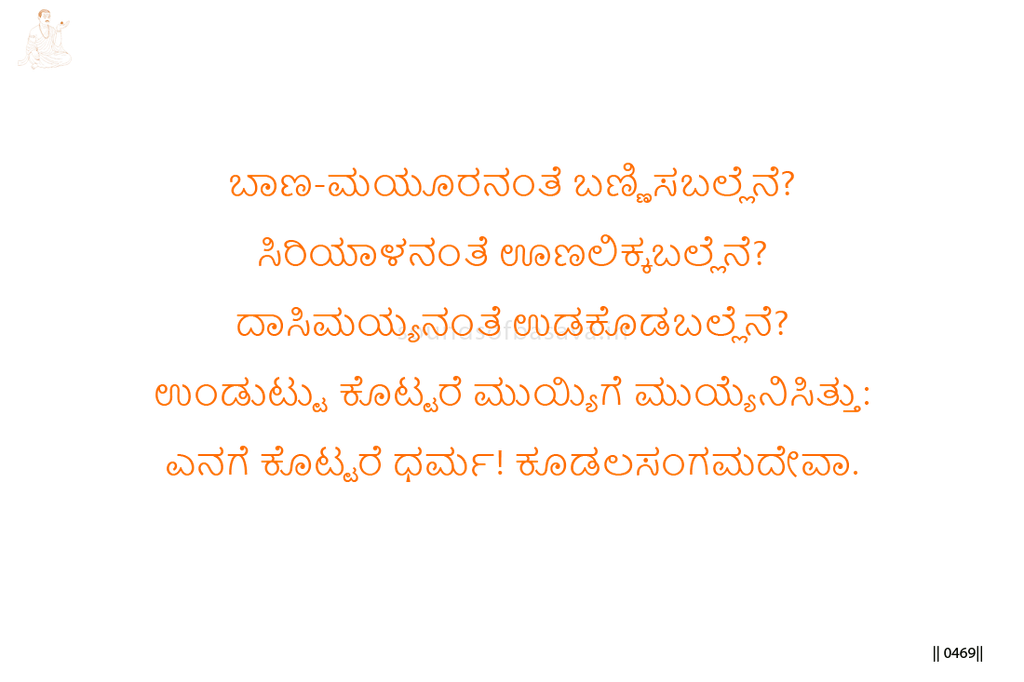
In this vachana, Basavanna measures his own offering against the acts of great devotees. He asks whether he can praise like Bāṇa and Mayūra, feed like Siriyala, and give clothing like Dasimayya.
The questions are not asked for comparison alone. They test whether speech, feeding, clothing, and giving have truly become sacred, or whether they remain ordinary acts.
Basavanna then gives the distinction. What is eaten, worn, and merely returned remains exchange. What becomes dharma is not measured by the outward act alone, but by the truth of the offering before Kudalasangama Deva.
Imagery & Symbolic Relevance
Bāṇa and Mayūra stand first as examples of sacred expression. Basavanna does not claim their measure. He asks whether his own speech can stand with such worth.
Siriyala represents the act of feeding. Feeding is not treated merely as social generosity. It becomes meaningful only when it is free from self-claim and stands as offering.
Dasimayya represents the act of giving clothing. Clothing another is a concrete act of care, but Basavanna again tests the inner measure of the act.
Eating and wearing show the ordinary needs of embodied life. The body receives food and clothing, but receiving alone does not make life sacred.
The contrast between repayment and dharma is the center of the vachana. If one gives only because one has received, the act remains exchange. Dharma begins when giving is no longer a return for benefit, but an offering made in the right spirit.
The final address to Kudalasangama Deva places the true measure beyond public praise. The worth of offering is not decided by the visible scale of action, but by its inner truth before the Lord.
Lingayoga
In Lingayoga, this vachana tests Kayaka and Dasoha. Work, service, feeding, clothing, and speech do not become sacred by outward form alone.
Kayaka becomes meaningful when action is freed from self-display and return-seeking. Dasoha becomes true when giving is not held as one’s own merit.
The practice-point is direct: the seeker must examine whether an act is exchange or offering. Only when action loses the claim of repayment does it move toward dharma before Kudalasangama Deva.
Editorial Commentary
The named devotees should not be treated merely as decorative references. Each name introduces a form of sacred action: expression, feeding, and clothing.
The word “exchange” is important. Basavanna does not reject giving, but he explains the difference between giving that simply returns what was received as repayment or obligation and giving that becomes dharma through selfless offering.
“Dharma” here should not be reduced to public charity. In this vachana, dharma depends on the inward truth of the act before Kudalasangama Deva.
Related Vachana
Supporting Vachana
Prasadi Sthala Vachana 936 — Dasoha at Every Stage
Prasadi Vachana 936 supports this vachana by teaching that Dasoha is required in every state: Bhakta, Yukta, and Aikya. Devotion must become Dasoha, discernment must become Dasoha, and even the sense of “mine” must become Dasoha.
Vachana 320 asks whether speech, feeding, clothing, and giving have become dharma or remain exchange. Vachana 936 supports this by showing that no stage of the path permits possession. What is held as “mine” must be offered; otherwise the act does not reach the depth of Dasoha before Kudalasangayya.
Advancing Vachana
Sharana Sthala Vachana 342 — The Servant of Servants
Sharana Vachana 342 advances this teaching by taking the question of offering to its deepest point. In Vachana 320, Basavanna distinguishes exchange from dharma. In Vachana 342, he asks how anything can be offered when all already belongs to Kudalasangama Deva.
Thus the Pranalingi test of true offering advances into Sharana Sthala as the surrender of ownership itself. The act is no longer measured as “my giving.” Body, worship, action, and movement are recognized as already within the Lord’s house, and the seeker stands as servant of the servants before Kudalasangama Deva.
