

Summary
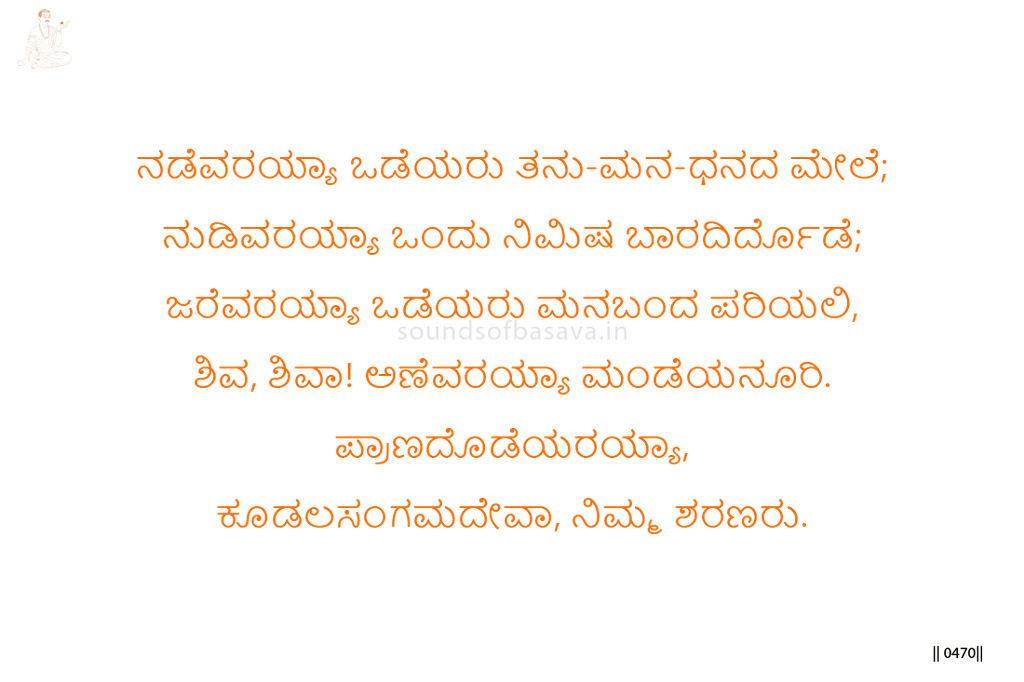
In this vachana, Basavanna describes the true Sharanas of Kudalasangama Deva. They move above the hold of body, mind, and wealth. These remain present in life, but they do not govern the Sharana.
Their vigilance is immediate. If remembrance weakens even for a moment, they feel the lapse and correct their own mind. Forgetfulness is not allowed to settle.
Their return is humble and direct. They cry “Shiva, Shiva,” bow their heads, and turn again to Kudalasangama Deva, the Lord of prana. Such ones, who know life itself as belonging to the Lord, are His Sharanas.
Imagery & Symbolic Relevance
The first image is moving above body, mind, and wealth. Basavanna does not say that the Sharana has abandoned life. He says that body, thought, and possession no longer rule the inner state.
The second image is the momentary lapse. Even a brief break in remembrance is felt at once. This shows the refined standard of Sharana life.
The third image is inward correction. The Sharana does not blame the world. The lapse is recognized within, and the mind is brought back.
The cry “Shiva, Shiva” is the sound of return. It is not display, but immediate remembrance.
The bowed head shows humility. The true Sharana does not stand in pride before realization. The deeper the awareness, the quicker the bowing.
The final image is Kudalasangama Deva as Lord of prana. The Sharana knows that life-force itself belongs to the Lord.
Lingayoga
In Lingayoga, this vachana teaches guarded realization. The seeker may move through body, mind, and wealth, but these cannot become the ruling center.
For Pranalingi Sthala, the reference to prana is decisive. Life-force is not self-owned. It must remain under Kudalasangama Deva, the Lord of prana.
The practice-point is direct: guard remembrance. When awareness slips, return at once with “Shiva, Shiva,” humility, and inward correction.
Editorial Commentary
“Above body, mind, and wealth” should not be read as rejection of life. It means freedom from being governed by body, mind, and possession.
The phrase “even for a moment” gives the vachana its sharpness. Basavanna is describing a refined state where even a small break in remembrance is felt immediately.
The closing phrase “Lord of prana” should remain central. It places the Sharana’s life-force under Kudalasangama Deva.
Related Vachana
Supporting Vachana
Prasadi Sthala Vachana 990 — Transformed Through the Touch of Grace
Prasadi Vachana 990 supports this vachana by showing the purification that arises through Mahānubhāva-sanga and Sharana-grace. There, body, mind, wealth, and the whole being are purified through realized company.
Vachana 340 carries that purification into Pranalingi Sthala as the condition of true Sharanas. They are no longer ruled by body, mind, or wealth. Even a momentary lapse in remembrance is corrected through humility before Kudalasangama Deva.
Advancing Vachana
Sharana Sthala Vachana 808 — The Measure of True Dasoha
Sharana Vachana 808 advances this teaching by carrying guarded realization into integrated Dasoha. In Vachana 340, the true Sharanas stand above body, mind, and wealth, and know Kudalasangama Deva as Lord of prana. In Vachana 808, service of body, life, inner being, and speech becomes whole only through the way of Prana-Linga known among the Sharanas.
Thus the Pranalingi portrait of vigilant Sharanas advances into Sharana Sthala as complete living service. Body, life, inner being, speech, remembrance, and conduct are gathered into the way of Prana-Linga before Kudalasangama Deva.
