

Summary
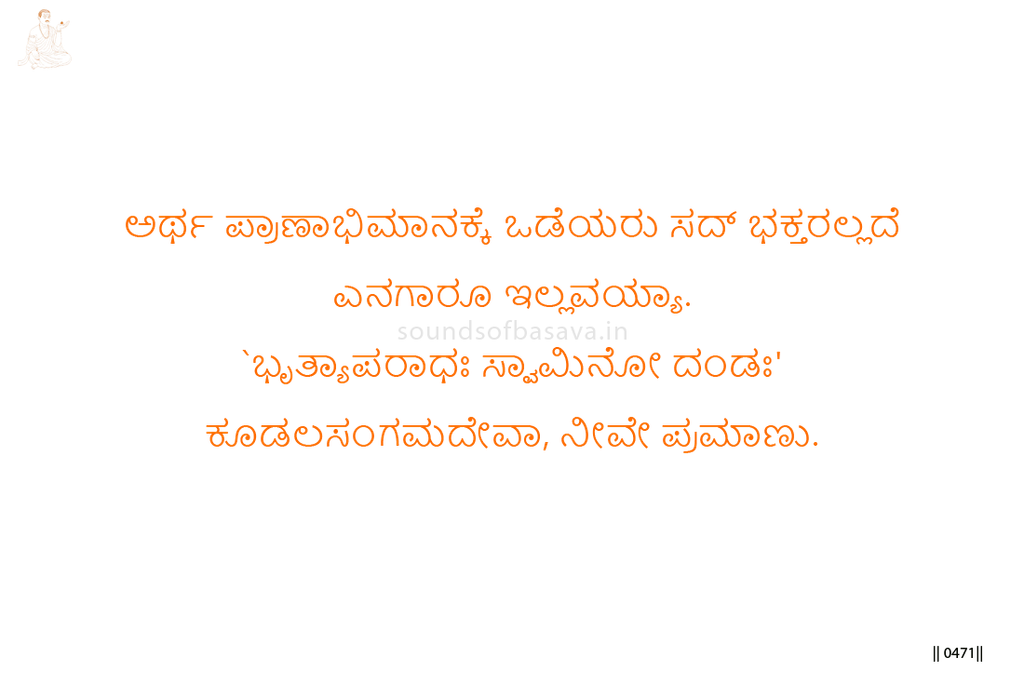
In this vachana, Basavanna turns toward the subtle inward reality of prana and awareness. This is not something known by ordinary outward perception. It is known only to true devotees.
Because this inner movement cannot be publicly displayed or externally certified, Basavanna does not seek validation from others. He turns to Kudalasangama Deva.
The closing statement gives the center of the vachana: Kudalasangama Deva alone is the pramāṇa (ultimate authority, witness, and standard of truth), the true witness and measure. The inward state of the devotee is known finally by the Lord alone.
Imagery & Symbolic Relevance
The first concern is prana, the living breath or life-force. Basavanna points to something subtler than bodily life alone. The life within the seeker has an inward movement that is not visible to all.
The second concern is inner awareness. This awareness cannot be proved by display. It belongs to direct knowing, not to public demonstration.
The true devotees are the only ones said to know this. Their knowledge is not ordinary information. It arises from lived inward realization.
The absence of other witnesses is important. Basavanna does not place this realization before the judgment of society, scholarship, ritual authority, or external appearance.
Kudalasangama Deva as pramana is the final image. The Lord is both witness and measure. What cannot be seen by others is not therefore unreal; it stands before the Divine witness.
Lingayoga
In Lingayoga, this vachana teaches that the relation between prana and awareness must be directly lived. It cannot remain merely spoken, explained, or externally marked.
For Pranalingi Sthala, the emphasis is precise: life-breath and inward awareness are not separate from the spiritual path. Yet their truth is subtle and cannot be reduced to outward proof.
The seeker must therefore give up the need for public validation. The true measure of inward realization is Kudalasangama Deva, not the recognition of others.
Editorial Commentary
“Pramana” should be read carefully. Here it does not mean ordinary evidence placed before people. It means Kudalasangama Deva as the final witness and measure of the inward state.
Basavanna simply distinguishes between what is outwardly visible and what is inwardly known by true devotees.
Related Vachana
Supporting Vachana
Prasadi Sthala Vachana 849 — The Fragrance of Truth is Known Only By Living It
Prasadi Vachana 849 supports this vachana by teaching that truth must be known through direct experience. There, taste is known by tasting, fragrance does not need outside certification, and sacred teaching becomes complete only when it is lived.
Vachana 341 carries the same principle inward. The subtle reality of prana and awareness is known only by true devotees, with Kudalasangama Deva as witness. Thus Prasadi direct experience supports the Pranalingi teaching that inward realization does not depend on external proof.
Advancing Vachana
Sharana Sthala Vachana 953 — Beyond Veda, Shastra, and Argument: The Source Alone
Sharana Vachana 953 advances this teaching by showing the limit of all external systems of knowing. Veda, Shastra, Tarka, and Agama name what lies beyond their reach, but the Sharana does not remain in naming, word, ritual, thought, or doctrine.
In Vachana 341, Basavanna says that the subtle inward reality is known only by true devotees and witnessed by Kudalasangama Deva alone. In Vachana 953, this inward certainty advances into Sharana Sthala as direct abidance in the source beyond external certification. Thus the unseen witness of Pranalingi matures into Sharana resting in Kudalasangama Deva Himself.
