

Summary
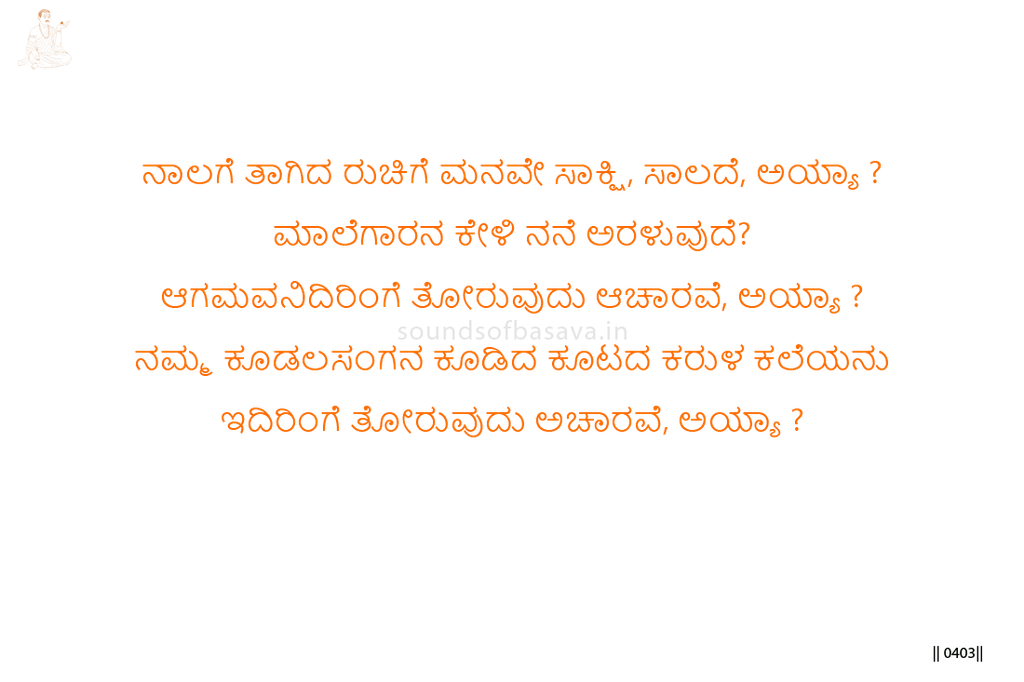
In this vachana, Basavanna teaches that direct experience does not need external proof.
When taste touches the tongue, the mind itself becomes witness. Is that not enough? Why should one ask the garland-maker to know the fragrance of a flower?
Basavanna then asks whether merely showing Agama is Achara. Agama means sacred textual or ritual tradition; Achara means lived sacred conduct.
The true Achara is to reveal the inner bond of the company joined with Kudalasanga. The teaching is that truth must be tasted and lived. It is not fulfilled by external display, borrowed explanation, or scriptural showing alone.
Imagery & Symbolic Relevance
The first image is taste on the tongue. Taste is known by contact. It does not need another witness outside the one who tastes.
The second image is the mind as witness. Once the tongue has tasted, the mind knows directly. This is the image of Anubhava, lived experience.
The third image is the garland-maker. A flower’s fragrance does not require outside certification. Asking the garland-maker is unnecessary when the fragrance is directly present.
Basavanna then turns to Agama and Achara. Showing Agama outwardly is not the same as Achara. Sacred teaching becomes complete only when it is lived.
The final image is the company joined with Kudalasanga. This is not a public display of religion. It is the inner bond, the living pulse, and the realized fellowship of those who are joined to Kudalasangama Deva.
Lingayoga
In Lingayoga, this vachana teaches that realization must become direct experience.
The seeker should not remain satisfied with description, text, or external demonstration. Just as taste is known by tasting, Linga must be known by lived awareness.
For Prasadi Sthala, this means that Prasada is not merely received as an outer act. It becomes meaningful when the seeker inwardly tastes the truth of Kudalasangama Deva through lived participation.
Editorial Commentary
The Kannada rests on two simple examples: taste known by the tongue and fragrance known without asking the garland-maker.
These examples correct dependence on second-hand knowledge. What is directly tasted does not need borrowed confirmation.
Agama is not rejected. Basavanna questions whether showing Agama without lived realization can be called Achara.
The central teaching is that sacred conduct must arise from direct experience and from the living company joined with Kudalasanga.
Related Vachana
Supporting Vachana
Maheshwara Sthala Vachana 597 — The Taste of the Essence
Maheshwara Vachana 597 supports this vachana by showing that nearness to sweetness is not the same as tasting it. The sheep enters the sugarcane field but eats only the dry leaves, while the elephant reaches the essence.
In Vachana 849, taste itself is the witness, and truth must be known directly. Both vachanas teach that outer contact, description, or nearness does not equal living experience.
Advancing Vachana
Pranalingi Sthala Vachana 1096 — The Worship of the Inner Lotus
Pranalingi Vachana 1096 advances this teaching by turning worship inward. Bliss, heart, yearning, illumination, and direct experience become offerings to the Prana-Linga.
In Vachana 849, Basavanna says that truth must be tasted and lived, not merely shown through Agama. In Vachana 1096, this matures into Pranalingi worship, where direct experience itself becomes the offering.
