

Summary
In this vachana, Basavanna speaks of a state where the faculties are filled beyond ordinary movement.
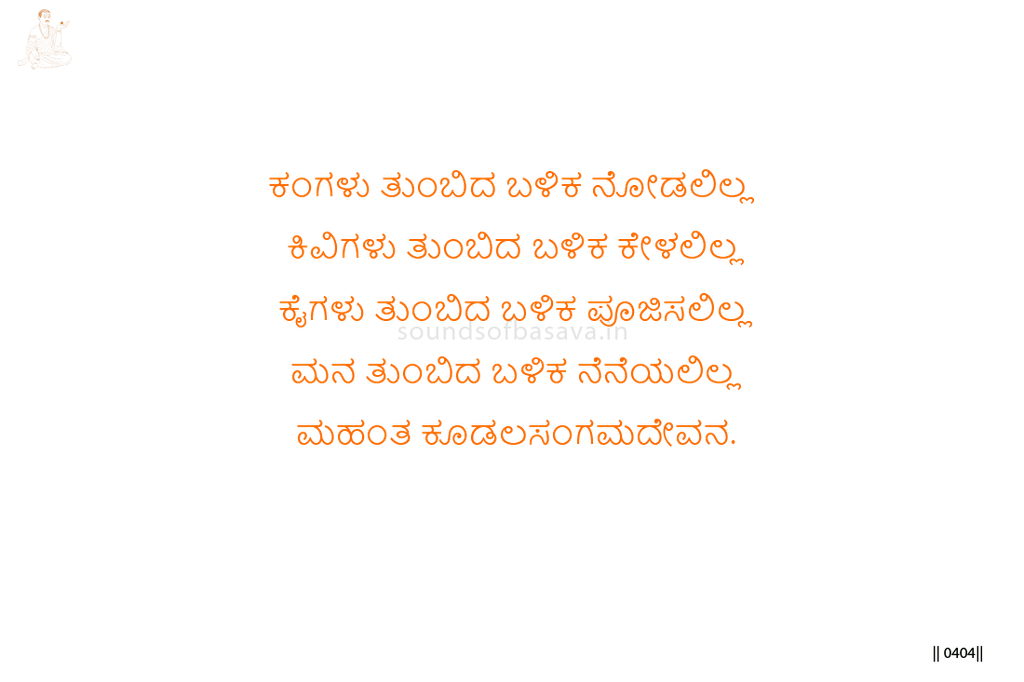
When the eyes are filled, they do not see. When the ears are filled, they do not hear. When the hands are filled, they do not worship. When the mind is filled, it does not remember.
The meaning is not absence of devotion. It is fullness beyond ordinary activity. Seeing, hearing, worshipping, and remembering no longer function as separate acts.
Before the great Kudalasangama Deva, the seeker is gathered into such fullness that the faculties lose their usual outward movement.
Imagery & Symbolic Relevance
The first image is the eyes filled. When the eyes are full, ordinary seeing stops. Vision is no longer scattered toward many objects.
The second image is the ears filled. Hearing also ceases as a separate outward movement. The ear no longer runs after sound.
The third image is the hands filled. Even worship as a visible act falls silent. The hands do not need to perform separately when the inner state has become full.
The fourth image is the mind filled. Remembrance itself no longer appears as effort. The mind does not move from one thought to another in order to remember.
The repeated structure shows progressive inward saturation: sight, hearing, action, and mind are all gathered into one fullness before Kudalasangama Deva.
Lingayoga
In Lingayoga, this vachana teaches that devotion may mature beyond deliberate practice.
At first, the seeker sees, hears, worships, and remembers through effort. In this vachana, fullness has entered these faculties so deeply that effort falls away.
For Prasadi Sthala, the teaching is that Prasada is not only received as an outer gift. It becomes inner fullness, where the faculties are no longer driven by outward hunger.
Editorial Commentary
The negative verbs: the filled eyes do not see, the filled ears do not hear, the filled hands do not worship, and the filled mind does not remember.
These negatives should not be read as spiritual failure. They point to fullness in which ordinary functioning is overcome.
“Mahanta Kudalasangama Deva” should be understood as the great Kudalasangama Deva before whom this fullness arises.
The central teaching is that when devotion becomes complete, separate acts of seeing, hearing, worshipping, and remembering are absorbed into inward fullness.
Related Vachana
Supporting Vachana
Maheshwara Sthala Vachana 217 — The True Measure of Devotion
Maheshwara Vachana 217 supports this vachana by saying that devotion is not measured by outward display while the mind remains restless. True devotion is known by inward steadiness.
In Vachana 853, the eyes, ears, hands, and mind are no longer scattered into separate outward movements. Both vachanas show that devotion must be measured by inner fullness, not by visible activity alone.
Advancing Vachana
Pranalingi Sthala Vachana 910 — The Inseparable Grace
Pranalingi Vachana 910 advances this teaching by showing knowing that surrounds, settles, and remains without wandering from one thing to another.
In Vachana 853, the faculties are filled and stop moving outward. In Vachana 910, this becomes Pranalingi steadiness: the knowing of Kudalasangama Deva rests within unwaveringly.
