

Summary
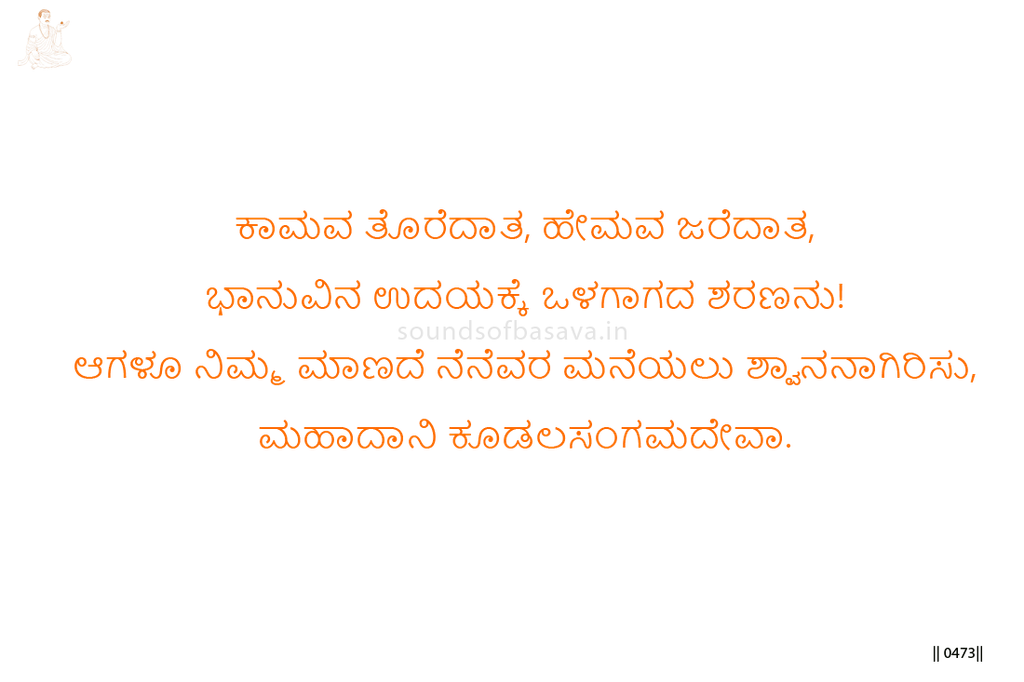
In this vachana, Basavanna speaks of a Sharana who has cast away desire and rejected gold. The gross pulls of craving and wealth no longer govern such a one.
He then places this Sharana at the rising of the sun. Even at that refined threshold, Basavanna does not claim completion. Renunciation is not treated as enough by itself.
The prayer turns toward constancy. Basavanna asks Kudalasangama Deva not to let him forget, but to keep him in the house of remembrance like a faithful dog. The highest request here is not status, attainment, or recognition, but unbroken nearness to the Lord.
Imagery & Symbolic Relevance
Desire is the first image of bondage. To cast away desire means that the seeker is no longer ruled by craving.
Gold is the second image. It represents wealth, possession, and worldly attraction. The Sharana who rejects gold has moved beyond the pull of external value.
The rising sun marks a threshold of light. The Sharana stands in a state where darkness has been crossed, yet Basavanna still asks for protection against forgetfulness. This shows that even a refined state must remain guarded by remembrance.
The house of remembrance is the central spiritual space of the vachana. It is not merely a physical house. It is the condition in which awareness remains turned toward Kudalasangama Deva.
The faithful dog is the final image. A dog remains near its master’s house and does not claim ownership. Basavanna chooses this lowly and loyal image to express humility, nearness, vigilance, and dependence.
The address “great giver” completes the prayer. Remembrance is not claimed as personal achievement. Basavanna asks Kudalasangama Deva to keep him in that remembrance.
Lingayoga
In Lingayoga, this vachana teaches that renunciation must become continuous remembrance. Casting away desire and gold is not the final claim; the seeker must remain near the Lord without lapse.
For Pranalingi Sthala, the emphasis is on living constancy. The Linga is not remembered only during an exalted moment. The seeker asks to be kept in the house of remembrance, as one who never wanders from the Master.
The practice-point is humility after renunciation. Even when desire and gold have been set aside, the seeker must not become self-assured. He must pray to remain faithful before Kudalasangama Deva.
Editorial Commentary
The dog-image should be read carefully. It does not signify low craving here, but faithful nearness. Basavanna transforms the image into a sign of loyalty and humility.
The house of remembrance is also important. The prayer is not merely “let me remember,” but “keep me there.” This makes remembrance a place of abiding, not a passing act.
Related Vachana
Supporting Vachana
Prasadi Sthala Vachana 35 — The Licking Tongue of Craving
Prasadi Vachana 35 supports this vachana by using the dog-image to show repeated craving. There, the dog’s tongue returns to the taste of ghee, and Basavanna asks Kudalasangama Deva to remove that dog-nature.
Vachana 359 carries the same image into a purified form. The dog that once signified compulsive return to worldly taste becomes the faithful dog that remains in the house of remembrance. Thus the Prasadi prayer for release from craving supports the Pranalingi prayer for unwavering nearness to Kudalasangama Deva.
Advancing Vachana
Sharana Sthala Vachana 1365 — My Inner Faults Still Cling
Sharana Vachana 1365 advances this teaching by showing that nearness and knowledge must become lived transformation. In Vachana 359, Basavanna asks to remain like a faithful dog in the house of remembrance. In Vachana 1365, the dog that licks the cooking pot but cannot place it back shows the danger of receiving taste without fulfilling responsibility.
Thus the Pranalingi prayer for faithful remembrance advances into Sharana Sthala as the demand that remembrance become lived Dasoha before Jangama-Linga. The seeker must not only remain near; he must allow that nearness to transform conduct, dissolve clinging faults, and become offering before Kudalasangama Deva.
