

Summary
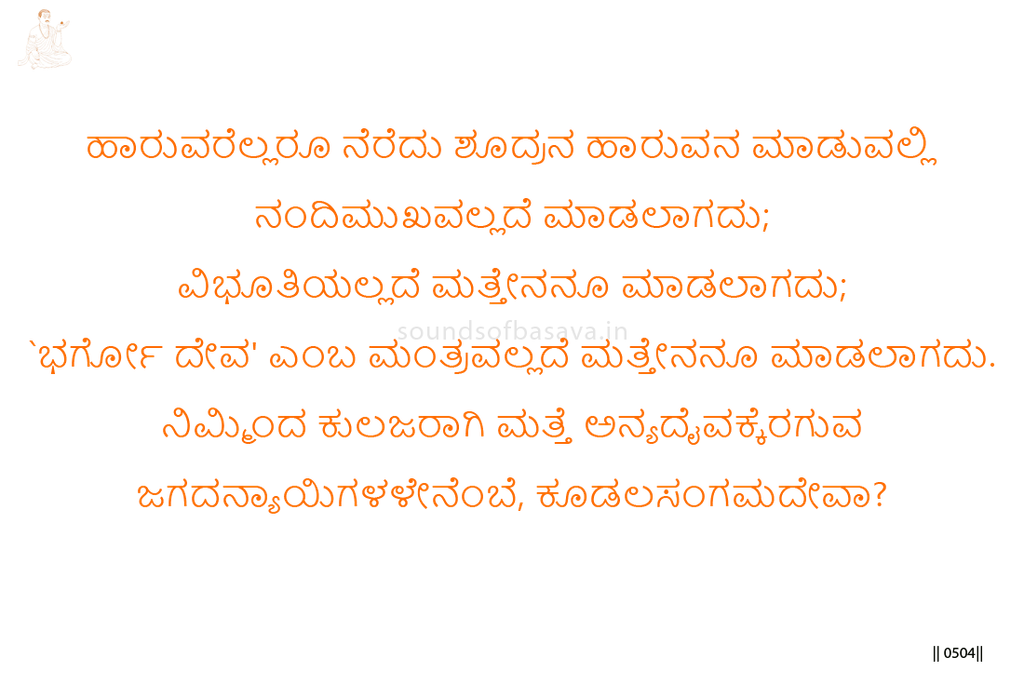
In this vachana, Basavanna exposes dependence on external religious requirements. The ritual authorities say that without Nandimukha nothing can be done, without Vibhuti nothing can be done, and without the mantra “Bhargo Deva” nothing can be done.
His concern is not with the sacred sign, ash, or mantra in themselves. His concern is with treating them as sufficient while inner realization remains absent. A mark may be placed, ash may be worn, and mantra may be recited, but without inward awakening they remain borrowed supports.
The final question gives the force of the vachana. Having become persons of sacred lineage through Kudalasangama Deva, if they again bow to another deity, what should such people be called? The teaching is that sacred form must become undivided allegiance to Kudalasangama Deva.
Imagery & Symbolic Relevance
The gathering of ritual authorities shows collective confidence in prescribed religious forms. They insist that certain marks, ash, and mantra are necessary before anything can proceed.
Nandimukha stands for formal ritual beginning and religious legitimacy. Basavanna questions the assumption that a correct preliminary form proves spiritual truth.
Vibhuti is the second sign. Sacred ash points to burning, purification, and sacred belonging. Yet if inward transformation is absent, the ash remains only an outer mark.
“Bhargo Deva” is the mantra named in the vachana. It invokes divine radiance, the self-illumined awareness that shines by its own light and does not depend on external marks, rituals, or inherited authority. Basavanna tests whether this radiance has awakened within the one who recites it. If the mantra remains only sound, it is borrowed speech; when its meaning is directly realized, the seeker becomes established in that self-luminous awareness.
Sacred lineage is the next concern. To become kulaja through Kudalasangama Deva means to belong to the Lord’s path in truth, not merely to inherit religious identity.
The final contradiction is bowing to another deity after receiving such belonging. The sign, ash, mantra, and lineage lose their force when allegiance becomes divided.
Lingayoga
In Lingayoga, this vachana teaches that outer signs must become inner alignment. Nandimukha, Vibhuti, mantra, and lineage cannot replace living relation to Linga.
For Pranalingi Sthala, the emphasis is inward realization. The seeker must not merely repeat the word of radiance; the inner being must be illumined by what the word invokes.
The practice-point is clear: let the sign, ash, mantra, speech, and lineage become one undivided movement toward Kudalasangama Deva.
Editorial Commentary
The repeated claim “nothing can be done without this” should be preserved. Basavanna is exposing the error of making external prerequisites absolute while inward recognition remains uncertain.
The final line is decisive. The issue is not symbol itself, but contradiction: those who receive sacred belonging through Kudalasangama Deva still bow elsewhere.
Related Vachana
Supporting Vachana
Prasadi Sthala Vachana 73 — The Alchemy of Transformation
Prasadi Vachana 73 supports this vachana by showing that Vibhuti is meaningful when joined to transformation. There, Basavanna asks whether a bitter gourd filled with Vibhuti cannot become sweet, whether a butcher’s knife touched by parasu cannot become gold, and whether Vibhuti on the forehead cannot overturn sin.
Vachana 613 warns against treating Vibhuti, mantra, and ritual requirement as sufficient while allegiance turns elsewhere. Vachana 73 supports this by showing the proper meaning of sacred contact: it must transform. Thus Prasadi Sthala prepares the Pranalingi teaching that sacred ash is not mere mark; it must become the sign of inward change before Kudalasangama Deva.
Advancing Vachana
Sharana Sthala Vachana 88 — The Recognition of Authenticity
Sharana Vachana 88 advances this teaching by showing sacred marks in their true place. There, when Basavanna sees the Sharana bearing the three lines of Vibhuti and Rudraksha, his mind trusts, rejoices, and does not doubt.
In Vachana 613, sacred forms are criticized when they become outer dependency and divided allegiance. In Vachana 88, those same signs become trustworthy when they belong to the lived authenticity of the Sharana. Thus the Pranalingi correction of borrowed word and outer sign advances into Sharana Sthala as recognition of signs made true by inward realization before Kudalasangama Deva.
