

Summary
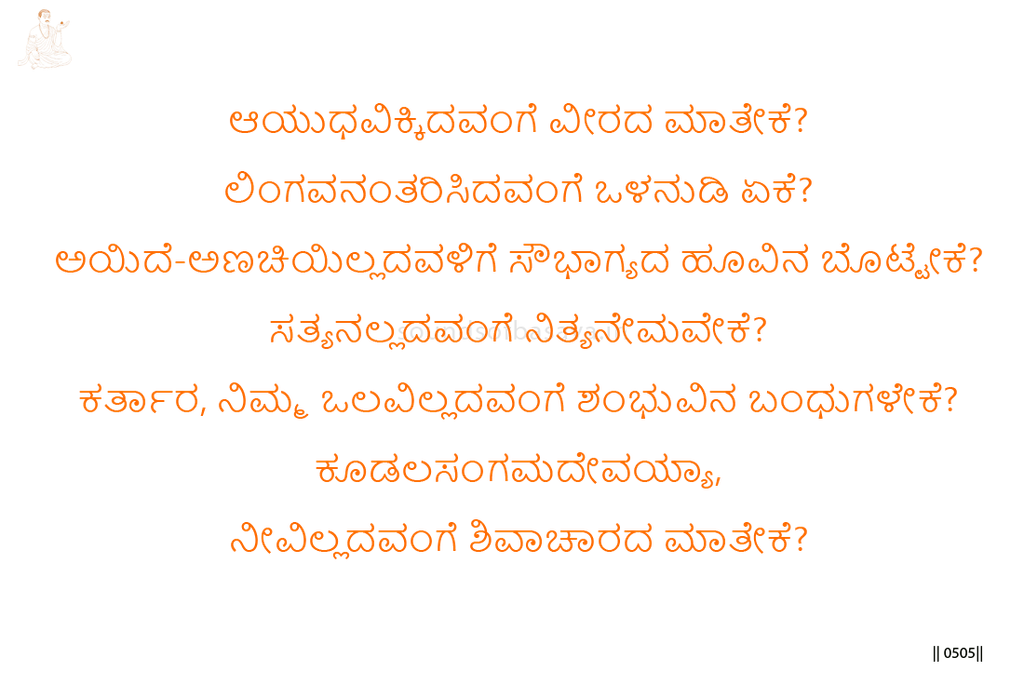
In this vachana, Basavanna asks a series of direct questions. What use is talk of heroism to one who has no weapon? What use is inner speech to one from whom Linga has withdrawn? What use is daily observance to one without truth?
He then turns the question toward devotion. O Creator, what use are the bonds of Shambhu—the sacred relationship, fellowship, and commitment that bind one to Shiva and His path—to one who has no love for You? Finally, before Kudalasangama Deva, he asks: what use is speaking of Shivachara—the lived conduct of Shiva, expressed through devotion, truth, right action, and alignment with the Divine—to one who does not have You?
The teaching is clear. Speech, observance, fellowship, and religious identity have no worth when their living ground is absent. Shivachara is not a word to be claimed; it must arise from truth, Linga, love, and living relation to Kudalasangama Deva.
Imagery & Symbolic Relevance
The first image is the weapon and heroism. Heroic speech has no value when the weapon is absent. Basavanna uses this to show the emptiness of claim without capacity.
The second image is Linga withdrawn. If Linga is not present in living awareness, inward speech loses its ground. Words about inner realization cannot replace the presence of Linga.
The third image is truth and daily observance. Nitya-nema, or daily observance, does not become sacred by repetition alone. Without truth, observance becomes hollow form.
The fourth image is love for the Lord. Even the bonds of Shambhu have no meaning for one who lacks love for Kudalasangama Deva. Sacred association cannot replace inward turning.
The final image is Shivachara. Basavanna brings all the earlier questions to this point. If Kudalasangama Deva is absent from the seeker’s life, speech about Shivachara remains empty.
Lingayoga Relevance
In Lingayoga, this vachana teaches that practice must have its living ground. Speech, vow, fellowship, and conduct must be joined to Linga and truth.
For Pranalingi Sthala, the emphasis is inward presence. The seeker must not speak of inner realization when Linga has withdrawn from awareness. The relation to Linga must remain alive.
The practice-point is direct: do not speak of Shivachara as identity or doctrine. Let it arise from truth, love, Linga-awareness, and undivided relation to Kudalasangama Deva.
Lingayoga
In Lingayoga, this vachana teaches that practice must have its living ground. Speech, vow, fellowship, and conduct must be joined to Linga and truth.
For Pranalingi Sthala, the emphasis is inward presence. The seeker must not speak of inner realization when Linga has withdrawn from awareness. The relation to Linga must remain alive.
The practice-point is direct: do not speak of Shivachara as identity or doctrine. Let it arise from truth, love, Linga-awareness, and undivided relation to Kudalasangama Deva.
Editorial Commentary
The repeated “what use?” gives the structure of the vachana. Basavanna strips each religious claim down to its necessary ground.
The final question is decisive. Shivachara is not validated by speech; it is valid only where Kudalasangama Deva is livingly present.
Related Vachana
Supporting Vachana
Prasadi Sthala Vachana 864 — When the Covering is Removed, the Fruit is Revealed
Prasadi Vachana 864 supports this vachana by teaching that word, conduct, and inner state must become true in Kudalasangama Deva. The pure Sharana is not one who merely claims the path, but one whose life becomes aligned in truth.
Vachana 631 asks what use daily observance has without truth and what use Shivachara has without Kudalasangama Deva. Vachana 864 supports this by showing that spiritual fruit appears only when word, action, and inner steadiness become true before the Lord.
Advancing Vachana
Sharana Sthala Vachana 1170 — Guru’s Grace Is the Path
Sharana Vachana 1170 advances this teaching by showing the true source of Shivachara. There, Basavanna says that Guru’s grace itself is Shivachara, Guru’s grace itself is Sadachara, and Guru’s grace itself is the taste of Prasada.
In Vachana 631, Shivachara spoken without Kudalasangama Deva is hollow. In Vachana 1170, Shivachara becomes living conduct through Guru-karunya. Thus the Pranalingi warning against empty speech advances into Sharana Sthala as grace-made conduct, where Guru stands before, Linga stands behind, and the seeker walks in Kudalasangama Deva.
